
Blog / How to Benchmark Marketing Performance
How to Benchmark Marketing Performance
Benchmarking marketing performance is about measuring your strategies against goals, industry standards, and competitors. For businesses in the UAE, where digital markets are highly competitive, this process helps optimise spending and improve results. Here's a quick summary:
-
Why Benchmarking Matters:
- UAE digital ad spend is projected to exceed USD 3.3 billion by 2026.
- Poor tracking can increase Customer Acquisition Costs (CAC) by 20% to 60%.
- Proper benchmarks help lower CAC and improve ROI.
-
Key Metrics to Track:
- Revenue Metrics: Return on Ad Spend (ROAS) and CAC.
- Example: Mobile campaigns in the UAE deliver 50% higher ROAS than desktop.
- Engagement Metrics: Click-Through Rate (CTR), Cost Per Click (CPC), and conversion rates.
- UAE Google Ads CTR: 3% to 5%.
- Ramadan campaigns see 50% to 100% ROAS boosts for family-focused products.
- Customer Metrics: Retention Rate, Net Promoter Score (NPS), and Lifetime Value (LTV).
- Revenue Metrics: Return on Ad Spend (ROAS) and CAC.
-
Data Sources:
- Internal: Use tools like Google Analytics 4 (GA4) and Meta's Conversions API (CAPI) for accurate tracking.
- External: Platforms like Meta, Google, and DataReportal provide industry benchmarks.
-
Competitor Analysis:
- Tools like Facebook Ad Library and Ahrefs can track competitor campaigns and keywords.
- UAE brands often rotate 20–40 creatives monthly in both Arabic and English.
-
Improvement Strategies:
- Optimise underperforming landing pages and creatives.
- Use server-side tracking to reduce data loss by 25% to 55%.
- Implement AI tools for personalised engagement and predictive lead scoring.
-
Regular Reviews:
- Conduct quarterly reviews to adjust benchmarks and strategies.
- Use real-time dashboards (e.g., Looker Studio) for ongoing performance tracking.
Takeaway: Benchmarking transforms marketing into a measurable investment. By tracking the right metrics and continuously refining strategies, UAE businesses can maximise ROI and stay competitive in the region's dynamic market.
Benchmark Marketing: How to Monitor Progress in Digital Marketing
sbb-itb-058f46d
Identify Key Marketing Metrics
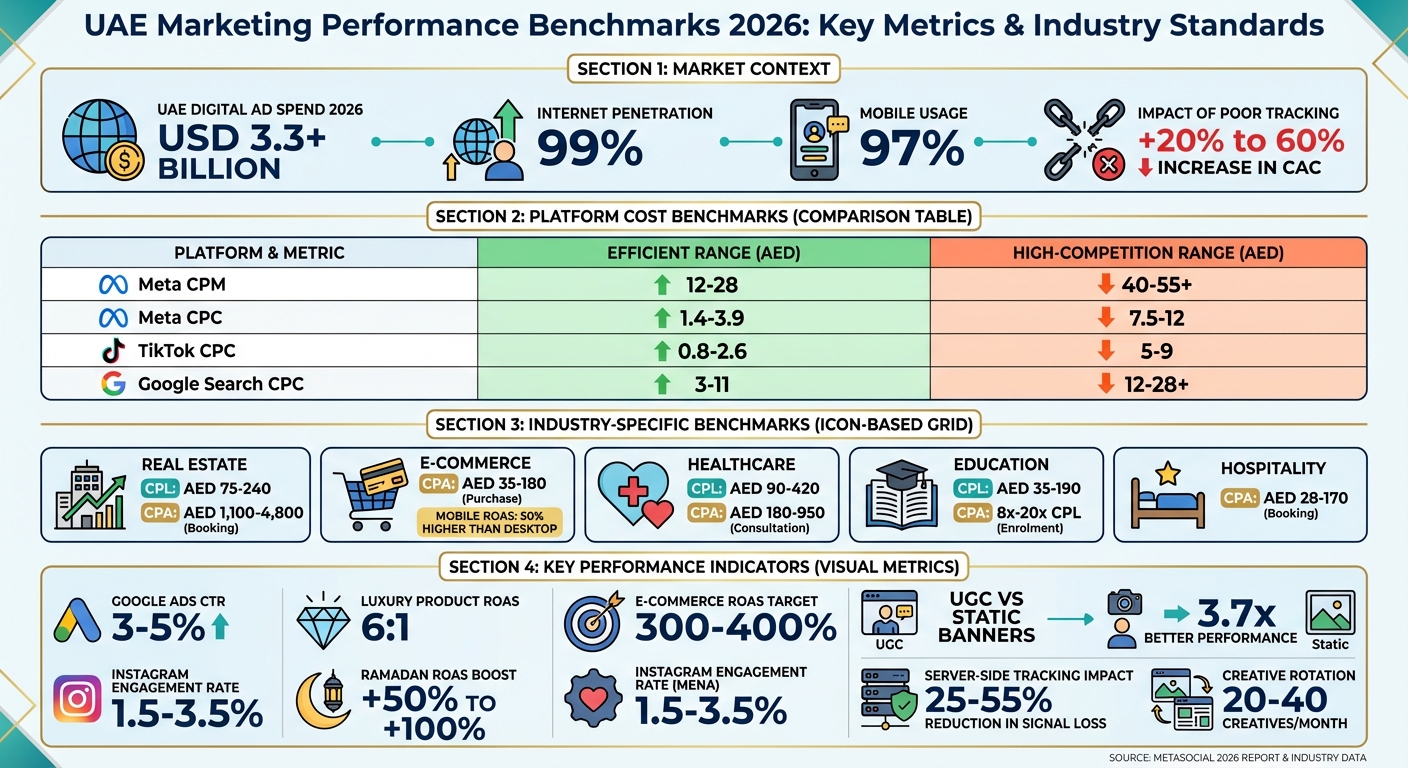
UAE Marketing Performance Benchmarks 2026: Key Metrics by Industry
Choosing the right metrics is essential for assessing whether your marketing efforts are delivering measurable results. In the UAE, it's important to focus on metrics that align directly with your business goals, whether that's increasing revenue, boosting audience engagement, or building customer loyalty.
Revenue-Driven Metrics
Return on Ad Spend (ROAS) is a critical metric that measures the revenue generated for each dirham spent on advertising. For example, luxury products in the UAE often achieve a 6:1 ROAS, while e-commerce brands typically aim for a blended ROAS between 300% and 400%. Instead of relying solely on industry benchmarks, set your ROAS targets based on your gross margins. For instance, if your margin is 20%, you'll need a 5:1 ROAS to maintain profitability. Interestingly, mobile campaigns in the UAE tend to perform better, delivering 50% higher ROAS compared to desktop campaigns, highlighting the importance of prioritising mobile-first strategies.
Customer Acquisition Cost (CAC) is another essential metric, revealing how much it costs to bring in each new customer. Accurate tracking is crucial here. Implementing server-side tracking can reduce signal loss by 25% to 55%, making your CAC data more reliable. To ensure sustainable growth, always compare CAC with Customer Lifetime Value (LTV).
Here’s a snapshot of efficient CPL (Cost Per Lead) and CPA (Cost Per Acquisition) ranges for key UAE industries:
| UAE Industry | Efficient CPL Range (AED) | Efficient CPA Range (AED) |
|---|---|---|
| Real Estate | 75–240 | 1,100–4,800 (Booking) |
| E-Commerce | N/A | 35–180 (Purchase) |
| Healthcare | 90–420 | 180–950 (Consultation) |
| Education | 35–190 | 8x–20x CPL (Enrolment) |
| Hospitality | N/A | 28–170 (Booking) |
Engagement and Conversion Metrics
Metrics like Click-Through Rate (CTR) and Cost Per Click (CPC) help gauge how well your ads grab attention. In the UAE, Google Ads typically see CTRs ranging from 3% to 5%. A boost of 30% in CTR can lead to a 22% to 38% drop in CPC, making your campaigns more cost-efficient. Additionally, user-generated content and product demos tend to outperform static banners by an average of 3.7 times in the UAE market.
Conversion rates track the percentage of visitors who take a desired action, such as completing a purchase, filling out a form, or booking a consultation. If you notice high CTR but low conversion rates, it might be time to revisit your landing pages instead of tweaking your ad creatives. Combining organic traffic insights with paid metrics offers a fuller picture of your digital performance. For instance, during Ramadan, ROAS for family-focused products often increases by 50% to 100%, showcasing the value of seasonal tracking.
Customer-Centric Metrics
To measure long-term success, focus on metrics like Customer Retention Rate and Net Promoter Score (NPS). In the UAE's competitive market, keeping existing customers happy through loyalty programmes can be as important as acquiring new ones. It's also wise to prioritise lead quality over sheer volume. For industries like real estate and finance, tracking sources that deliver high-intent leads can significantly improve ROI. In these sectors, search CPCs often range from AED 12 to AED 28+.
Gather Reliable Data Sources
To make benchmarking truly effective, you need accurate data - both from your internal systems and external sources. This ensures you can measure your performance against industry standards with confidence.
Internal Data Collection
Your internal data is the backbone of any benchmarking effort. Tools like Google Analytics 4 (GA4) are essential for tracking cross-channel ROI, especially when dealing with fragmented traffic sources like WhatsApp, TikTok, and Instagram. But GA4 alone won’t cut it. With internet penetration at 99% and smartphone usage at 97%, server-side tracking tools like Meta's Conversions API (CAPI) are critical. These tools reduce signal loss and provide a more accurate picture of customer behaviour. Without server-side attribution, brands could see their Customer Acquisition Costs (CAC) spike by 20% to 60% by 2026.
Integrating your CRM system with marketing platforms is equally important. This connection allows you to track the entire customer journey, helping you retrain ad algorithms to target actual buyers instead of just leads. This is especially crucial for high-intent industries like real estate and healthcare. For platforms like WhatsApp, Snapchat, and TikTok, which lack native Google integration, use detailed UTM parameters to track performance effectively. At the same time, ensure all tracking complies with the UAE's Personal Data Protection Law (PDPL) by using anonymised and consent-based methods.
While internal data is key, external benchmarks are essential for a well-rounded analysis.
External Benchmarking Data
External data gives you the context needed to evaluate your metrics. Platforms like Meta, Google, TikTok, and LinkedIn offer ad planning tools that provide real-time reach and cost estimates. Additionally, organisations such as DataReportal compile data from sources like ITU, GSMA Intelligence, and Eurostat, offering a clear industry snapshot. With digital ad spending in the UAE expected to surpass USD 3.3 billion by 2026, staying informed through sector-specific reports is more important than ever.
"Performance marketing in the UAE has entered a scale-and-efficiency era. With digital ad spend projected to touch USD 3.3B+ by 2026, growth is no longer determined by how much brands spend, but how intelligently they spend." - MetaSocial
When comparing your metrics, focus on sector-specific benchmarks rather than general averages. For example, Real Estate CPL targets differ greatly from E-commerce CPA goals. Also, make sure external data reflects current market conditions, as rising platform saturation has steadily pushed up digital costs.
Metric Comparison Table
Here’s a quick breakdown to see how your platform costs stack up within efficient and competitive ranges:
| Platform | Metric | Efficient Range (2026) | High-Competition Range |
|---|---|---|---|
| Meta | CPM | AED 12–28 | AED 40–55+ |
| Meta | CPC | AED 1.4–3.9 | AED 7.5–12 |
| TikTok | CPC | AED 0.8–2.6 | AED 5–9 |
| Google Search | CPC | AED 3–11 | AED 12–28+ |
For instance, if your Meta CPC is AED 8, you’re operating in a competitive range. This might signal the need to refine your creative or adjust your targeting. To simplify this process, use tools like Looker Studio to integrate GA4 and CRM data into branded dashboards, eliminating the hassle of manual CSV exports.
Analyse Performance Against Industry and Competitors
To truly understand your position in the market, it's essential to compare your performance against both industry benchmarks and competitors. In the UAE, where digital ad spending is expected to surpass USD 3.3 billion by 2026, this kind of analysis becomes even more crucial. By aligning your internal data with competitor insights, you can gain a well-rounded view of where you stand and identify areas for improvement.
Competitor Benchmarking
Start by clearly defining your competitors. Direct competitors offer the same products or services, while indirect competitors may address the same customer needs in different ways or compete for the same budgets.
Tools like the Facebook Ad Library allow you to track competitors’ campaigns, offering insights into their creative strategies, messaging, and how often they test new ideas. Similarly, platforms like Ahrefs can help you uncover the keywords they rank for and identify backlink opportunities. For instance, leading UAE brands in 2026 are expected to rotate 20–40 creatives monthly, using both Arabic and English to maximise their reach.
"Doing a competitor analysis helps us stay in touch with what platforms, formats, and creative ideas the competition is using... It also gives us marketing ideas that we may not have tried yet."
- Stuart Pereira, Campaign Manager, WSI Comandix
Segment your analysis by Emirate, as market dynamics can vary significantly between Dubai, Abu Dhabi, and the Northern Emirates. Additionally, monitor engagement rates closely. For example, Instagram engagement rates in the MENA region typically range from 1.5% to 3.5%. If your engagement rate is below 1%, it might indicate that your content isn’t resonating with your audience, regardless of how many followers you have.
Once you've gathered competitor insights, integrate them into a broader strategy using a structured framework like the Four Pillar Framework.
Applying the Four Pillar Framework
At Wick, the Four Pillar Framework provides a systematic approach to identifying and addressing performance gaps across your marketing efforts. This framework includes:
- Build & Fill: Website development, content creation, and social media management.
- Plan & Promote: SEO, paid advertising, and influencer marketing.
- Capture & Store: Data analytics and customer journey mapping.
- Tailor & Automate: Marketing automation and AI-driven personalisation.
By applying these pillars, you can pinpoint whether your challenges lie in areas like creative quality, audience targeting, conversion tracking, or segmentation. For example, using server-side tracking via CAPI can reduce signal loss by 25–55%, which directly impacts your cost per acquisition (CPA).
"The brands that win won't be the brands that spend more - but the brands that track smarter, create faster, and feed algorithms with cleaner signal."
- MetaSocial Report
Implement Data-Driven Improvements
To close performance gaps identified in your benchmarking analysis, focus on data-driven strategies that resonate with the UAE market. A mobile-first, bilingual approach, paired with clean data and swift creative execution, is key to staying competitive. Success in 2026 isn't about spending more; it's about working smarter - tracking effectively and producing content at speed.
SEO and Content Optimisation
Start by targeting quick-win opportunities - pages ranking between positions 8–20 on Google. These pages already have traction and can climb to Page One with enhancements like expanding content, adding internal links, and improving topical depth. If impressions are high but click-through rates (CTR) are low, the issue lies in appeal, not visibility. Update title tags to highlight benefits and align meta descriptions with UAE-specific search intent.
For strong organic traffic but weak conversions, review landing pages for trust signals and clear calls-to-action. In the UAE, post-click nurturing via WhatsApp automation can effectively guide prospects from interest to booking. A dual-layer routing model - using Meta for demand creation and Google Search for demand capture - has reduced Customer Acquisition Cost (CAC) by 30–60% for mid-funnel industries in the region.
Establish a 30-day benchmark by recording total clicks, impressions, organic sessions, and conversions over the past month. This baseline will help measure progress. Break down performance data by device (mobile vs. desktop) and city (e.g., Dubai vs. Abu Dhabi) to uncover patterns that averages might obscure.
Beyond SEO, leverage AI to personalise user experiences further.
AI-Driven Personalisation
AI-powered segmentation can process large datasets to group audiences by behaviour, preferences, and buying patterns. This enables dynamic content delivery, such as tailoring email subject lines, send times, and messaging based on user actions - boosting open and click-through rates.
Integrate AI chatbots on your website and WhatsApp to ensure round-the-clock engagement. With 34% of UAE respondents using ChatGPT daily, consumers expect quick, localised responses. Aim for chatbot response times under 800 milliseconds to avoid user drop-off. Ensure the chatbot supports both Arabic and English, as Arabic CTAs like "احجز الآن" (Book Now) outperform English alternatives among UAE nationals by 45%.
Use predictive lead scoring to prioritise high-conversion prospects, allowing sales teams to focus on the most promising opportunities. Feed offline conversion data - like qualified leads or actual sales - from your CRM back into Meta and Google algorithms. This helps optimise for high-value buyers instead of just clicks. Clean tracking ensures accurate signals reach AI algorithms, improving overall efficiency.
Pair these efforts with a sharp focus on optimising your conversion funnel.
Funnel Optimisation
Use heatmap tools to analyse high exit-rate pages and identify friction points or weak CTAs. Even a 1% increase in Conversion Rate (CVR) can reduce CAC by 10–28% without additional spending.
For modern funnels, rapid creative iteration is critical. Successful brands in the UAE maintain 20–40 active creatives monthly, balancing Arabic and English variants. User-generated content (UGC) and product demos outperform static banners by an average of 3.7x in the UAE. Address attribution gaps with GA4's data-driven attribution, which highlights "assist" channels like YouTube or TikTok that drive awareness but often go uncredited in last-click models.
The table below outlines actionable steps for each funnel stage:
| Funnel Stage | Improvement Lever | Expected Impact |
|---|---|---|
| Top Funnel | Creative Velocity (20–40/mo) | 15–45% drop in CAC |
| Mid Funnel | Server-Side Tracking (CAPI) | 25–55% reduction in signal loss |
| Bottom Funnel | Landing Page Optimisation (+1% CVR) | 10–28% reduction in CAC |
| Retention | LTV-Based Bidding | Scalable growth with safe CAC expansion |
"In 2026, cost efficiency on social platforms is no longer won at the audience level - it's won in creative, segmentation logic, and conversion feedback loops."
- MetaSocial
Monitor and Iterate Benchmarks Over Time
Keeping your strategies aligned with the UAE’s fast-changing market requires ongoing monitoring. Benchmarks aren’t static; they evolve. What worked in Q1 might not hold up by Q3 in the UAE's dynamic digital environment. Regularly revisiting benchmarks ensures your strategies stay relevant and your budgets focus on initiatives that deliver measurable results.
Think of benchmarks as "living documents." As Owen Steer from Fifty Five and Five explains:
"Benchmarking acts like a magnifying glass, highlighting where your business may fall short compared to other industry leaders or standard practices".
Failing to review benchmarks periodically can leave you stuck in outdated practices while competitors adapt and surge ahead. Regular iteration also ensures the data driving your decisions remains accurate and actionable.
Setting Quarterly Reviews
Establish annual benchmarks, but review them quarterly. For teams handling high volumes, monthly reviews using 30-, 60-, and 90-day rolling windows can help identify trends and filter out anomalies. This approach enables you to compare short-term performance with long-term, evergreen programmes.
Before each review, standardise definitions for key terms like "response", "qualified lead", and "revenue" to ensure consistency across teams and regions. Adjust metrics for scale - such as spend, impressions, or audience size - so you can accurately measure efficiency, like cost per opportunity, over different periods. Bring in stakeholders from Marketing, Sales, and Finance to translate these insights into actionable budget adjustments.
One global B2B company saw the impact of disciplined reviews firsthand. By standardising campaign taxonomy and benchmarks, they reallocated 22% of their budget from underperforming programmes to top-performing campaigns in just one year. That’s the kind of transformation quarterly reviews can drive.
These regular reviews also lay the groundwork for integrating advanced analytics into your strategy, ensuring every data point informs your next move.
Leveraging Advanced Analytics
In a market like the UAE, where 99% of the population is online and 95% use mobile devices, advanced analytics tools are essential. Google Analytics 4 (GA4) can serve as your central hub, integrating data from platforms like Instagram, Google Ads, and WhatsApp into a single, actionable view. This ensures you can track the entire customer journey - from TikTok awareness campaigns to WhatsApp-driven conversions.
For cleaner conversion data, server-side tracking (CAPI) is a must. Pair it with real-time dashboards in Looker Studio or Power BI to eliminate the need for manual CSV exports. Data-driven attribution models can also provide a more accurate picture of your customer journey by crediting touchpoints that last-click models often overlook.
To fully operationalise these analytics, platforms like Wick’s data analytics services integrate CRM, ERP, and marketing systems into a unified view. Yusuf Kamal, Analytics Head, highlights the value of this approach:
"We finally have a data model that helps guide - not just report - our decisions".
Quarterly KPI reviews ensure your metrics align with both your brand goals and market realities. Assigning monetary values to leads - for instance, if 1 in 10 leads generates AED 1,000, then each lead is worth AED 100 - helps you track ROI with precision.
Conclusion
Benchmarking ensures every dirham works harder in the UAE's competitive market. By focusing on the right metrics, collecting accurate data, analysing competitors, and refining your strategy, you move from "guesswork" to making decisions that maximise the value of every dirham spent.
Operating without advanced tracking systems isn't just inefficient - it can be costly. Brands without these systems often spend 20% to 60% more on Customer Acquisition Costs than they need to.
These strategies aren't just about saving money; they're about driving smarter growth. Whether you're implementing server-side tracking to cut signal loss by 25% to 55%, rotating 20–40 creatives each month to avoid ad fatigue, or leveraging LTV-based bidding for safer scaling, each improvement adds up. Benchmarking shows you exactly where you stand and what steps to take next.
Connecting CRM, ERP, and marketing platforms into a single, unified system transforms benchmarks into actionable strategies. Tools like Wick's unified analytics services make it easier to ensure your benchmarks guide meaningful decisions instead of just tracking performance.
With internet penetration in the UAE surpassing 99%, the brands that thrive are those that measure, adapt, and optimise continuously. This relentless focus on data and improvement is what separates the leaders from the rest.
Start by defining your key metrics, commit to quarterly reviews, and create feedback loops that turn insights into action. This is how you move from uncertainty to precision and make every dirham count.
FAQs
What key metrics should businesses in the UAE track to benchmark marketing performance?
To assess marketing performance in the UAE, businesses should rely on a combination of global digital KPIs and metrics that reflect the unique aspects of the local market. Some of the key indicators to monitor include website traffic, conversion rates, and engagement metrics, all of which help gauge overall digital success.
For paid campaigns, focusing on metrics such as cost per lead (CPL), customer acquisition cost (CAC), return on ad spend (ROAS), and campaign ROI is crucial. These figures reveal how efficiently your campaigns are running and whether they’re delivering the desired profitability.
Given the UAE's fast-evolving market, platform-specific costs like cost per mille (CPM) and cost per click (CPC) on platforms such as Meta, TikTok, and Snapchat are particularly important. Moreover, tracking audience response during local events like Ramadan or UAE National Day can offer valuable insights into how well your campaigns resonate with the audience. By keeping a close eye on these metrics, businesses can fine-tune their strategies and drive meaningful growth in the region.
How can businesses in the UAE use AI to improve their marketing strategies?
Businesses in the UAE have a powerful ally in AI tools, which can transform their marketing strategies. These tools enable highly personalised campaigns, automate repetitive tasks, and provide deeper insights through data analysis. For example, AI can segment audiences by behaviours, demographics, or even local events like Ramadan and National Day, ensuring campaigns resonate with the region's unique culture and traditions.
AI also simplifies content creation. It can quickly produce customised visuals, engaging copy, or even video scripts, saving both time and resources. Beyond that, features like smart bidding, precise audience targeting, and detailed performance analytics help fine-tune campaigns for better returns. Dashboards powered by AI offer actionable insights, making it easier to base decisions on solid data.
Incorporating AI into their strategies allows UAE businesses to remain competitive, connect more effectively with customers, and adapt to the fast-changing digital world.
Why is server-side tracking important for lowering Customer Acquisition Costs (CAC)?
Server-side tracking is a game-changer when it comes to cutting down Customer Acquisition Costs (CAC). By delivering more precise data on how customers engage with your marketing across various channels and devices, it helps paint a clearer picture of your audience's behaviour. Unlike traditional client-side tracking, it bypasses issues like ad blockers and privacy restrictions, ensuring that your insights remain reliable - even in environments with stricter privacy controls.
This level of accuracy allows businesses to make smarter decisions about budget allocation, fine-tune campaigns, and zero in on strategies that deliver results. In a highly competitive market like the UAE, where precise targeting can make or break your ROI, server-side tracking offers a significant edge.