

Blog / Behavioral Triggers vs. Event-Based Automation

Wick
December 25, 2025Behavioral Triggers vs. Event-Based Automation
Behavioral triggers and event-based automation are two powerful tools to improve user engagement, but they work differently:
- Behavioral Triggers: React instantly to user actions like scrolling, clicking, or revisiting pages. They aim to capture intent and guide users in real-time. Example: Sending a cart abandonment email when a user leaves items in their cart.
- Event-Based Automation: Activates based on predefined milestones or events, such as birthdays, subscription renewals, or webinar signups. Example: Sending a renewal reminder before a subscription expires.
Key Differences:
- Timing: Behavioral triggers are immediate; event-based automation follows schedules.
- Focus: Behavioral triggers interpret user intent; event-based automation aligns with specific milestones.
- Goal: Behavioral triggers reduce hesitation; event-based automation supports lifecycle events.
Quick Comparison
| Feature | Behavioral Triggers | Event-Based Automation |
|---|---|---|
| Timing | Real-time, action-driven | Predefined, milestone-driven |
| Personalisation | Based on user intent and actions | Based on specific events |
| Use Case | Cart abandonment, exit popups | Birthday discounts, renewals |
| Primary Goal | Address hesitation, boost conversions | Build loyalty, lifecycle progression |
Combining both methods can create highly effective customer journeys, balancing real-time responses with timely, event-driven messages. This hybrid approach ensures tailored communication across every channel, enhancing user experience and driving better results.
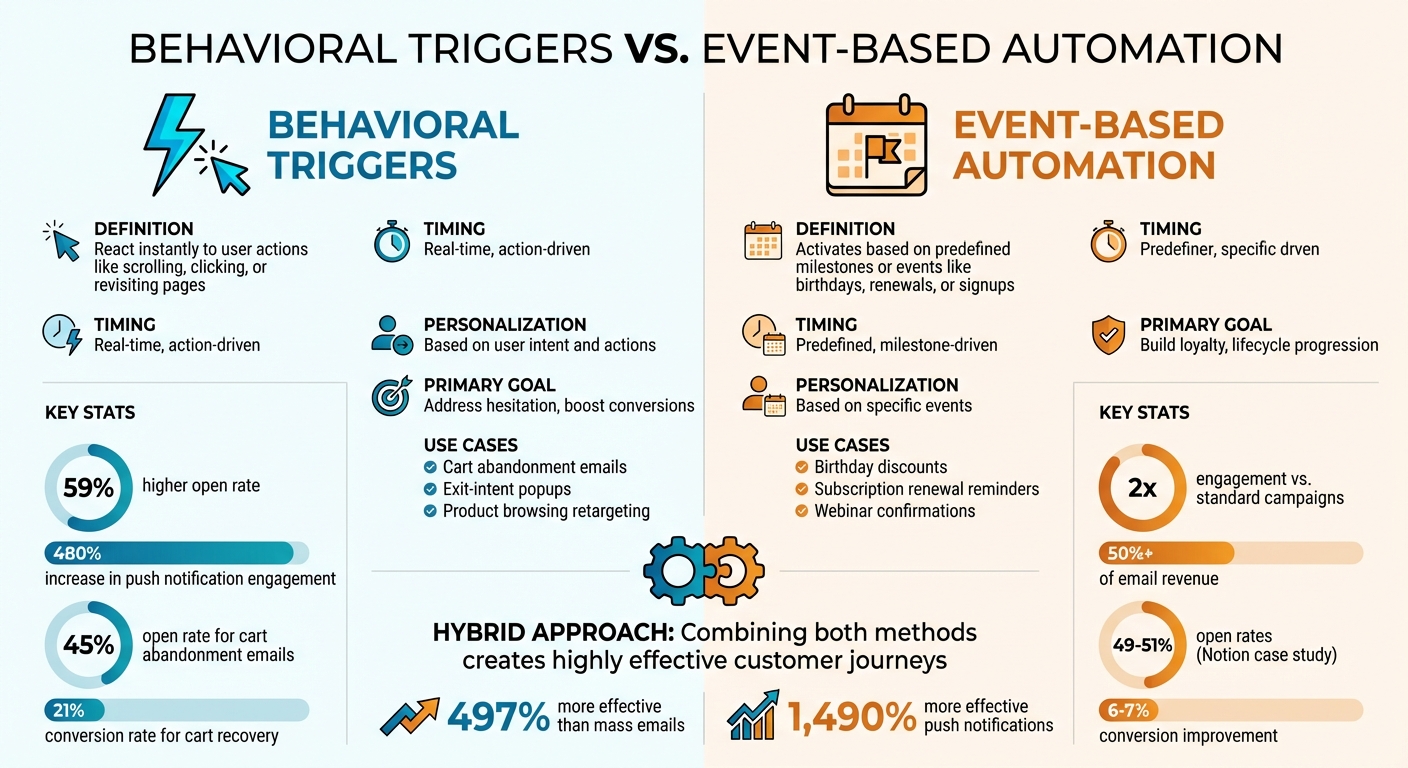
Behavioral Triggers vs Event-Based Automation: Key Differences and Use Cases
What Are Triggers In Marketing Automation? - Modern Marketing Moves
Main Differences Between Behavioural Triggers and Event-Based Automation
Behavioural triggers and event-based automation differ in their timing, personalisation, and the type of triggers they use. Behavioural triggers act immediately, responding to user actions like scrolling most of the way through a page, hovering near an exit button, or frequently visiting a pricing page. These triggers aim to capture the "moment of readiness" - those precise instances when a user shows clear interest or hesitation. On the other hand, event-based automation operates on predefined schedules, tied to specific milestones such as subscription renewals, signup anniversaries, or reaching a usage threshold. These distinctions in timing and context shape how each method approaches personalisation.
Personalisation strategies also vary significantly between the two. Behavioural triggers rely on context, interpreting emotions and intent based on user actions. Event-based automation, however, focuses on specific events, delivering messages aligned with completed tasks or lifecycle stages. As Customer.io explains, the shift is about moving from asking "who should get this message" to determining "when does this message actually help".
"Behavioural triggers connect what you can measure (clicks, scrolls, visits, events) with what you can't see directly (emotions, intent, hesitations)."
– Personizely
This quote highlights the strength of behavioural triggers in aligning messages with user behaviour. For instance, "buying intent" automations - triggered when a user visits a specific product category two or three times within a week - can achieve open rates above 50% and purchase conversion rates as high as 30%.
Comparison Table: Behavioural vs. Event-Based Automation
| Feature | Behavioural Triggers | Event-Based Automation |
|---|---|---|
| Timing | Real-time, immediate response to live signals | Predefined schedules or milestone-driven |
| Personalisation Focus | Context-driven; infers intent and emotions | Event-specific; based on completed actions |
| Trigger Types | Activated by user actions (scrolls, hovers, repeats) | Triggered by milestones (signups, purchases, renewals) |
| Primary Goal | Reduce friction by capturing intent at critical moments | Drive adoption and lifecycle progression |
| Data Source | Interaction patterns and environmental context | Product analytics and system events |
Benefits and Use Cases of Behavioural Triggers
Behavioural triggers leverage real-time user actions to deliver messages that align perfectly with what users are doing, rather than relying on pre-scheduled campaigns. This approach ties specific actions - like clicking or hesitating - to subtle user intentions, creating communication that feels more like personalised guidance than traditional marketing. It's about being there at the exact moment users need you.
The numbers back this up. Triggered emails have a 59% higher open rate, while action-based push notifications see a staggering 480% increase in engagement. Cart abandonment emails alone boast a 45% open rate and a 21% conversion rate. These stats highlight why behavioural triggers are so effective at easing friction during critical moments like checkout or onboarding. By addressing hesitation with timely reassurance or social proof, brands can guide users through the journey seamlessly.
AI-powered triggers take this even further by predicting behaviours like churn or repeat purchases, shifting from reactive responses to proactive engagement. This aligns with Wick's "Tailor & Automate" strategy, which uses AI to deliver messages tailored to where each user is in their journey. The result? A smarter, more unified approach to marketing automation.
Practical Applications of Behavioural Triggers
The advantages of behavioural triggers translate into actionable strategies that can drive real results. One of the most effective examples is cart abandonment recovery. When a user leaves items in their cart without completing the purchase, a well-timed email featuring product images, a clear call-to-action, and perhaps a free shipping offer can bring them back. The ideal timing involves a three-step follow-up: the first email on the same day, a second the next day, and a final reminder about a week later.
Another powerful use case comes from analysing product browsing behaviour. If a user visits a specific category two or three times within a week, it’s a strong indicator of buying intent. Sending a retargeting email with product details or recommendations can nudge them toward a purchase. Similarly, if users repeatedly visit pricing pages, they might be stuck in decision-making mode. A well-placed comparison table or a "talk to sales" prompt can help resolve their hesitation.
Exit-intent triggers are another valuable tool. When a user is about to leave - such as hovering near the close button - a popup offer or lead magnet can re-engage them and reduce bounce rates. Milestone-based triggers, like sending rewards or discounts on purchase anniversaries, are excellent for building loyalty and showing appreciation.
To ensure these triggers deliver maximum impact, it’s crucial to implement exception events. These automatically cancel a message if the user completes the desired action before the trigger is sent, avoiding unnecessary communication. Additionally, use frequency caps and delivery windows (e.g., 09:00 to 21:00) to avoid overwhelming users. After all, 67% of consumers cite irrelevant or excessive messages as the main reason they unsubscribe from mailing lists. For cart abandonment, a slight delay of 30 minutes to an hour often performs better than sending an immediate message, giving users a chance to return on their own first.
Benefits and Use Cases of Event-Based Automation
Event-based automation kicks in when specific milestones occur - like a purchase, registration, or subscription renewal - making communication timely and relevant. Unlike behavioural triggers that react to ongoing user actions, this approach focuses on clear, defined events. For instance, it activates when a customer completes a transaction, signs up for a webinar, or celebrates their account anniversary. These moments serve as precise markers in the customer journey, seamlessly fitting into Wick's strategy of collecting and unifying granular data at critical touchpoints.
Why does this matter? Event-triggered messages deliver twice the engagement and account for over 50% of email revenue. They feel more like a service than a sales pitch. Think about it: a confirmation email after checking out of a hotel or a renewal reminder before a subscription expires arrives exactly when it's needed.
"A static campaign feels like 'marketing.' An event-driven journey feels like service." – Evam
This approach works across the entire customer lifecycle. During acquisition, signups can trigger welcome messages. In onboarding, failed transactions might prompt instant support. And for retention, inactivity can spark reactivation campaigns. By being proactive, brands can address issues like payment failures or trial expirations before they escalate into customer losses.
Take Monarch Money, for example. In 2025, they shifted from generic, time-based email sequences to behaviour-driven onboarding by integrating data from Segment and Snowflake into Customer.io. The impact? A 3.36% drop in cancellations, a 4.4% increase in reports page views, and a 2.5% rise in category updates. Adding in-app nudges led to a 200% spike in referrals in just one week. Similarly, Notion used event-based automation to tailor onboarding by market and language, achieving open rates between 49–51% and improving conversions by 6–7%.
Practical Applications of Event-Based Automation
The versatility of event-based automation allows it to be applied throughout the customer journey. One of the most common uses is transactional confirmations. When someone completes a purchase or books a service, an immediate confirmation email or receipt reassures them that their transaction was successful. Follow-up updates, like shipping notifications, keep customers informed without requiring manual effort.
Registration-based sequences are another example. A webinar signup can trigger a confirmation email with login details and calendar links. Similarly, newsletter subscriptions might activate a welcome discount or a series of emails introducing the brand's key offerings. These messages arrive exactly when customers expect them, reducing confusion and fostering trust.
Milestone recognition adds a thoughtful, personal touch. For instance, sending a birthday discount or loyalty bonus on a customer’s anniversary with the brand strengthens the relationship beyond transactions. Automated messages for significant milestones - such as a tenth purchase or reaching a new loyalty tier - encourage repeat engagement and deepen brand loyalty.
Post-event follow-ups are another effective use case. After a hotel checkout or event attendance, a thank-you message or a review request arrives while the experience is still fresh. In publishing, event triggers can convert free readers into paid subscribers by prompting them when they hit a predefined article limit or their trial period ends. Timing is everything here - balancing prompt service with user comfort. To avoid overwhelming users, implement exceptions to prevent redundant messages and restrict delivery times to between 09:00 and 21:00.
Cross-Channel Synchronisation Methods
Effectively mapping cross-channel user journeys demands synchronisation methods that bring together behavioural triggers and event-based automation. These strategies must work seamlessly across platforms like email, SMS, and mobile apps to ensure a connected experience.
Event-based automation hinges on unique identifiers - such as session IDs or application IDs - to manage multiple concurrent journeys. For instance, if a customer submits two loan applications at the same time, each application is assigned its own identifier. This ensures that follow-up messages, whether sent via email or SMS, link to the correct application. This method excels at tracking users as they switch devices or channels, maintaining accuracy throughout the process. It differs from behavioural triggers, which focus on real-time exceptions rather than identifiers.
On the other hand, behavioural triggers handle exception events to maintain a smooth experience. For example, if a user completes a purchase on the mobile app, the system automatically cancels any pending "abandoned cart" reminders scheduled for email or SMS. This approach avoids unnecessary or redundant communication, making the interaction feel helpful rather than pushy. It’s all about understanding user intent and lifecycle stages - like offering loyalty rewards after a user reaches their tenth app session.
Both methods rely on frequency management to prevent overwhelming users. Systems often enforce delivery windows - for example, restricting push notifications and SMS messages to between 09:00 and 21:00 in the user’s local time zone. Additionally, daily message limits are set to keep communication balanced. A great example of this in action comes from 2025, when mobile app developer Bladestorm used Pushwoosh’s Customer Journey Builder to re-engage inactive users. The result? A 16.62% increase in Monthly Active Users (MAU) and a 4.58% boost in total revenue.
"Triggered communication is a strategic foundation for how modern brands engage. By responding to real-time behaviour... you can move from static outreach to dynamic interactions." – Team Braze
When combined, these synchronisation methods create a seamless cross-channel experience. Event-triggered journeys adapt dynamically, allowing users to enter, pause, or switch devices, while automation logic keeps up without manual intervention. Meanwhile, behavioural triggers ensure that messages remain relevant and aligned with user intent, avoiding the risk of feeling robotic. Together, they enable automatic milestone tracking and dynamic journey mapping, whether the customer is checking email, responding to SMS, or browsing the app.
Pros and Cons of Cross-Channel Synchronisation
| Method | Advantages | Disadvantages |
|---|---|---|
| Behavioural Triggers | Highly relevant; builds trust over time; avoids redundant messaging through exception events. | Can feel intrusive if overly aggressive; requires detailed segmentation to work effectively. |
| Event-Based Automation | Instant responses; highly accurate for transactional actions; supports multiple journeys at once. | Needs high-quality, unified data across platforms; risks generic communication without proper context. |
When to Use Behavioural Triggers Instead of Event-Based Automation
Behavioural triggers are perfect for responding to real-time user actions, while event-based automation works best for scheduled or milestone events. Use behavioural triggers to react instantly to user interests or hesitations, and rely on event-based automation for campaigns tied to specific dates or moments. This distinction helps identify where behavioural triggers can bring unique advantages.
To decide between the two, apply the "Volume × Intent × Friction" framework. Behavioural triggers should take priority when actions involve a large audience (volume), show a clear intent to convert, and occur at points where users often hesitate or drop off (friction). For example, if users frequently visit your pricing page but don’t proceed to checkout, this behaviour signals an opportunity to use a behavioural trigger, like a comparison table or a "talk to sales" prompt . These triggers address psychological barriers that pre-scheduled event-based automation can’t adapt to.
Behavioural triggers can also help when requesting permissions. Instead of prompting users for app permissions - like access to the camera or location - right after they open the app, wait until they interact with a feature that requires it. This approach respects user preferences and increases the likelihood of approval. Similarly, for products with complex features, behavioural triggers can identify whether a user is a beginner or an advanced user, delivering personalised resources instead of a one-size-fits-all onboarding experience.
Research shows that triggered emails and action-based push notifications consistently outperform standard campaigns .
Use behavioural triggers when addressing emotional cues like doubt, hesitation, or confusion. These states often manifest as repeated visits to the same page or long pauses on FAQ sections. On the other hand, event-based automation is better suited for large-scale promotions, transactional emails, or other situations where timing is calendar-driven rather than behaviour-driven. By tailoring your strategy to user behaviour and campaign needs, you can make your messaging far more effective.
Combining Both Methods for Better Results
Blending behavioural triggers with event-based automation creates a dynamic approach to shaping customer journeys. Event-based automation handles predictable milestones - like subscription renewals or onboarding processes - while behavioural triggers react in real-time to individual actions, such as browsing a specific product or abandoning a cart. By strategically using email for educational content, SMS for urgent updates, and in-app messaging for high-priority actions, you can deliver a seamless, cross-channel experience tailored to each customer. This combination ensures your automation aligns with both strategic goals and real-time user behaviour.
Wick's Four Pillar Framework provides the backbone for this hybrid approach. It integrates data from your website, CRM, and product analytics into a single, unified customer profile, eliminating delays that lead to inconsistent messaging. This unified profile enables dynamic segmentation based on real-time behaviour, lifecycle stage, and engagement levels. By bridging predictable milestones with real-time actions, this framework strengthens your overall digital strategy.
The benefits of this approach are tangible. A recent case study showed that replacing generic, time-based email sequences with behaviour-triggered onboarding reduced cancellations by 3.36% and boosted referrals by 200%. Similarly, foodora leveraged AI-powered timing to optimise message delivery across email, push notifications, and in-app channels, achieving a 41% conversion rate and reducing unsubscribe rates by 26%.
To avoid frustrating your users, ensure automation is smart and responsive. For example, if a customer abandons their cart but later completes the purchase, your system should immediately cancel any scheduled cart recovery emails. Combine this with frequency capping to prevent overwhelming users with messages across multiple channels.
Measuring Success in Hybrid Implementations
Measuring the effectiveness of your hybrid strategy requires careful tracking of key metrics. A mix of leading indicators (e.g., feature adoption) and lagging indicators (e.g., cancellation rates) helps you avoid misinterpreting results. For instance, if users engage with a new feature (leading), but churn rates remain steady (lagging), it might indicate the feature isn't solving the right problem.
Here’s a breakdown of critical metrics to monitor:
| Metric Category | Specific Metric | Purpose |
|---|---|---|
| Engagement | Open/Click-through Rates | Evaluates how relevant and timely the triggers are |
| Activation | Time-to-First-Value (TTFV) | Measures how quickly users find value from the product |
| Retention | Churn/Cancellation Rate | Tracks the long-term impact of automated touchpoints |
| Revenue | Conversion Rate/ROI | Assesses the financial success of the hybrid strategy |
| Efficiency | Unsubscribe Rate | Identifies if automation is becoming intrusive |
To ensure your automation is driving real results, use holdout groups. Keep a small segment of users out of your hybrid campaigns to measure the true impact. This method helps you distinguish between actual behaviour changes and conversions that would have happened regardless of your efforts.
"Data-driven lifecycle marketing is the shift from 'send more' to 'learn faster'." – Customer.io
Conclusion
Choosing between behavioural triggers and event-based automation isn't about picking sides - it's about knowing when to use each for the best results. Behavioural triggers shine when it comes to interpreting why users act a certain way, analysing patterns like how far they scroll or how often they revisit a page to gauge intent or hesitation. On the other hand, event-based automation focuses on the what, reacting to clear milestones like completing a form or renewing a subscription. The real magic happens when you combine both approaches, creating a system that adapts to individual behaviours while staying consistent for predictable events.
The numbers back this up: trigger-based marketing emails are a staggering 497% more effective than traditional mass emails, and mobile push notifications triggered by user actions can be up to 1,490% more effective than batch notifications. These stats highlight a major shift from static campaigns to real-time, personalised engagement - especially significant when 72% of consumers say they only interact with messages tailored to their preferences.
To make the most of automation, map out your customer journey to identify key high-intent moments. Use the "volume × intent × friction" framework to prioritise actions that truly drive results. At the same time, ensure your automation stays user-friendly by incorporating exception events and frequency limits so your messages feel helpful, not overwhelming. This strategy ties directly into aligning real-time signals with actionable insights.
Wick’s Four Pillar Framework takes this a step further by integrating data into a single, unified customer profile. This enables real-time segmentation and messaging that works seamlessly across both planned milestones and unexpected user actions. By eliminating delays and inconsistencies from disconnected systems, this approach ensures your marketing stays sharp and relevant.
Ready to take your marketing automation to the next level? Wick’s tailored solutions can help you deliver the right message at the right time, across every channel. Visit Wick's marketing automation services to see how their expertise can transform your engagement efforts.
FAQs
How do behavioural triggers and event-based automation work together to improve user engagement?
Combining behavioural triggers - like scrolling through 75% of a page, adding an item to the cart, or signing up for a newsletter - with event-based automation - such as completing a purchase or submitting a form - creates a highly responsive and context-aware system. This method allows businesses to react in real time to user actions and important milestones.
For instance, if someone is browsing a product (behavioural trigger), they could receive personalised recommendations tailored to their interests. Once they add the product to their cart (event trigger), a follow-up message - perhaps a reminder or even a discount - can be sent to encourage them to complete the purchase. These interactions can be delivered through email, SMS, push notifications, or WhatsApp, customised to local preferences in the UAE. Think bilingual content in Arabic and English, prices displayed in AED, or timing campaigns around key cultural events like Ramadan.
This approach ensures timely and relevant communication, creating smooth and engaging user experiences that not only drive conversions but also deliver clear, measurable outcomes.
What makes behavioural triggers more effective than event-based automation?
Behavioural triggers stand out because they respond to what users actually do, reflecting their real intent, instead of relying on static, predefined events. By observing actions like scrolling through a pricing page, revisiting a product multiple times, or adding items to a shopping cart, these triggers enable personalised, real-time interactions. This means messages reach users at just the right moment, increasing both engagement and conversion rates.
Unlike traditional event-based automation, which reacts to single actions like submitting a form, behavioural triggers analyse multiple signals to craft context-aware responses. For instance, if a visitor scrolls 75% down a page, they might see a tailored case study, while an abandoned cart could prompt a recovery email. This method reduces repetitive messaging, enhances the value of CRM systems, and minimises message fatigue.
For businesses in the UAE, using behavioural triggers through a consultancy like Wick ensures that automated interactions are tailored to local preferences. This includes AED pricing, bilingual Arabic/English content, and a culturally relevant approach, making every customer interaction feel timely and meaningful.
What is the 'Volume × Intent × Friction' framework, and how does it guide automation choices?
Currently, there’s no in-depth breakdown of the 'Volume × Intent × Friction' framework in this context. Without further details, it’s tricky to explain how this model aids in deciding between behavioural triggers and event-based automation. If you have more information or resources about this framework, please share them, and we can offer a clearer and more detailed explanation.