
Blog / Behavioral Segmentation in Journey Analytics
Behavioral Segmentation in Journey Analytics
Behavioral segmentation is about understanding what your customers do and why they do it, rather than focusing on who they are. By analyzing actions like purchases, app usage, and engagement patterns, businesses can predict future behavior and create personalized experiences. This approach is particularly relevant in the UAE, where 95% of consumers have changed shopping habits, and 71% use digital tools in their buying journeys. Here’s how it works:
- Purchase Behavior Segmentation: Uses RFM (Recency, Frequency, Monetary value) to identify top customers. For example, Adidas saw a 259% increase in average order value from new customers using targeted offers.
- Occasion-Based Segmentation: Focuses on timing triggers like Ramadan or personal milestones to align campaigns with customer behavior.
- Engagement-Based Segmentation: Tracks interactions across channels (e.g., email, social media) to gauge interest and re-engage users. Carrefour achieved a 350% boost in conversion rates with targeted notifications.
To make this work, businesses in the UAE should integrate data from multiple sources using Customer Data Platforms (CDPs). By unifying online and offline data, companies can better personalize experiences, which is crucial as 76% of consumers feel frustrated without personalization. Examples like Maggi's Ramadan campaign show how first-party data can drive results, such as a 66% rise in registrations.
For success:
- Use real-time data to adjust customer journeys.
- Focus on dynamic segmentation to adapt to changing behaviors.
- Prioritize personalization while respecting privacy regulations in the UAE.
Behavioral segmentation isn’t just about data collection - it’s about creating meaningful, timely connections that drive results.
How to segment customers based on their behavior - examples for Management Consultants
sbb-itb-058f46d
Main Types of Behavioural Segmentation
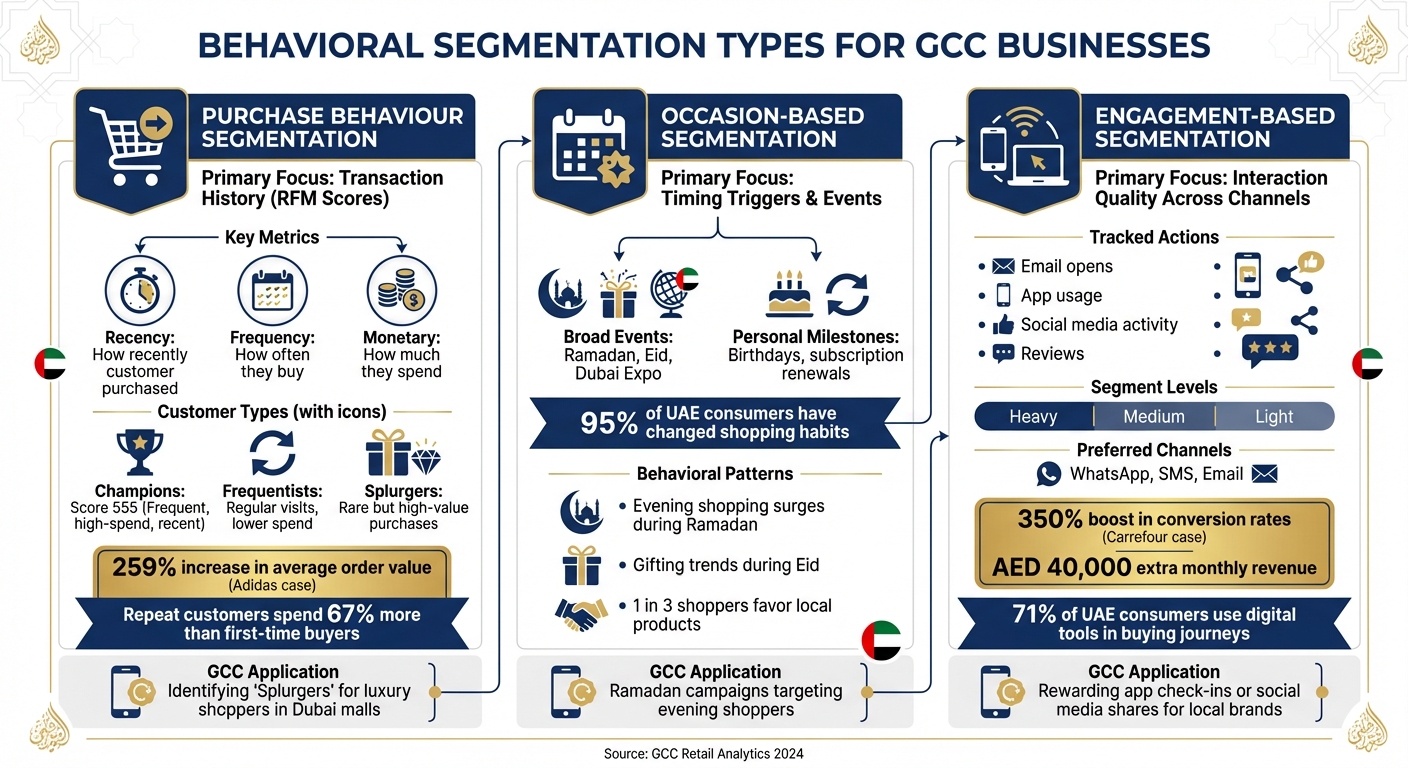
Three Types of Behavioral Segmentation: Purchase, Occasion, and Engagement
This approach offers three distinct ways to understand customer behaviour. By focusing on purchase habits, timing, and engagement levels, businesses can gain a clearer picture of how customers interact with their brand throughout their journey.
Purchase Behaviour Segmentation
This method digs into transaction data using RFM metrics: Recency (how recently a customer made a purchase), Frequency (how often they buy), and Monetary value (how much they spend). Customers are scored on a scale of 1–5 for each metric, which helps identify patterns. For instance, a "Champion" customer scores 555 - they shop often, spend a lot, and bought recently. On the other hand, "Frequentists" visit regularly but spend less, while "Splurgers" make rare but high-value purchases.
For GCC retailers, these insights are particularly valuable. In 2024, Adidas ran an A/B test with coupon codes targeting both new and returning website visitors. The result? A 259% jump in average order value for new customers and a 35.5% increase in conversion rates for returning ones within a single month. Repeat customers, on average, spend 67% more than first-time buyers. This makes identifying and nurturing top customer segments essential. Beyond transaction data, timing plays a vital role in customer behaviour.
Occasion-Based Segmentation
This method revolves around timing triggers - whether they’re broad events like Ramadan, Eid, or the Dubai Expo, or personal milestones such as birthdays or subscription renewals. In the UAE, where 95% of consumers have recently shifted their shopping habits, recognising these patterns is key to staying relevant.
During Ramadan, for example, evening shopping surges. Around Eid, gifting trends dominate. Even global supply chain issues have pushed one in three UAE shoppers to favour local products, especially in categories like perishables. Successful campaigns align product offerings, promotional timing, and messaging to these predictable shifts in behaviour. Occasion-based segmentation works hand-in-hand with transaction analysis by focusing on when customers are most likely to act.
Engagement-Based Segmentation
This approach looks beyond purchases to examine how actively customers interact with your brand. By tracking actions like email opens, app usage, social media activity, or even writing reviews, businesses can gauge intent and segment users based on interaction levels - Heavy, Medium, or Light - and preferred channels like WhatsApp, SMS, or email.
For example, Carrefour in 2024 used web push notifications to re-engage customers who abandoned their carts. By highlighting specific product benefits, they generated AED 40,000 in extra monthly revenue and saw a 350% boost in conversion rates. In a mobile-first GCC market - where 71% of UAE consumers incorporate digital tools into their shopping journeys - tracking engagement across channels provides valuable early indicators of purchase intent, allowing businesses to refine their customer journey strategies.
| Segment Type | Primary Focus | GCC Application Example |
|---|---|---|
| Purchase Behaviour | Transaction history (RFM scores) | Identifying "Splurgers" for luxury shoppers in Dubai malls |
| Occasion-Based | Timing triggers and events | Ramadan campaigns targeting evening shoppers |
| Engagement-Based | Interaction quality across channels | Rewarding app check-ins or social media shares for local brands |
How to Collect and Use Behavioural Data
Gathering behavioural data from various channels requires a streamlined and unified approach. Customer Data Platforms (CDPs) play a key role by consolidating both online and offline data into a single, comprehensive customer profile. This is especially crucial for businesses in the GCC region, where 80% of consumers in the UAE expect companies to understand their specific needs, and 66% demand personalised offers.
One major hurdle is identity stitching, which links interactions across devices and platforms to create a consistent, person-level customer identity. Techniques like field-based or graph-based stitching help eliminate blind spots in the customer journey. However, addressing technical challenges and ensuring data privacy are critical to turning this unified data into actionable insights.
Privacy compliance is another vital consideration. In the UAE, 55% of consumers say that a brand’s ability to safeguard their personal data directly impacts their trust. First-party data collection - through methods like user registrations, loyalty programmes, and email sign-ups - has become essential. Brands leveraging first-party data have reported revenue increases of 1.5X to 2.9X.
"Trust and first-party data always go hand in hand. Fifty-five per cent of people in the UAE, Egypt, and Saudi Arabia, say that a brand's ability to protect their personal data affects how much they trust it".
A standout example is Maggi's first-party data strategy during Ramadan 2022 in the Middle East and North Africa. By using Google's Performance Max to drive website registrations, they gained insights into consumer interests - like recipes and kitchen tips - and used this data with Customer Match to target similar audiences on Search and YouTube. The results? A 66% increase in website registrations and a 118% boost in click-through rates.
Integration of Multichannel Data Sources
Once data is unified, the next step is combining real-time and offline sources for actionable segmentation. A full picture of customer behaviour requires integrating digital event data (from websites and apps) with offline information, such as in-store purchases or customer support interactions. Real-time data ingestion tools, including streaming data and APIs, ensure that segments are immediately pushed into activation platforms. In the UAE, implementing a CDP often results in a 20–30% lift in campaign engagement and a 15–25% increase in conversion rates within six months. Typically, a CDP project for UAE businesses takes 6 to 10 weeks, covering steps like data mapping, ingestion, and profile unification.
Compliance is non-negotiable for GCC businesses. Data collection must align with UAE regulations, including SAMA and NCA guidelines for financial data, by employing robust consent management, encryption, and audit trails. Regular evaluations of data sources for accessibility, relevance, and reliability are equally important.
| Tool | Primary Use Case in UAE | Key Feature |
|---|---|---|
| Mixpanel | Product Analytics | Tracks user engagement and conversions |
| Amplitude | Behavioural Analytics | Offers real-time analytics and user-friendly dashboards |
| Heap Analytics | Automated Tracking | Captures interactions without manual setup |
| Woopra | Omnichannel Analytics | Tracks multiple channels in real-time |
| Adobe CJA | Journey Analytics | Unifies online/offline data via identity stitching |
Real-Time Customer Journey Mapping
With a strong data foundation in place, real-time customer journey mapping becomes possible. This approach uses live data to track customer actions across touchpoints, allowing brands to identify friction areas and high-value moments as they unfold. It also enables segment-triggered journeys, where customers are automatically added to or removed from marketing paths based on behavioural criteria - like cart abandonment or reaching a loyalty milestone.
Real-time mapping enhances next-best-action strategies. For instance, if a customer doesn’t open an email within two hours, the system might send an SMS instead. Once the customer makes a purchase, they are removed from retargeting ads, reducing unnecessary ad spend. Re-entry logic can also be configured, so customers who repeat high-value behaviours re-enter the flow, maintaining engagement.
In the UAE, real-time mapping should account for local preferences, such as bilingual (Arabic/English) navigation and the widespread use of WhatsApp for customer interactions. Monitoring behavioural signals like "rage clicks" (indicating frustration from bugs or poor user experience) can trigger proactive support, preventing customer churn.
"We finally understood why leads drop off. The map showed us how to fix it".
For mid-sized companies in the UAE, professional journey mapping - including scoping, data cleanup, and initial setup - typically costs between AED 30,000 and AED 80,000. This investment often pays off through improved conversion rates and lower customer acquisition costs, especially when campaigns align with regional events like Ramadan and consider gender-specific communication styles.
Best Practices for GCC Businesses
Prioritise Dynamic Segmentation
The UAE's market moves fast, and consumer habits shift just as quickly. With 95% of shoppers changing their behaviours - trying new stores or experimenting with brands - static customer segments can quickly lose relevance. What worked last quarter might already be outdated.
Dynamic segmentation helps you keep up. It updates customer profiles in real time, adapting to their evolving behaviours. For example, if a shopper switches from browsing high-end products to hunting for discounts, your system should pick up on this immediately and adjust your messaging. Why does this matter? Triggered messages outperform standard email blasts with a staggering 624% higher conversion rate.
Take the example of a leading UAE fashion retailer in December 2024. They launched a behavioural loyalty programme using the Capillary platform. This programme awarded bonus points for shopping on specific days and offered extra perks for purchases across multiple categories. The result? A noticeable increase in both transaction values and store visits.
Another shift that highlights the importance of dynamic segmentation is the move from cash-on-delivery to digital wallets like Apple Pay and Google Wallet. As payment preferences evolve, segmentation strategies must reflect these changes to ensure relevance.
By embracing dynamic segmentation, businesses can also track precise metrics and KPIs, which are essential for aligning customer insights with financial goals.
Optimise Metrics and KPIs
When just 1% of customers drive 67% of sales, effective segmentation becomes non-negotiable.
| KPI Category | Key Metric | Why It Matters in the GCC |
|---|---|---|
| Value Metrics | Customer Lifetime Value (CLV) | Helps identify high-value customers in sectors like luxury and real estate |
| Loyalty Metrics | Net Promoter Score (NPS) | Crucial in markets where referrals power growth |
| Efficiency Metrics | Time to Value (TTV) | Vital for fast-paced digital markets like Dubai |
| Engagement Metrics | Product Activation Rate | Highlights friction in bilingual onboarding flows |
In the GCC, traditional customer feedback like surveys often falls short - 85% of dissatisfied customers simply switch brands or delete apps without saying a word. Real-time behavioural metrics, such as tracking drop-offs in bilingual navigation or measuring how quickly customers find value in their purchases, provide a more reliable alternative.
"The next frontier is precision experience where every interaction is not only personalised but contextually intelligent, ethically designed, and strategically measurable."
- Newmetrics
To maximise the impact of these metrics, tie them directly to financial outcomes. Companies that implement journey orchestration report revenue increases of 10–20%, alongside cost savings of 15–25%. This approach ensures segmentation strategies resonate with the market while driving measurable results.
Use Local Market Knowledge
Dynamic segmentation and well-optimised KPIs are just the start. To truly connect with consumers, you need to understand the UAE's unique market behaviours. For example, while 71% of shoppers use digital tools, many still prefer an in-store "touch-and-feel" experience for items like clothing and electronics.
With the UAE retail market expected to grow from AED 507 billion in 2023 to AED 804 billion by 2032, tailoring strategies to local preferences is essential. Consider how one in three shoppers prefers local brands for perishables. Loyalty programmes could offer extra rewards for buying GCC-based products, encouraging this behaviour.
Payment habits also offer insights. Despite the UAE's high GDP per capita, many consumers are becoming more price-conscious, frequently searching for discounts and coupons. By segmenting "deal-seekers" from "premium-tier" customers, you can craft messaging and offers that speak directly to their needs. Additionally, physical stores continue to serve as social hubs in the GCC. Rewarding non-transactional actions like in-store check-ins, pre-ordering during quiet hours, or attending social dining events can strengthen customer relationships.
"Behavioural loyalty is the ability of brands to retain loyal customers by adopting strategies to reward members' non-transactional behaviour."
- Gitanjali Mittal, Marketer, Capillary
Local habits, such as late-night app usage, also create opportunities for precise targeting. Timed push notifications or personalised offers during these hours can boost engagement. Similarly, offering higher incentives for "click-and-collect" options can encourage cost-saving behaviours, while premium customers might appreciate perks like private shopping slots or assisted shopping in boutiques.
Wick's Four Pillar Framework for Behavioral Segmentation
Applying behavioural segmentation across the GCC requires a clear and structured strategy, especially given the region's dynamic digital environment. Wick's Four Pillar Framework offers a detailed system to gather customer data, analyse their behaviours, and deliver automated, personalised experiences that adapt in real time.
This framework tackles a key issue for UAE businesses: the non-linear customer journey. With high mobile usage and a tech-savvy population in cities like Dubai and Abu Dhabi, customers frequently switch between devices and languages. They expect seamless and consistent experiences at every interaction point. Wick's framework helps unify these varied touchpoints into a cohesive strategy, aligning perfectly with the region's focus on data-driven customer journeys.
Capture & Store Pillar
This is the foundation of behavioural segmentation, focusing on gathering and organising data. It pulls information from multiple channels like GA4, CRMs, and CDPs. For GCC businesses, tracking bilingual navigation habits and mobile-first preferences is particularly important.
The system monitors high-intent actions such as clicking on specific service links, adding items to a cart, or abandoning purchases. This creates a robust data repository that includes both known customers and anonymous website visitors. Businesses are advised to build historical data over 3–6 months before launching segmentation efforts.
"Knowing who your customers are is only half the battle; knowing what they do is where the real magic happens." - Sarah, Marketing Analyst
Instead of relying on static CSV exports, dynamic data feeds are recommended to keep messaging relevant. Customer behaviours can shift rapidly, and outdated data risks alienating users. Use your CRM to manage data for known customers, while GA4 tracks trends among anonymous visitors.
Once this comprehensive data collection is in place, businesses can move forward with personalised interactions based on these insights.
Tailor & Automate Pillar
With a solid data foundation, this pillar focuses on turning insights into immediate, actionable outcomes. AI-powered tools are key here, analysing qualitative data from sources like heatmaps and session recordings to identify friction points in the customer journey. Based on real-time behaviour, the system can automatically adjust messaging. For instance, if a customer frequently browses products without purchasing, they might receive a personalised email within two hours offering styling tips or exclusive access.
AI and predictive models play a major role in refining messaging and forecasting ROI. This ensures segmentation stays relevant, which is especially crucial in the GCC, where customers demand efficiency and high-quality experiences.
"In Dubai and Abu Dhabi, where customer expectations are high and tolerance for inefficiency is low, a misaligned journey results in lost revenue." - Octopus Marketing
For example, when a "Frequent Buyer" stops engaging, they can be automatically reassigned to a "Lapsed Customer" segment and entered into a re-engagement workflow. This ensures messaging aligns with their current behaviour, showcasing the framework's ability to adapt in real time.
In the GCC, tailoring and automation must also account for local nuances. This might involve adjusting fitness app recommendations to reflect Dubai's intense summer temperatures or prioritising Arabic-first content for users who consistently select that language. The ultimate aim is to deliver personalised experiences that respect local preferences while driving tangible outcomes.
Conclusion and Key Takeaways
In the GCC, behavioural segmentation goes beyond identifying who customers are - it uncovers their actions, intentions, and the ideal moments to connect with them. In fast-paced markets like Dubai and Abu Dhabi, where high expectations meet low tolerance for inefficiency, this approach plays a key role in driving conversions.
Here’s what stands out: multicultural audiences, high mobile usage, and bilingual interactions create customer journeys that span devices, languages, and channels. By leveraging dynamic segmentation - where customers shift from "Frequent Buyer" to "Lapsed Customer" based on real-time behaviour - you can ensure your messaging stays relevant and impactful.
Wick’s Four Pillar Framework ties data from social media, search, email, and offline interactions into a unified customer profile. Its "Tailor & Automate" pillar takes it further by enabling real-time, personalised workflows. These strategies keep segmentation flexible and aligned with local preferences.
For best results, focus on 3–5 core customer groups to ensure your insights are statistically reliable. Use RFM analysis (Recency, Frequency, and Monetary value) to identify your most valuable customers, and rely on a Customer Data Platform to consolidate data across multiple channels. Tailor your approach to the GCC by considering regional payment habits, bilingual content needs, and the social nuances that drive referrals and advocacy.
Behavioural segmentation isn’t just about gathering data - it’s about turning insights into personalised, timely experiences. For businesses in the GCC looking to move past guesswork, this method offers a clear path to sustainable growth and stronger customer connections.
FAQs
How do I choose the right behavioural segments for my business?
To select the most effective behavioural segments, begin by setting clear, measurable goals. Whether your aim is to increase sales or enhance customer engagement, having a defined purpose ensures your efforts align with your overall objectives.
Gather data from reliable sources such as website analytics, purchase records, and customer interactions. This information forms the foundation for identifying patterns and trends. Pay close attention to key factors like how often customers make purchases or their browsing habits. These variables help in forming segments that are both actionable and insightful.
In the UAE, it's essential to factor in regional behaviours and preferences. For example, you might want to pinpoint frequent shoppers, high-value customers, or those showing signs of disengagement. Tailoring your approach to these segments can lead to more targeted and effective strategies.
What data do I need to start behavioural segmentation in the UAE?
To start behavioural segmentation in the UAE, gather data on customer interactions, preferences, behaviours, and demographics. Pay special attention to factors like language preferences, key cultural events, and regional trends that influence consumer habits. Use a mix of real-time and historical data to get a clearer picture of patterns. This analysis can help you tailor engagement strategies to resonate with your audience more effectively.
How can I activate real-time segments without breaking privacy rules?
To use real-time segments responsibly while adhering to privacy rules, restrict data evaluation to a 24-hour window. Avoid mixing batch and streaming data within the same segment to maintain clarity and compliance. Ensure alignment with privacy laws such as GDPR or UAE-specific regulations by securing explicit user consent and being transparent about how their data is utilised. Additionally, establish strong data governance and consent management protocols to handle real-time segmentation in an ethical and compliant manner.