

Blog / How Behavioral Data Personalizes Email Campaigns
How Behavioral Data Personalizes Email Campaigns
Generic emails no longer work. Customers in the UAE and across the Middle East now expect brands to deliver content that feels relevant and timely. Behavioral data helps businesses achieve this by focusing on what customers do - like browsing products, clicking links, or abandoning carts - rather than just who they are. This approach enables businesses to send highly personalized emails that boost engagement, loyalty, and sales.
Key Takeaways:
- Behavioral Data: Tracks actions like email opens, clicks, purchases, and website activity.
- Why It Works: Personalized emails outperform generic ones, with conversion rates up to 405 times higher in the UAE.
- Local Relevance: Tailored campaigns for UAE audiences - considering language, location, and cultural events like Ramadan - drive better results.
- Tools: Platforms like Mailchimp, HubSpot, and Salesforce enable smarter segmentation and automated, behavior-driven campaigns.
- Privacy: Ethical data collection and transparency are crucial, as 55% of UAE consumers prioritize data protection.
Personalized email campaigns are a game-changer in the UAE, where high internet connectivity and a diverse population demand smarter audience targeting. By leveraging behavioral data, businesses can deliver tailored experiences that resonate deeply with their customers and significantly improve ROI.
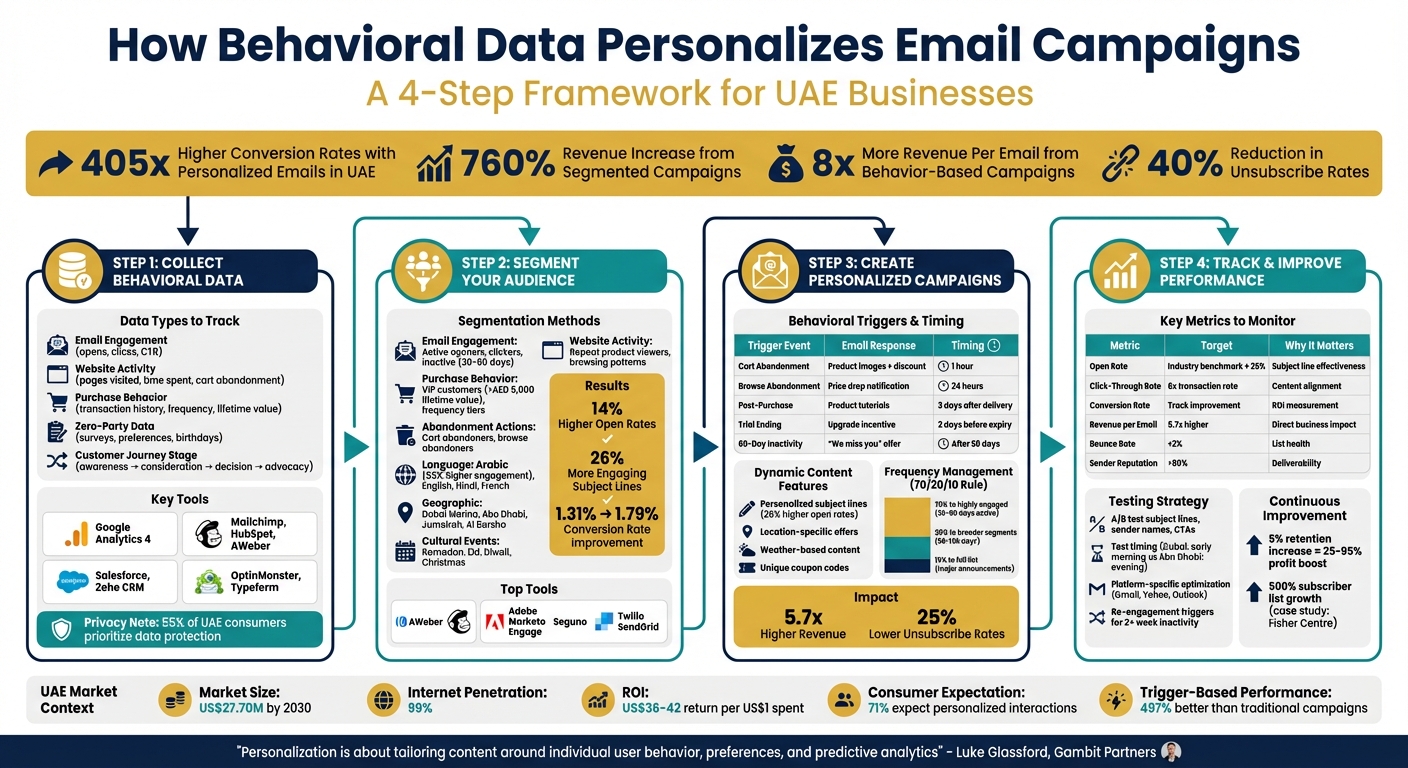
4-Step Process for Personalizing Email Campaigns with Behavioral Data
Activating data in HubSpot: Triggering emails w/ custom behavioral events
Step 1: Collecting Behavioural Data
Creating personalised email campaigns starts with gathering behavioural data that reflects real customer actions while respecting privacy. Let’s explore the key types of data you’ll need to craft emails that truly resonate.
Types of Behavioural Data
Email engagement data captures how subscribers interact with your emails. Metrics like open rates, click-through rates (CTR), click-to-open rates (CTOR), and time spent reading an email provide insights into what content works and which subject lines grab attention.
Website activity sheds light on customer intent. This includes tracking pages visited, products browsed, time spent on the site, forms completed, and abandoned carts.
Purchase behaviour focuses on transaction history - past orders, purchase frequency, average order value, preferred product categories, and customer lifetime value. Analysing this data helps predict future buying patterns and recommend products that match customer preferences.
Zero-party data is information customers willingly provide, such as survey responses, preferences shared via forms, or birthday details. For example, in 2022, Maggi collected such data during Ramadan through website registrations. By asking users if they preferred recipes, kitchen tips, or ingredient recommendations, they tailored newsletters that boosted registrations by 66% and click-through rates by 118%.
Tracking customer journey stage data is equally important. This identifies whether a user is in the awareness, consideration, decision, or advocacy stage of the funnel. Technical details like device type, email client, and location (based on IP) also help refine personalisation efforts.
Data Collection Methods and Tools
Combine automated tools with direct customer input for a comprehensive approach.
- Analytics platforms like Google Analytics 4 (GA4) track real-time site interactions, including pages visited, time spent, and actions taken.
- Email service providers (ESPs) such as Mailchimp, HubSpot, and AWeber automatically monitor engagement metrics like opens, clicks, and unsubscribes, offering insights into email performance.
- CRM systems like Salesforce, HubSpot CRM, and Zoho centralise customer data across channels, connecting online and offline interactions for a complete customer view. As Luke Glassford, Marketing Director at Gambit Partners, explains, personalisation hinges on tailoring content to individual behaviours.
- Preference centres and feedback tools like OptinMonster, Typeform, and Jotform gather zero-party data through forms and surveys. These tools let subscribers choose email frequency and topics, a key feature in the UAE, where 55% of consumers prioritise data protection.
For seamless personalisation, synchronise your e-commerce platform, CRM, and ESP to trigger real-time, tailored emails.
Privacy and Data Protection
In the UAE, where 80% of consumers expect businesses to understand their unique needs, ethical data collection is non-negotiable. Always use permission-based practices, such as double opt-in consent during registrations or loyalty programme sign-ups.
Ensure every email includes an easy-to-find unsubscribe option. Transparency is critical, especially in a market where poor privacy practices are seen as seriously as data breaches.
Using first-party data - information customers willingly share - can deliver a revenue boost of 1.5 to 2.9 times compared to businesses that don’t. However, with 66% of UAE consumers expecting personalised offers, striking a balance between data collection and respecting privacy is key.
Regularly audit your data to ensure its accuracy, relevance, and timeliness. Remove outdated records and verify compliance with regulations. By prioritising transparency and ethical practices, you can build trust and maintain strong relationships with your customers.
Step 2: Segmenting Your Audience
Once you've gathered behavioural data, the next step is to divide your email list into meaningful groups. By segmenting your audience based on how they engage with your brand - rather than just who they are - you can create campaigns that feel personal and relevant. This approach sets the stage for crafting messages that truly connect.
How to Segment by Behaviour
Email engagement is a great starting point. Group your subscribers based on their interaction patterns. For instance, you can identify those who open your emails regularly, those who click but don’t make purchases, and those who’ve been inactive for 30–60 days. While demographic details tell you who your customers are, behavioural insights reveal when and why they buy.
Website activity gives you clues about what’s on your customers' minds right now. Look at the pages they visit, the products they view repeatedly, and how long they spend browsing certain categories. If someone keeps revisiting a product, it’s a strong indicator of interest - perfect for a well-timed email featuring a special offer.
Purchase behaviour helps you identify your most valuable customers. Segment your list based on how often they shop, their average spending, and the products they prefer. For example, you could create a VIP group for customers whose lifetime spending exceeds AED 5,000 and reward them with perks like early access to new launches or exclusive loyalty benefits.
Abandonment actions also warrant their own segments. For cart abandoners, send a follow-up email with a discount within 4–24 hours. For those who browse but don’t add items to their cart, consider sending educational content, like tutorials or customer reviews, to nudge them along.
In the UAE’s diverse market, language-based segmentation is essential. Divide your audience by their preferred language - Arabic, English, Hindi, or French. For instance, Arabic-language campaigns can achieve up to 55% higher engagement rates compared to English-only emails for certain groups.
Geographic segmentation in the UAE works best when it’s hyper-local. Instead of broad regions, focus on specific areas like Dubai Marina, Abu Dhabi, or neighbourhoods like Jumeirah and Al Barsha. This lets you tailor offers, such as location-specific delivery deals or references to nearby landmarks (e.g., "Free delivery to Downtown Dubai").
Cultural and religious events provide unique opportunities for segmentation. Use behavioural data to identify customers who respond to content around occasions like Ramadan, Eid, Diwali, Christmas, or Chinese New Year.
Segmentation Examples
Start with broad categories and refine as you go:
- New subscribers: Send a welcome series introducing your brand and offering a first-time discount.
- VIP customers: Reward those with high lifetime spending with early product launches and loyalty perks.
- Lapsed customers: Re-engage those who haven’t purchased in 60–90 days with personalised recommendations based on their browsing history.
In the UAE, you can also create behavioural profiles that reflect local shopping habits. For example:
- The Maintainer: Regularly shops on a set schedule.
- The Experimenter: Frequently tries new products or trends.
- The Occasioner: Shops sporadically for special events.
By combining demographic and behavioural insights, you can create highly specific segments. For instance, you might target Emirati women with wellness offers during key times of the year or Indian expats with promotions tied to Diwali. With over 200 nationalities in Dubai alone, these tailored segments can make a big difference.
Segmented campaigns are incredibly effective. They can boost revenue by up to 760%, achieve 14% higher open rates, and feature subject lines that are 26% more engaging than generic emails. For e-commerce businesses, segmented campaigns often improve conversion rates from 1.31% to 1.79%.
Segmentation Tools
Today’s email platforms make segmentation much easier with built-in tools:
- AWeber: Automates campaigns using tags and triggers.
- Mailchimp: Lets you create segments based on purchase history, email engagement, and website activity.
- Adobe Marketo Engage: Uses real-time data to build smart segments and dynamic content blocks.
- Seguno (for Shopify users): Offers pre-built segment templates and unique coupon codes to prevent misuse.
- Twilio SendGrid: Updates data like "last website visit" daily using its Contacts API, ensuring your segments stay current.
"HubSpot's advanced segmentation tools enable us to categorise our audience based on their interests and behaviours, ensuring that each email is relevant and tailored to their preferences."
- Hayley Mollett, Marketing Co-Ordinator, Better-II
When choosing a tool, look for one that integrates with your CRM and e-commerce platform. This ensures your campaigns are timely and aligned with customer actions.
To scale personalisation, use dynamic content blocks. One email template can adapt to different segments by swapping images or calls-to-action - like showing yoga gear to yoga enthusiasts and running shoes to runners.
Keep your segments actionable yet statistically meaningful, typically around 5–10% of your total list. Regularly review and update your criteria to ensure they align with your goals. Thoughtful segmentation leads to more effective personalisation, making every email resonate with its intended audience.
sbb-itb-058f46d
Step 3: Creating Personalised Email Campaigns
Now that you’ve segmented your audience, it’s time to craft email campaigns that respond directly to customer behaviour. This approach shifts the focus from pre-planned marketer-led schedules to emails triggered by user actions. Why does this matter? Behaviour-based emails generate 8 times more revenue per email compared to generic broadcasts.
Setting Up Behavioural Triggers
Behavioural triggers take the guesswork out of email timing. These automated emails are sent when customers perform specific actions - like abandoning a cart, browsing a product repeatedly, or completing a purchase. Instead of following a fixed schedule, these emails are tailored to what your customers are doing in real time.
Here’s how it works: track customer activity on your website, sync this data with your email service provider (ESP), and use IF-THEN logic to set up triggers. For example, if a customer adds items to their cart but doesn’t check out within an hour, send a cart abandonment email featuring those exact products.
It’s crucial to map these triggers to different stages of the customer journey. For instance:
- New registrations: Trigger onboarding emails.
- Browsing without adding items: Send a browse abandonment email.
- Purchases: Follow up with transactional receipts or product tutorials.
Timing is everything. High-intent actions like cart abandonment demand quick responses (within one hour), while softer signals like multiple visits to a pricing page might benefit from a strategic delay (24 hours).
Start small with 3–5 high-value triggers that show strong purchase intent. Common examples include:
- Cart abandonment
- Visits to pricing pages
- Product page views without action
- Resource downloads
In the UAE, consider localising triggers around cultural events. For example, if a customer browses gift items before Eid or Diwali, send a gift guide email. During Ramadan, you could trigger emails for customers looking at evening delivery options or meal-related products.
To avoid overwhelming your audience, apply frequency caps. For example, if a customer qualifies for both a cart abandonment email and a weekly newsletter, prioritise the cart email and suppress the newsletter for that day.
| Trigger Event | Email Response | Timing |
|---|---|---|
| Cart Abandonment | Images of left-behind items + discount code | Within 1 hour |
| Browse Abandonment | Price drop notification on viewed products | 24 hours later |
| Post-Purchase | Product tutorials and care tips | 3 days after delivery |
| Trial Ending | Upgrade incentive with key features | 2 days before expiry |
| 60-Day Inactivity | "We miss you" offer or feedback survey | After 60 days |
These examples highlight how behavioural triggers can seamlessly fit into a personalised email strategy.
Adding Dynamic Content
Dynamic content takes personalisation to the next level. Instead of creating separate emails for every segment, you can design a single email template with modular sections that adapt to each recipient.
For example, use dynamic modules to recommend products based on recent browsing history or personalise subject lines to reflect user actions. This approach can boost open rates by 26%. For UAE customers, include location-specific details - such as confirming product availability at the nearest store or offering same-day delivery to their emirate. For Arabic-speaking subscribers, ensure subject lines are localised and culturally appropriate.
Weather-based content can also be effective in the UAE. During the scorching summer months (June–September), highlight indoor activities, air-conditioned venues, or products suited for temperatures above 40°C. In cooler months (December–February), focus on outdoor events and related items.
Another great tactic is using unique coupon codes. These not only add a sense of exclusivity but also prevent misuse. Each subscriber gets a code tied to their account, ensuring it can’t be shared widely.
Dynamic content also allows you to tailor emails to different lifecycle stages. For example:
- New subscribers: Send educational content about your brand.
- Active customers: Highlight loyalty rewards.
- Lapsed customers: Share win-back offers with enticing incentives.
"Stop sending emails like a marketer, and start sending them like a personal assistant."
- Casey Winters, Growth Advisor
Personalised campaigns can deliver 5.7 times higher revenue. With a global cart abandonment rate of 74.3%, even small improvements through dynamic content can have a big impact.
Managing Email Frequency
Personalisation isn’t just about what you send - it’s also about how often. Even the most tailored emails can backfire if sent too frequently.
To avoid overwhelming your subscribers, consider an engagement-based cadence. Send more emails to highly engaged users (those who open and click often) and reduce the frequency for less active ones. This protects your sender reputation and helps keep your emails out of spam folders.
Segment your audience by engagement level:
- Highly engaged: Send emails more frequently.
- Moderately engaged: Reduce frequency.
- Disengaged: Send occasional re-engagement emails.
Using this approach can lower unsubscribe rates by up to 25%, while behavioural emails can reduce unsubscribes by as much as 40%.
Another effective strategy is the 70/20/10 rule:
- 70% of emails go to highly engaged segments (e.g., users active in the last 30–60 days).
- 20% go to broader segments (e.g., users active in the last 90–180 days).
- 10% are sent to your full list for major announcements like product launches or seasonal sales.
Preference centres are also a smart way to manage frequency. Let subscribers choose how often they hear from you - daily, weekly, or monthly - and allow them to pick topics of interest. This simple step can significantly reduce unsubscribe rates.
Finally, align your email schedule with purchase cycles. For example, if you sell consumables like vitamins or skincare, send follow-up emails around the time customers are likely to need a refill (e.g., 30 days after purchase).
Track key metrics like Revenue Per Recipient and open rates to find the sweet spot where additional emails no longer yield better results. Use smart groups to automatically shift disengaged users into lower-frequency segments, keeping your campaigns effective without overwhelming your audience.
Step 4: Tracking and Improving Performance
Once your behavioural email campaigns are live, the real challenge begins: figuring out what's working and fine-tuning what isn't. Behavioural data helps you identify areas for improvement, turning your campaigns into ongoing, performance-driven efforts.
Metrics to Track
Start with the basics: open rates, click-through rates (CTR), and conversion rates. These metrics reveal how well your emails grab attention and drive action. For instance, emails with personalised subject lines are 26% more likely to be opened. If your open rates are falling short, it might be time to tweak those subject lines. A noticeable gap between open rates and CTR could signal that your email content or calls-to-action (CTAs) aren't hitting the mark.
Beyond engagement, focus on revenue per email and transaction rates. Personalised emails, on average, deliver six times higher transaction rates and can generate up to 5.7 times more revenue. For campaigns targeting UAE audiences, consider testing localised personalisation tactics. For example, Dubsat customises the "From" name in emails to feature a customer's account manager, creating a sense of familiarity and trust.
Also, keep an eye on deliverability metrics like bounce rates and sender reputation. Aim for a bounce rate below 2%, and maintain a sender reputation score above 80%. As Chris Stott, Director at Seven Marketing, explains:
"By maintaining a strong sender reputation, our emails reach the right recipients, leading to maximised open rates."
| Metric | What It Measures | Why It Matters |
|---|---|---|
| Open Rate | % of recipients who open the email | Validates subject line effectiveness and timing |
| Click-Through Rate | % of recipients who click links | Shows if the content aligns with subscriber interests |
| Conversion Rate | % who complete the desired action | Reflects how well personalisation drives business outcomes |
| Revenue per Email | Average revenue generated per message | Links personalisation directly to ROI |
| Bounce Rate | % of emails that fail to deliver | Highlights list health and any deliverability issues |
Testing Your Campaigns
After reviewing your metrics, use A/B testing to refine your approach. Experiment with subject lines, "From" names, email copy, images, and CTAs to see what resonates most. For example, try comparing emails with a recipient's first name in the subject line to those with a more general greeting. Or test emails sent from an account manager's name versus a company name.
In the UAE, timing can make all the difference. Analyse when your audience is most likely to engage and schedule emails accordingly. For instance, professionals in Dubai might prefer early morning emails, while those in Abu Dhabi might engage more in the evening. Always include fallback text for personalised fields to maintain professionalism if subscriber data is missing.
"Email marketing trends and best practices are great starting points, but your target audience is unique. Only the data can tell you what the best practices are for the audience's preferences."
- Kath Pay, Founder, Holistic Email Academy
Using Data for Improvement
Once you've mastered segmentation and dynamic content, use performance data to refine your strategy further. This isn't just about celebrating wins - it's about continual improvement. Behavioural data allows you to create even more specific audience segments. For example, instead of targeting a general "Male" category, narrow it down to "Men who enjoy winter camping", based on browsing and purchase behaviours.
Organisations like The Fisher Centre have used this approach effectively. By tagging and segmenting their audience based on donor history and interests, they achieved a 500% increase in their email subscriber list.
Also, track how your emails perform across different providers like Gmail, Yahoo, and Outlook to identify platform-specific deliverability issues. If open rates vary significantly between providers, it might be time to adjust your content or sender authentication settings. Dive into post-click data from website analytics to see what users do after clicking an email. This helps you measure the true ROI and conversion impact of your campaigns.
Set up re-engagement triggers for subscribers who have been inactive for more than two weeks. This reduces churn and protects your sender reputation. Regularly clean your email list by removing invalid or disengaged addresses. Remember, boosting customer retention by just 5% can increase profits by 25% to 95%. By continuously refining your strategy, you can turn behavioural insights into consistent revenue growth.
Conclusion
Behavioural email marketing is transforming the way businesses in the UAE engage with their audiences. By leveraging the right data, segmenting based on user actions, setting up triggered campaigns, and refining strategies through consistent testing, companies can shift from generic email blasts to personalised, results-driven communication.
The numbers speak for themselves: trigger-based emails outperform traditional campaigns by a staggering 497%, while segmentation can boost revenue by as much as 760%. Businesses that prioritise personalisation generate 40% more revenue than their competitors and can cut customer acquisition costs by up to 50%. With 71% of consumers now expecting tailored interactions, this approach is no longer optional - it’s essential for staying competitive.
In the UAE, the email marketing industry is on a steady growth trajectory, projected to reach US$27.70 million by 2030. With internet penetration exceeding 99%, and email marketing delivering an impressive return of US$36 to US$42 for every US$1 spent, the potential for growth in this market is immense.
The key to success lies in clean data, automation, and a commitment to ongoing testing. Real-time behavioural insights enable businesses to craft messaging that resonates deeply with their audience. As Luke Glassford from Gambit Partners aptly puts it:
"Personalization is more than just including a recipient's name in the email, it's about tailoring the content and messaging around individual user behavior, preferences, and predictive analytics."
Companies in Dubai are already harnessing behavioural data to better understand their customers and drive engagement. The real question isn’t whether to adopt this strategy, but how quickly you can make it a reality. By embracing behavioural email marketing, UAE businesses can position themselves for sustained growth and success in an increasingly competitive market.
FAQs
How can behavioural data make email campaigns more effective?
Behavioural data plays a key role in making email campaigns more effective. By analysing actions, preferences, and engagement history, businesses can segment their audience into more targeted groups. This way, each recipient gets content that aligns closely with their interests.
Using dynamic content and customising messages based on past interactions allows businesses to deliver a more personalised experience. This strategy doesn’t just boost engagement - it also increases the chances of converting readers into customers, ultimately driving better results for your campaigns.
What behavioural data can help personalise email campaigns?
To make email campaigns more engaging and relevant, focus on key behavioural data. Start with browsing activity - this includes the pages or products a user has explored, offering a window into their interests. Then, look at their purchase history, which sheds light on their preferences and shopping habits. Another valuable data point is cart abandonment information, which can be used to send gentle, tailored reminders to encourage users to complete their purchases. Lastly, track email engagement metrics, such as open rates and click-throughs, to understand what grabs their attention.
Real-time actions, like when a user visits your site or interacts with specific content, are equally important. These insights allow you to create timely, relevant email messages that feel personal and meaningful. By combining these data points, you can design campaigns that truly connect with your audience and inspire action.
How can businesses collect customer data ethically for email marketing?
To ethically gather customer data for email marketing, businesses should focus on clarity, consent, and safeguarding privacy. Be upfront with customers about the type of data you’re collecting, why you need it, and how it will be used. It’s crucial to get clear and explicit permission before collecting any personal information.
Adhering to privacy laws and regulations is non-negotiable, particularly when tracking behavioural data. Make sure your practices align with both local and international standards, steering clear of anything that might come across as invasive. On top of that, use secure systems to protect data from unauthorised access and ensure its accuracy. Ethical data collection isn’t just about compliance - it’s about earning trust and building lasting customer relationships, which are the foundation of effective marketing.