

Blog / How Behavioral Data Enhances Marketing Automation
How Behavioral Data Enhances Marketing Automation
Behavioral data transforms marketing automation by enabling businesses to respond to customer actions in real time. Unlike demographic or transactional data, behavioral insights focus on what users do now - like browsing patterns, clicks, or app interactions - helping predict intent and craft timely, relevant campaigns. For UAE businesses, where mobile and WhatsApp dominate, leveraging this data is key to personalising messages during events like Ramadan or the Dubai Shopping Festival.
Key Takeaways:
- What it is: Behavioral data tracks user actions, such as page visits, cart additions, or WhatsApp messages.
- Why it matters: It helps predict customer intent and enables automated responses like cart recovery emails or re-engagement campaigns.
- UAE-specific benefits: Tailors campaigns for local trends, such as night-time shopping during Ramadan or multilingual targeting.
- How to use it: Combine it with demographic and transactional data for lead scoring, send-time optimisation, and personalised offers.
- Compliance: Ensure data privacy by adhering to UAE’s PDPL laws and obtaining explicit user consent.
By aligning behavioral insights with business goals, UAE companies can create more precise, timely, and impactful marketing strategies, driving better engagement and ROI.
Should Marketers Use Behavioral Data For Email Automation? - Modern Marketing Moves
What Behavioural Data Is and How It Works
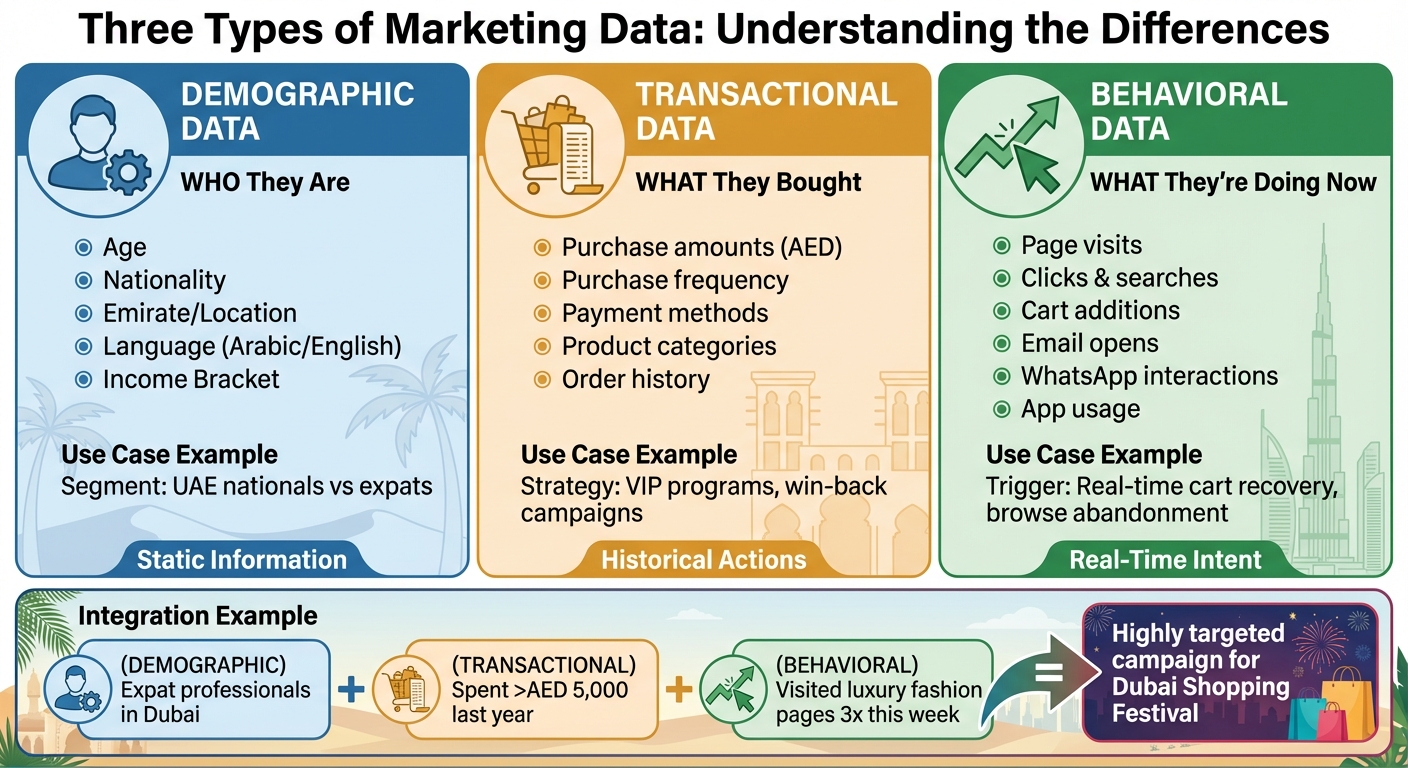
Behavioral vs Demographic vs Transactional Data in Marketing Automation
Defining Behavioural Data
Behavioural data is all about tracking what users actually do across your digital platforms. Every action - whether it’s visiting a page, clicking a button, searching for something, submitting a form, opening an email, sending a WhatsApp message, or making a purchase - creates a timestamped record of their activity. In the UAE, where mobile and WhatsApp dominate digital interactions, this data is especially insightful. For instance, mobile app events like screen views, feature usage, and push notification clicks are key indicators of user engagement. Similarly, WhatsApp behaviours, such as initiating chats or interacting with messages, are just as critical to monitor.
What’s fascinating is how seasonal trends shape this data. During Ramadan, there’s a noticeable shift towards night-time browsing and shopping, particularly around Iftar. Events like the Dubai Shopping Festival bring their own patterns, with users diving into deal-hunting, redeeming coupons, and comparing products across categories. Each interaction also contains contextual details - such as the device used, the channel of engagement, the campaign that led them there, and even their location - giving businesses a clearer picture of user behaviour.
Now, let’s see how this type of data stands apart from other forms like demographic and transactional insights.
How Behavioural Data Differs from Demographic and Transactional Data
Demographic data tells you who your audience is - details like age, nationality, emirate, preferred language (Arabic or English), and income bracket. On the other hand, transactional data focuses on what they’ve already bought, including purchase amounts (in AED), frequency, payment methods, and product categories. Behavioural data, however, captures what users are doing right now. This real-time aspect is what makes it so powerful, especially for creating timely and relevant automation.
Here’s an example: demographic data can help you divide users into broad groups, like UAE nationals versus expats. Transactional data can guide value-based strategies, such as offering VIP programmes or running win-back campaigns. But behavioural data goes a step further - it uncovers current user intent, helping predict what they might do next.
When you combine all three types, you get a multidimensional view of your customers. Imagine this: you identify expat professionals in Dubai (demographic) who spent over AED 5,000 in the past year (transactional) and recently visited luxury fashion pages three times in one week (behavioural). With this level of detail, you can create highly targeted campaigns, like exclusive early-access offers during the Dubai Shopping Festival.
This layered understanding of your audience is the foundation for creating effective automation strategies.
Common Uses in Marketing Automation
Behavioural data is the backbone of event-driven automation, enabling businesses to respond instantly to customer actions. For instance, if a user abandons their cart before completing checkout, an automated flow can send them a reminder. Similarly, browse-abandonment messages can re-engage users who frequently view pricing or product pages but don’t make a purchase. And for customers who’ve been inactive - like those who haven’t logged in or opened emails for a while - re-engagement campaigns can bring them back.
Lead scoring is another area where behavioural data shines. Actions like viewing pricing pages, requesting demos, or visiting a site repeatedly can earn users higher scores, while declining engagement can lower them. This approach ensures that sales teams focus on the most promising leads. In the UAE, where digital habits vary by time and occasion, these automated triggers can be fine-tuned to match local patterns, making campaigns even more precise.
Behavioural data also supports send-time optimisation. For example, since browsing activity in the UAE often peaks during the evening or late at night - especially during Ramadan - automation tools can schedule messages to reach users at the most engaging times, rather than relying on arbitrary schedules.
For businesses in the UAE, platforms like Wick bring these insights to life, turning behavioural data into actionable and timely automation.
Building a Behavioural Data Strategy for UAE Businesses
Connecting Business Goals to Behavioural Data
To start, align your business objectives with user actions that reflect progress. For instance, if your goal is to increase online revenue by 20%, focus on tracking behaviours like product detail page views, add-to-cart actions, and completed checkouts. Then, measure key metrics such as conversion rates, average order value (in AED), and points where users drop off in the funnel. If reducing churn is your priority - especially relevant for subscription services or loyalty programmes - monitor warning signs like fewer logins, reduced email engagement, lower session frequency, or decreased feature usage over a 30–60 day period.
Identify 3–5 primary business goals and assign 3–7 core behavioural events along with 1–2 KPIs for each. Ensure all metrics are reported in AED and can be segmented by emirate, device type, and language preference (Arabic or English). Tools like Wick can help UAE businesses formalise this mapping process within an integrated digital marketing and analytics framework, ensuring every tracked action directly supports measurable outcomes.
With your goals set, the next step is to determine the specific behavioural events that will indicate progress.
Selecting Key Behavioural Events to Track
The behavioural events you track will depend on your industry and customer journey. For retail and e-commerce, you’ll want to monitor activities such as product and category views, search queries, add-to-cart actions, wishlist additions, checkout initiations, payments, AED-valued purchases, and cart abandonment. These insights fuel automations like cart-abandonment reminders, browse-abandonment sequences, and personalised product recommendations.
In real estate, critical events include project page views, floor plan interactions, price list downloads, mortgage calculator usage, property enquiries, callback requests, WhatsApp chat initiations, site visit bookings, and unit reservations. These signals highlight buyer intent, helping sales teams prioritise leads based on repeated visits or reopened payment plan emails. For hospitality and travel, focus on tracking destination searches, date searches, room type views, package views, booking initiations, AED-valued booking completions, booking abandonment, loyalty sign-ups, special requests, and add-ons like spa or dining reservations. This data enables targeted actions such as booking-abandonment triggers, pre-arrival upsell campaigns, and loyalty engagement strategies tailored to stay frequency and total spend.
Once you’ve defined the events, the next step is to integrate data from various sources while adhering to local privacy laws.
Data Sources and Privacy Requirements
Integrating multiple data sources is essential for a complete understanding of user behaviour. Begin with web and app analytics platforms - such as GA4 or Piwik PRO - to track page views, events, funnels, and device data. Link your CRM and CDP systems to store information about leads, opportunities, email engagement, purchases, and support history. Add marketing automation platforms to capture data on email, SMS, and push notifications, including opens, clicks, unsubscribes, and workflow participation. In the UAE, WhatsApp Business API and call centre logs are particularly valuable for recording enquiries, conversation intent, and response times. Additionally, integrate POS, booking, or property management systems to connect in-store or in-stay transactions with online behaviour.
Aggregate all this data into a central warehouse, linking identifiers like login credentials, phone numbers, and email addresses to create unified customer profiles. When it comes to privacy, UAE businesses must comply with the federal Personal Data Protection Law (PDPL) and any relevant free-zone regulations. This involves clearly stating your tracking purposes, collecting explicit consent where necessary (e.g., for cookies, profiling, and marketing), and providing simple opt-out options. Maintain consent records in your CRM or automation tools, ensure workflows respect channel and language preferences, and use platforms that meet UAE regulations for data residency and approved cross-border mechanisms, especially for sensitive or financial data. Companies like Wick can assist in building a compliant, unified data infrastructure tailored to both technical and legal requirements.
Creating Behavioural Data Features for Automation
After gathering raw behavioural data - like page views, clicks, email opens, and app sessions - the next step is to transform those event logs into structured features that your marketing automation platform can work with. These features are essentially derived variables that summarise user behaviour in a way that helps trigger, segment, or personalise campaigns. This process turns a mountain of raw data into actionable insights. Let’s break down both basic and advanced feature types that can power effective automation.
Basic Behavioural Features
Start by converting raw interactions into three key metrics: recency, frequency, and engagement.
- Recency measures the time since a key user interaction, like the last website visit, WhatsApp click, email open, in-store visit (tracked through loyalty apps), or purchase. For businesses in the UAE, calculate recency in days using Gulf Standard Time (UTC+4) to ensure segments like "last 7 days" align with local working hours.
- Frequency counts how often a specific event occurs within a set time frame, such as the number of site visits, app sessions, or purchases in the past 30 or 90 days. Use rolling time windows that match local business calendars.
- Engagement combines multiple signals into a single measurement, such as average session duration or pages per session. These can be normalised into scores between 0 and 100 for easier integration into automation rules.
For example:
- A retail or e-commerce business might track cart activity recency and product view frequency to send WhatsApp reminders when a customer views an item three times without purchasing.
- A real estate portal could monitor property search recency and lead form frequency to prioritise follow-ups, like sending SMS messages when users view multiple listings in Dubai Marina within 48 hours.
- In hospitality, analysing stay frequency and engagement with seasonal offers can help create tailored staycation deals for guests who visited twice in the past year but haven’t booked in 120 days.
- Financial services can track app login frequency and product page clicks to deliver timely nudges for credit cards or Sharia-compliant solutions when interest is shown but no action is taken.
Advanced Behavioural Features
Advanced features go beyond simple metrics to predict future actions or preferences. These include propensity scores, channel affinity, and other predictive measures.
- Propensity scores estimate the likelihood (on a scale from 0 to 1) that a user will take a specific action, like making a purchase, upgrading a plan, or churning. Unlike basic features that summarise past behaviour, these scores forecast what’s next, helping you prioritise offers or sales efforts.
- Channel affinity identifies the most effective communication channel - email, SMS, WhatsApp, push notifications, or in-app messages - by analysing open, click, and response rates. This approach ranks channels based on their performance for each user.
For UAE businesses, other advanced features might include price sensitivity indices, category preferences, or churn risk scores for subscription products.
To create propensity scores:
- Define the outcome you want to predict (e.g., a purchase within 30 days, subscription renewal, or hotel booking).
- Select behavioural predictors like recency, frequency, engagement metrics, average AED basket size, device type, and key actions such as adding items to a cart or submitting property enquiries.
- Train a model using historical data and methods like logistic regression or gradient boosting. Assign each user a score between 0 and 1, segmenting them into high (≥0.7), medium (0.3–0.7), and low (<0.3) propensity groups.
- Sync these scores daily with your automation tools to prioritise high-propensity leads, customise offers, and allocate paid channels efficiently. Adjust models regularly to account for seasonal shifts, like Ramadan, Eid, or year-end travel peaks.
For channel affinity, track performance metrics like opens, clicks, replies, and conversions for each channel. Normalise these metrics to account for varying send volumes and compute an affinity score for each user. Refresh these scores regularly - especially during high-activity periods like the Dubai Shopping Festival or Ramadan. Use these insights to:
- Deliver time-sensitive offers (e.g., limited AED discounts) through the most effective channel.
- Use secondary channels as backups for unresponsive users.
- Run A/B tests comparing WhatsApp and SMS to refine strategies.
Feature Engineering Process
With both basic and advanced features defined, the next step is turning raw data into structured insights. A solid feature engineering workflow includes:
- Defining use cases: Start with clear goals, like cart abandonment flows, win-back campaigns, or lead scoring.
- Standardising data: Organise raw event logs into a consistent format that includes event name, user ID, timestamps in Gulf Standard Time, and metadata like product details, AED amounts, and locations.
- Aggregating data: Summarise events over time windows (daily or weekly) to create metrics like session counts, total AED spent, last purchase date, or email clicks in the past 30 days. Derive higher-level features like recency, frequency, average order value, engagement scores, propensity scores, and channel affinity.
Validate your features by:
- Spot-checking sample data.
- Comparing aggregate distributions to expectations.
- Ensuring there are no errors like negative counts or future dates.
Finally, document features in a data dictionary, sync them with your marketing automation platform via APIs or native connectors, and test them in pilot campaigns before scaling up.
Wick helps UAE businesses design effective behavioural feature sets and integrate them into automation systems to support sustainable growth.
sbb-itb-058f46d
Integrating Behavioural Features Into Marketing Automation
Once you've developed and validated your behavioural features, the next step is connecting them to your marketing automation platform. This allows you to use insights like recency, frequency, engagement, propensity, and channel preferences to segment audiences, trigger workflows, and personalise messages. The aim is to shift from static, calendar-driven campaigns to dynamic, behaviour-responsive journeys that adapt to each customer’s actions. This integration transforms raw data into actionable insights, paving the way for campaigns that are both segmented and trigger-based.
Segmenting Audiences with Behavioural Features
Start by defining clear segment objectives that align with your business goals. For example:
- High-value VIPs could be customers in the top 10–20% revenue bracket over the past 6–12 months, showing frequent purchases and recent activity.
- At-risk or churn segments might include users who haven’t logged in for 60–90 days, show declining app engagement, or no longer open emails.
- New leads could be those who recently submitted an enquiry or visited your pricing page multiple times but haven’t yet converted.
Each segment should be tied to specific behavioural signals. For instance, "high-intent prospects" could be users who visited the pricing page twice within seven days without submitting an enquiry. Similarly, an "inactive customer" segment might target users with no activity for 60 days, adjusted for your industry - longer for sectors like real estate, shorter for fast-moving ones like food delivery. Use real-time tracking of events such as view_product, add_to_cart, start_checkout, and contact_form_submitted across platforms like your website, app, email, and WhatsApp.
For businesses in the UAE, seasonality plays a key role. Adjust segmentation timeframes to account for local shopping trends during Ramadan, Eid, the Dubai Shopping Festival, and back-to-school periods. For example, a "dormant" threshold that works in January might need tweaking for March when consumer activity increases. This ensures segmentation aligns with both broader business goals and the unique buying patterns of the region.
Setting Up Event-Driven Triggers and Lead Scoring
Event-driven workflows allow you to automatically respond to specific user actions. For example, an abandoned cart workflow might send reminders with incentives like instalment plans or free shipping, tailored to local preferences and always including delivery and return details in AED.
- Browse abandonment workflows can trigger when someone views the same villa listing or electronics page three times in seven days without enquiring. Follow up with tailored content, a personalised video tour, or an invitation for a direct callback.
- Price-drop alerts notify users when an item they’re watching drops in price. These alerts can be sent via email, SMS, or WhatsApp in their preferred language, ensuring engagement at the right moment.
For lead scoring, assign points based on user actions. Positive points might go to behaviours like downloading a pricing guide, visiting the pricing page twice, or booking a showroom visit. Deduct points for activities like bounces, unsubscribes, or long periods of inactivity. Combine these behavioural signals with demographic factors - such as company size, emirate, or industry - to create a composite score. A "sales-ready" lead might score 70 points or higher, triggering a CRM task for the sales team, while leads scoring 30–69 remain in nurture sequences. Regularly review win-loss data (e.g., every 30–60 days) to adjust scoring criteria, ensuring they reflect actual revenue outcomes rather than assumptions.
Personalising Content and Timing
Behavioural data helps you customise not just what you say, but when and how you say it. Dynamic content can adapt based on user behaviour and lifecycle stage. For instance, an email to someone frequently browsing SUV pages might feature SUV promotions and financing options, while someone focused on apartments might receive property investment content. Recommendation engines can also suggest complementary items - like accessories for electronics, home décor for furniture, or add-on services like extended warranties - based on past clicks and purchases.
Send-time optimisation uses historical engagement data to determine the best times to reach each contact. Start by testing broader cohorts - weekdays versus weekends, mornings versus evenings - and then refine to individual-level models as your data grows. In the UAE, consider the local workweek (Monday–Friday), higher B2C engagement during evenings and weekends, and Ramadan-specific shifts, where late-night and pre-iftar windows often perform better. Ensure your automation system respects Gulf Standard Time and avoids sending non-essential promotions during major religious or public holidays.
Store language preferences (e.g., Arabic or English) as profile fields, and use this data to tailor all communications - whether email, SMS, or landing pages - in the preferred language. For example, behavioural signals can help segment local versus expat audiences, allowing you to adjust messaging tone, holidays referenced, and examples (e.g., AED prices, local landmarks, or UAE-specific delivery options).
Track key metrics like segment-level conversion rates, revenue per recipient, cart recovery rates, time-to-purchase after a trigger, and lead-to-opportunity rates by score band. At the workflow level, monitor trigger volume, email open and click-through rates, SMS and WhatsApp engagement, unsubscribe rates, and incremental lift compared to control groups. Real-time dashboards can help identify issues - like drop-offs at a specific checkout step - so you can quickly address UX problems or adjust your messaging. By maintaining consistency across platforms like your website, email, and paid media, you can ensure these dynamic experiences drive meaningful growth.
Maintaining Data Quality and Compliance
According to Gartner, poor data quality costs organisations a staggering USD 12.9 million annually, impacting productivity, compliance, and revenue. For businesses in the UAE, this highlights the importance of developing clear processes to monitor data consistency, resolve identity issues, manage privacy, and track performance. These measures ensure that automation delivers results while protecting against regulatory or reputational risks. After successfully integrating behavioural features into marketing automation, maintaining high data standards and compliance becomes essential for long-term success in the UAE market.
Ensuring Data Quality and Cross-Device Tracking
Accurate behavioural data starts with consistent event tracking across all platforms - be it your website, mobile app, email, WhatsApp, or offline touchpoints. To achieve this, create a unified tracking specification that defines event names, required properties (like AED currency, product IDs, or campaign sources), and naming conventions. Make it mandatory for all platforms to follow this standard. Assign a data owner, often from marketing operations or analytics, to oversee schema updates, quality checks, and access controls, while specialists for each channel ensure proper implementation.
Daily checks are crucial for validating event volumes and ensuring mandatory fields are correctly formatted. Compare key events across your analytics and automation platforms, and test core user journeys monthly - tracking the path from new visitor to lead, then lead to MQL (Marketing Qualified Lead), and finally to customer - on various devices. Automated alerts can flag unexpected drops in key event volumes, like a decline in checkout_started events, to quickly identify and address issues such as broken tags or website errors. Offline interactions should also be mapped to corresponding digital events for a complete picture.
Cross-device identity resolution is equally important, especially since more than 60% of online shoppers begin their purchase on one device and finish on another. Use deterministic matching methods, such as customer IDs, hashed emails, or UAE mobile numbers, to consolidate data into a single, central profile. A Customer Data Platform (CDP) is invaluable here, as it can maintain a unique customer ID and merge identifiers from various sources, creating an accurate, unified view of user behaviour across devices. Tools like Wick assist UAE businesses in building these systems for precise cross-device tracking and actionable insights.
Meeting UAE Privacy and Compliance Standards
In the UAE, behavioural tracking falls under Federal Decree-Law No. 45 of 2021 on the Protection of Personal Data (PDPL), the nation’s first comprehensive federal data protection law. The PDPL is based on consent, requiring clear and affirmative user actions for most marketing-related data uses. It also mandates transparent privacy notices and straightforward opt-out options. For businesses, this means tracking must have a specific purpose - like personalising offers or fraud prevention - while collecting only necessary data and steering clear of sensitive categories unless absolutely required and legally justified.
Implement a Consent Management Platform (CMP) with bilingual notices that explain data collection and usage, offering granular opt-in options. Include separate toggles for popular UAE communication channels such as email, SMS, and WhatsApp. Store consent preferences as attributes tied to customer profiles, ensuring every automation workflow respects these preferences. For lead forms and signups, use explicit opt-in language and avoid pre-ticked boxes. Record timestamps and sources for each consent to maintain compliance.
When using SMS or voice marketing, adhere to UAE telecom regulations, including TRA/TDRA rules and policies from Etisalat and du. These rules require opt-in consent, sender ID registration, and opt-out options via reply keywords. Avoid sending bulk messages without prior consent, particularly during culturally sensitive times such as Ramadan or public holidays, unless users have explicitly opted in and the content is appropriate.
Before launching new features or campaigns - like cart recovery emails or in-mall beacon promotions - conduct a brief privacy impact review. This review should address what data is collected, its necessity, storage duration, access permissions, and potential risks in case of misuse. Opt for the least intrusive methods that still meet business objectives, such as using aggregated analytics instead of individual-level data or applying shorter lookback windows for behavioural segments. Pseudonymise identifiers and limit access to raw data to essential personnel only. Train marketing teams and agency partners on local privacy expectations to avoid conflicts with UAE norms, especially when integrating with third-party systems like mall Wi-Fi or loyalty programmes.
Monitoring Performance and Making Adjustments
To keep up with changing user behaviour, market trends, and seasonality, behavioural models and automation systems need regular reviews - typically every quarter. Evaluate technical metrics like precision, recall, and calibration alongside business KPIs such as conversion rates, average order value in AED, and acquisition costs.
Create shared dashboards to monitor three key areas: data health, automation activity, and business outcomes. For data health, track daily event volumes, error rates in API jobs, and identity match rates. For automation, monitor metrics like message sends, open and click rates, unsubscribe rates, and the delay between trigger events and message delivery. For business outcomes, measure revenue in AED from automated journeys, lead-to-opportunity conversion rates, and audience-specific retention metrics. Set up alerts for unusual patterns, such as a sudden drop in events from a key channel or a spike in opt-outs.
Incorporate seasonal patterns specific to the UAE, such as Ramadan, Eid, back-to-school shopping, the Dubai Shopping Festival, or holiday tourism peaks. Label historical data to understand how behaviour shifts during these periods. Adjust automation rules and content accordingly - for instance, altering send times during Ramadan, highlighting relevant product categories, or tweaking messaging tone. Retrain or recalibrate models every 6–12 months or after major disruptions like regulatory changes or economic shifts. Use champion–challenger testing to trial new models or rule sets on a small subset of traffic before rolling them out fully.
Establish a cross-functional steering group - comprising marketing, IT, legal, and sales teams - to review tracking changes and emerging risks on a monthly basis. Marketing defines use cases and behavioural needs, IT ensures secure implementation, legal confirms compliance, and sales provides feedback on lead quality and scoring. Tools like Wick can assist in designing monitoring frameworks, integrating data from multiple sources (web, CRM, POS, media), and running audits to ensure alignment with UAE-specific benchmarks and compliance requirements.
Conclusion
Behavioural data takes marketing automation to the next level, transforming it from a simple broadcasting tool into a real-time, personalised engine. By tracking actions like page visits, cart activity, email engagement, and feature usage, businesses in the UAE can send timely messages, create dynamic audience segments, and refine customer journeys on the spot. This shift - from relying on static demographic information to focusing on real-time behavioural signals - leads to stronger engagement, better customer retention, and improved returns on marketing investments.
To make the most of this, businesses need a clear strategy that connects their goals to specific customer behaviours, ensures data quality across platforms, and respects local privacy standards. Start with impactful automations such as cart recovery emails, follow-ups for browsing activity, and reactivation campaigns. As your data matures, you can incorporate predictive scoring to refine your efforts. Regular monitoring and adapting to seasonal trends will keep your strategy in sync with the preferences and habits of UAE customers.
Wick's Four Pillar Framework offers an integrated solution, connecting everything from data collection to intelligent automation. Their services include CDP implementation, audience segmentation, marketing automation, and AI-powered personalisation. This unified system not only simplifies operations but also drives measurable growth. By integrating tracking, insights, and action, businesses can create a seamless and efficient digital ecosystem.
Think of behavioural data as a key growth driver, not just an add-on. Assign clear ownership of the process, start with a few high-value automation flows, and establish a feedback loop where insights continuously improve your customer journeys and content strategies. According to McKinsey research, companies excelling at personalisation through behavioural data generate 40% more revenue from those activities compared to their competitors.
The message is clear: behavioural data is an essential tool for UAE businesses looking to move beyond generic campaigns. With the right strategy, technology, and partners like Wick, you can meet customer expectations for relevance and efficiency while building long-term growth. By embracing behavioural data, your marketing automation can become a powerful competitive advantage, driving both engagement and sustainable success in the UAE market.
FAQs
What makes behavioural data unique compared to demographic and transactional data in marketing automation?
Behavioural data is unique because it captures real-time actions and engagement patterns, shedding light on customer preferences and intent. While demographic data focuses on fixed attributes like age or location, and transactional data examines past purchases, behavioural data offers a dynamic perspective on how customers actively engage with your brand.
When businesses incorporate behavioural data into their marketing automation efforts, they can craft more tailored and timely campaigns, improving customer interactions and achieving stronger outcomes.
How does behavioural data improve marketing campaigns tailored for the UAE?
Behavioural data plays a key role in crafting tailored marketing campaigns by examining customer actions and preferences. This ensures the content strikes a chord with audiences in the UAE, reflecting their unique tastes and expectations. It enables businesses to better segment their audiences, deliver messages that resonate locally, and engage more effectively through timely, meaningful interactions.
By tapping into these behavioural insights, companies can boost conversion rates, strengthen customer loyalty, and get the most out of their marketing budgets. This strategy ensures campaigns align with local preferences, helping brands build stronger connections with the UAE audience.
How can businesses in the UAE stay compliant with PDPL when using behavioural data?
To align with the UAE's Personal Data Protection Law (PDPL) when handling behavioural data, businesses must prioritise obtaining clear and explicit consent from customers before collecting or processing their information. Additionally, customers should always have the ability to manage or delete their personal data whenever they choose.
Data security is a must, requiring companies to store information safely and maintain transparent policies about how this data is used. Appointing a Data Protection Officer (DPO) is another key step, alongside conducting regular reviews of compliance practices and updating policies to meet the latest legal standards. These measures not only ensure adherence to the law but also help build trust with customers.