
Blog / How Behavioral Data Shapes Content Strategies
How Behavioral Data Shapes Content Strategies
Behavioral data is transforming how businesses in the UAE create content strategies. By analyzing actions like clicks, scrolls, and time spent on pages, companies can better understand what their customers want. In a market where 80% of consumers expect personalized experiences and 96% use smartphones, using this data is no longer optional - it's essential for staying competitive.
Key takeaways:
- Behavioral data reveals what customers do, not just who they are.
- Metrics like time on page, WhatsApp enquiries, and repeat visits help refine content.
- UAE campaigns using first-party data, like Maggi's Ramadan campaign, have seen results like a 118% increase in click-through rates.
- Tools like Google Analytics 4, Mixpanel, and Contentsquare make segmentation and personalization easier.
For UAE businesses, leveraging this data means delivering relevant content at the right time, boosting engagement, and driving revenue growth by up to 2.9 times.
What is Behavioral Data?
Key Behavioural Metrics for Content Strategies
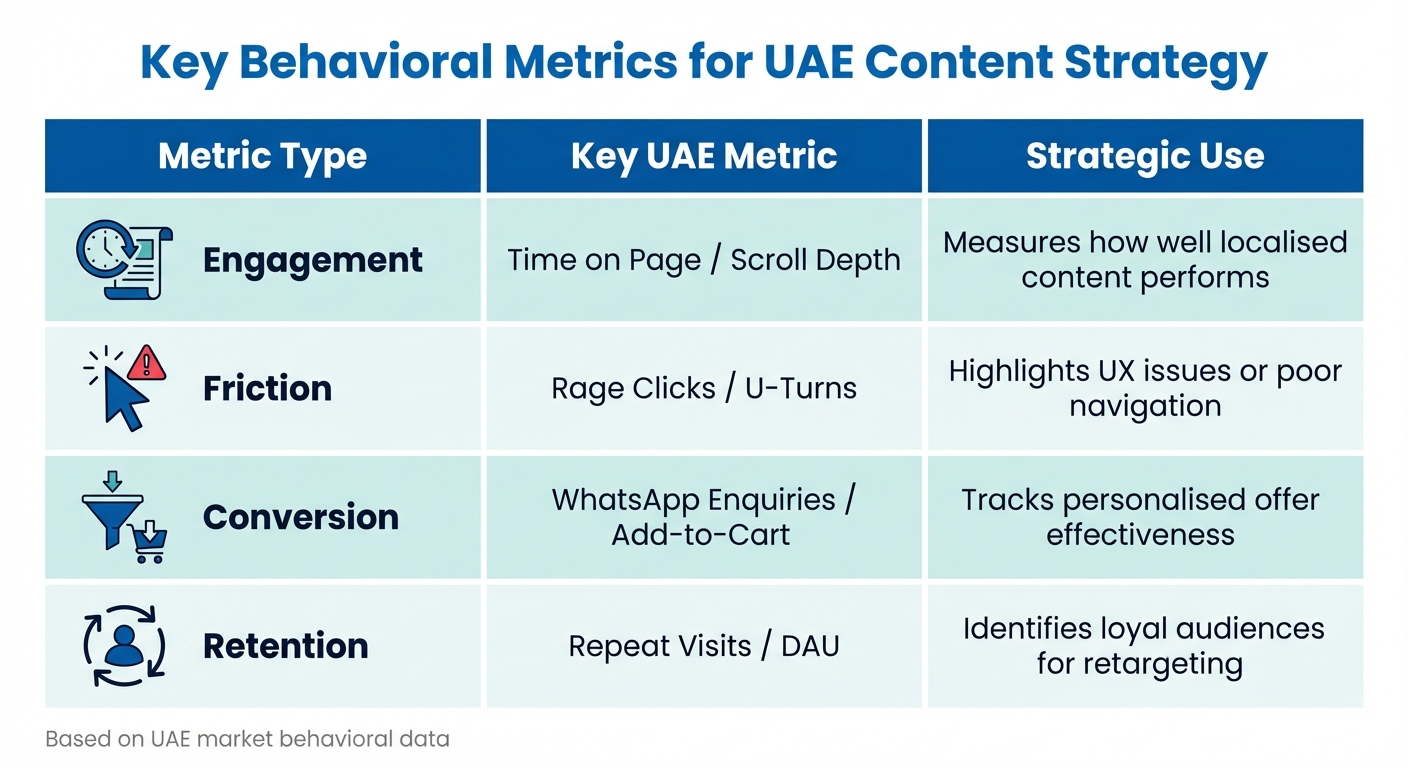
Key Behavioral Metrics for UAE Content Strategy
Tracking the right metrics turns guesswork into actionable insight. For businesses, especially in the UAE, understanding how users interact with content across different devices and platforms is crucial. These behavioural metrics provide the groundwork for creating content that truly connects with the local audience.
Engagement Metrics
Metrics like time on page, scroll depth, and click-through rates reveal whether your content is holding attention. They help determine if your message aligns with user expectations. In the UAE, platform-specific engagement plays a big role. For example, tracking Instagram Story exits, TikTok watch-through rates, and YouTube average view duration can show where your audience loses interest. Scroll maps are another useful tool - they highlight whether users are reaching your call-to-action buttons or leaving the page too soon. If most visitors stop scrolling halfway, consider moving critical elements higher up on the page.
Conversion-Related Behaviours
Engagement metrics are just the beginning - conversion behaviours provide deeper insights into your content's effectiveness. While sales data is important, it doesn't tell the whole story. In the UAE, WhatsApp enquiries are a strong indicator of high purchase intent and should be tracked as a key conversion metric. Other actions like form submissions, product views, add-to-cart rates, or even smaller steps such as watching a demo or completing an onboarding sequence also hold valuable clues. These "micro-conversions" can pinpoint where potential customers drop off in the funnel. With 71% of UAE consumers integrating digital tools into their shopping habits, understanding these behaviours allows for precisely timed, targeted campaigns.
Repeat and Return Visits
Repeat visits and daily active users (DAU) are key indicators of how "sticky" your content is. They can also help identify loyal customer segments for retargeting. Loyalty, however, isn't just about transactions. Non-transactional actions, such as writing reviews, linking loyalty accounts to online profiles, or revisiting specific pages, are equally important. Given that 95% of UAE consumers recently adjusted their shopping behaviours, tracking these patterns helps separate truly engaged users from casual browsers.
At the same time, keep an eye on negative behavioural signals like "rage clicks" (repeatedly clicking on non-responsive elements) and "u-turns" (quickly returning to a previous page). These behaviours often point to user experience issues or confusing navigation. Identifying and addressing these friction points can prevent them from derailing conversions.
| Metric Type | Key UAE Metric | Strategic Use |
|---|---|---|
| Engagement | Time on Page / Scroll Depth | Measures how well localised content performs |
| Friction | Rage Clicks / U-Turns | Highlights UX issues or poor navigation |
| Conversion | WhatsApp Enquiries / Add-to-Cart | Tracks personalised offer effectiveness |
| Retention | Repeat Visits / DAU | Identifies loyal audiences for retargeting |
Segmenting Audiences Using Behavioural Data
Benefits of Behavioural Segmentation
Behavioural segmentation moves beyond basic demographics like age or location by focusing on actions such as product views, sign-ups, cart additions, and downloads. Instead of guessing user intent based on general traits, it examines real behaviours. This method provides real-time insights into what users want, allowing businesses to respond quickly with targeted strategies. In the UAE, where 71% of consumers expect personalised experiences, tailoring interactions to individual behaviours is becoming a necessity. By distinguishing between casual browsers and serious buyers, businesses can prioritise resources on the most valuable segments. According to research, data-driven organisations are three times more likely to improve their business processes, highlighting the competitive edge gained through behavioural insights.
Examples of Behavioural Segments
The advantages of behavioural segmentation come to life through actionable user groups, each requiring unique approaches:
- Frequent Browsers: These users visit often but rarely convert. Retargeting ads and "pick up where you left off" messages work well here.
- Abandoned Cart Users: A timely email reminder, possibly with a small discount, can nudge these users toward completing their purchase.
- High-Engagement Readers: Users who spend a lot of time on blogs or articles are great candidates for newsletter sign-ups or exclusive eBooks.
- Super Users: Frequent buyers or active product users should be rewarded with VIP loyalty programmes or early-access events.
- Lapsed Customers: Re-engage these once-regular visitors with "We miss you" campaigns or special win-back offers.
A compelling example comes from DPG Media, which in 2022 used journey analysis to identify users who interacted with subscription ads versus those who didn’t. By repositioning subscription call-to-actions for the right audience, they achieved a 6.6% increase in newspaper subscriptions and a 7% boost in revenue.
Tools for Behavioural Segmentation
A variety of tools make behavioural segmentation more effective:
- Contentsquare: Offers heatmaps, session replays, and journey analysis to identify friction points in the user experience.
- Mixpanel and Heap: Track user interactions to visualise groups such as "power users" or "frequent buyers."
- Marketo and HubSpot: Enable list segmentation based on content downloads, email engagement, and lead scores.
- Google Analytics 4: Features predictive segments like "likely 7-day churning purchasers" or "predicted 28-day top spenders".
For example, South Korea's recruitment platform JOBKOREA used Braze to create dynamic user segments based on behaviour and custom attributes. By applying personalisation and A/B testing, they achieved a 4-5X increase in average click-through rates.
Integrating these tools with advanced data analytics ensures businesses can act on insights in real time. Platforms like Wick's data analytics services make this possible by analysing behavioural data to create dynamic audience groups, enabling precise and tailored content delivery.
sbb-itb-058f46d
Aligning Behavioural Insights with Content Delivery
To make the most of behavioural metrics and segmentation strategies, it’s crucial to align insights with how content is delivered. This ensures your audience gets the right message at the right time.
Creating Behaviour-to-Content Mapping Matrices
A behaviour-to-content matrix connects audience segments to the four key stages of the customer journey: Awareness, Consideration, Decision, and Retention. For example, first-time visitors in the Awareness stage benefit from educational content, while repeat visitors who abandoned their carts during the Decision stage may respond better to reassurance or incentives.
This matrix is built using data points like geographic location, device type, search keywords, visit frequency, and historical purchase data. For instance, tailoring experiences based on a user’s location can double conversion rates. Start by focusing on your top three audience segments or most impactful keywords, and use the matrix to identify gaps in your content that might disrupt the customer journey.
Modern personalisation methods break content into smaller, flexible components - such as text, images, and assets - that AI can assemble in real-time to create tailored experiences. Personalisation software enables businesses to set up rules using "AND" and "OR" logic, defining which behaviours trigger specific content variations. For example, VWO targeted Indian visitors with a customised "We're hiring" message to attract applicants for their New Delhi office, demonstrating how behavioural campaigns can drive specific outcomes.
Automating Content Personalisation
Automation tools analyse real-time data - like cart abandonment signals, location, and in-session activity - to deliver timely, relevant content. A standout feature, "open-time" personalisation, updates email content the moment it’s opened, increasing its relevance and impact. With no-code editors, marketing teams can easily deploy dynamic content without needing IT assistance.
Cross-channel orchestration takes this a step further by syncing automation with CRM, CDP, and analytics systems. This ensures a consistent experience across platforms such as websites, mobile apps, emails, and in-app interactions. Campaigns based on behavioural segmentation have been shown to increase conversions by 10–30% and generate similar revenue boosts, with 80% of consumers gravitating towards brands that offer personalised experiences.
Wick’s Four Pillar Framework enhances automation by integrating AI-driven personalisation with data analytics. For example, its Capture & Store pillar helps businesses set up behavioural triggers - like onboarding reminders or personalised homepage carousels. Real-time data continuously refines these customer journeys. Start small by personalising key touchpoints such as your homepage, product recommendations, or email newsletters.
This dynamic, data-driven approach not only enhances personalisation but also feeds into broader strategies for content optimisation.
Optimising Content Strategies with Behavioural Feedback
To keep content relevant and engaging, personalisation and automation rely heavily on continuous feedback. This ongoing cycle of gathering insights and taking action forms the backbone of effective feedback mechanisms.
Establishing Feedback Loops
A feedback loop is all about improvement - tracking how content performs and how customers interact with it, then using that data to enhance their experience. Real-time analytics play a key role here, helping you spot trends and make quick adjustments. For example, if you notice a high bounce rate on a landing page, it’s worth investigating whether the issue lies in slow loading times, unappealing messaging, or poor mobile optimisation.
Friction points like rage clicks, missed CTAs, or high bounce rates can signal user experience (UX) problems. Tools such as heatmaps and session replays help identify these issues, while broader patterns - like traffic sources and page views - can be tracked using web analytics platforms.
Mapping the user journey is another way to target key touchpoints for feedback. Techniques like pulse surveys can gather insights at critical stages. A/B testing brings these insights to life by testing different variations of headlines, layouts, or CTAs to see what resonates best. Social listening tools can also help monitor conversations about your brand, spotlighting emerging topics or the language your audience uses. Instead of discarding underperforming evergreen content, regularly reviewing performance data can guide updates to make it more relevant.
Combining Quantitative and Qualitative Insights
Feedback loops become even more effective when you combine quantitative data (like clicks, time on page, and bounce rates) with qualitative insights (such as user surveys or interviews). Quantitative data shows what’s happening, while qualitative data explains why. For example, if metrics reveal users are abandoning their carts at checkout, qualitative feedback might uncover issues like hidden fees or a confusing payment process.
"Data-driven decision-making organisations are three times more likely to report improvements in their processes." – Google
Surveys, interviews, and social listening are great ways to collect qualitative insights. These insights can then be validated against quantitative metrics like click-through rates or session durations. Advanced AI tools can process massive amounts of qualitative data - like customer comments - in real time, matching the speed of quantitative analysis. To ensure your efforts are focused, calculate Customer Lifetime Value (CLV) to prioritise high-value segments and analyse the content touchpoints they interact with most.
Conclusion
Behavioural data has become a cornerstone of the UAE market, driven by a growing consumer appetite for personalised experiences. Companies that leverage first-party data in their marketing strategies can see a revenue increase of 1.5X to 2.9X compared to those that don't.
This trend is reshaping business priorities, putting data audits and tailored content delivery at the forefront. Start by conducting a data audit and mapping the user journey to identify where drop-offs occur. Then, use behavioural insights to create audience segments that align with real customer needs. Campaigns that have embraced this method have shown measurable success, with notable boosts in registrations and click-through rates.
"Eighty per cent of consumers in the United Arab Emirates (UAE) expect companies to understand their unique needs and expectations." – Hanibal Ahwash and Chantal Azzi, Google MENA
Equally important is a commitment to data privacy. In a market where 55% of consumers believe that protecting their data builds trust in a brand, transparency in how data is collected and used is critical for maintaining credibility. By combining hard metrics with qualitative insights, businesses can uncover not just what their customers do, but the reasons behind their actions.
Looking ahead, UAE companies can adopt integrated frameworks to drive sustainable growth. Wick's Four Pillar Framework, which merges data analytics, AI-driven personalisation, and marketing automation, offers a structured approach to building a cohesive digital strategy. With internet penetration exceeding 99% and mobile usage at an impressive 170%, the UAE offers enormous potential for brands that use behavioural data both effectively and responsibly. From tracking initial metrics to refining strategies with automated personalisation, behavioural insights are the foundation for a future-ready content strategy in this fast-evolving market.
FAQs
How can businesses in the UAE use behavioural data to create better content strategies?
Businesses in the UAE have a powerful tool at their disposal: behavioural data. By diving into how audiences interact with digital platforms - like tracking website visits, social media activity, and purchasing habits - companies can create content that feels personal and aligns with local tastes and traditions.
Take Ramadan or UAE National Day, for example. These key moments in the year offer businesses the chance to design campaigns that are not only timely but also deeply relevant to their audience. By understanding how consumer behaviour shifts during these periods, brands can connect on a more meaningful level.
Another important aspect? Using first-party data. This approach allows businesses to personalise their messaging while respecting privacy concerns. With the UAE's rich and diverse population, this kind of tailored communication can make all the difference in standing out.
By embracing data-driven content strategies, companies can boost engagement, strengthen customer loyalty, and stay ahead in the ever-changing digital world.
What behavioural metrics should businesses in the UAE track to optimise content strategies?
To refine content strategies in the UAE, businesses should pay close attention to key behavioural metrics that reveal how audiences engage with their content and what they prefer. These metrics include:
- Bounce rate: Indicates how frequently users exit your website after viewing just one page, helping identify areas for improvement.
- Click-through rate (CTR): Tracks how often users interact with links, such as calls-to-action or featured content, giving insight into what grabs their attention.
- Time on page: Measures how long visitors stay on specific pages, showing which content holds their interest.
- Engagement with personalised content: Examines how users interact with tailored recommendations or dynamic features, providing clues about what resonates.
It’s also crucial to segment your audience based on demographics, behaviours, and preferences. This approach allows you to deliver content that aligns with their specific interests and needs. By analysing these metrics and tailoring content, businesses can craft data-driven strategies that better connect with the UAE audience.
How does behavioural segmentation improve personalised marketing for UAE audiences?
Behavioural segmentation plays a key role in enhancing personalised marketing for audiences in the UAE by focusing on actions like browsing habits, purchase trends, and interaction preferences. By delving into these patterns, businesses can design customised content and offers that resonate with individual customer needs, making their messaging more relevant and engaging.
Given the UAE's rich cultural diversity and deep-rooted traditions, this strategy becomes especially powerful during important occasions like Ramadan or UAE National Day. With the help of first-party data, brands can create personalised experiences that honour local customs and values. This not only strengthens customer loyalty but also drives deeper engagement in a market as distinctive as the UAE.