
Blog / Arabic SEO Competitor Audit: Step-by-Step Guide
Arabic SEO Competitor Audit: Step-by-Step Guide
Arabic SEO competitor audits help you understand why certain websites rank higher in search engines, focusing on technical factors like mobile responsiveness, RTL compatibility, and hreflang tags. In the UAE, where over 85% of searches are mobile, and Google holds a 96% market share, these audits are crucial for improving visibility in competitive markets like Dubai and Abu Dhabi.
Key Takeaways:
- Identify Competitors: Use tools like Google Search Console, Ahrefs, and SEMrush to find competitors dominating Arabic keywords in the UAE. Focus on those with high keyword overlap and UAE-specific targeting.
- Technical SEO Analysis: Evaluate site speed, crawlability, hreflang tags, and mobile responsiveness. Tools like Screaming Frog and PageSpeed Insights can simplify this process.
- Content Strategy: Examine how competitors localize Arabic content, target keywords, and structure pages for user intent. Look for gaps in your strategy compared to theirs.
- Action Plan: Organize findings, prioritize fixes, and focus on high-impact areas like filling Arabic keyword gaps, improving mobile performance, and optimizing for local search.
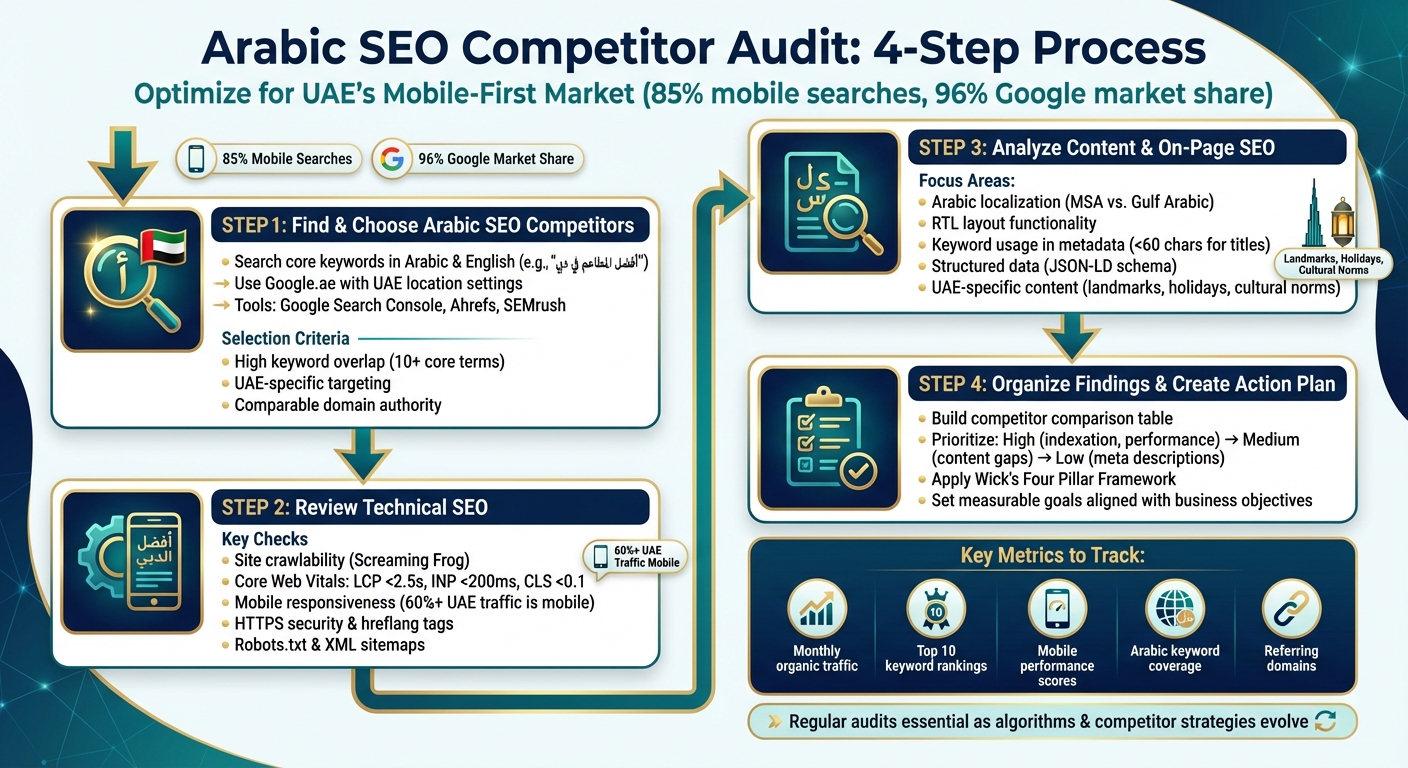
Arabic SEO Competitor Audit 4-Step Process for UAE Markets
Step 1: Find and Choose Arabic SEO Competitors
Your SEO competitors might not always align with your direct business rivals. Websites that dominate top-ranking Arabic keywords often include industry publications, blogs, or e-commerce platforms, which may not directly compete with your business. As Louis Pretorius, Brand Marketing and Creative Consultant, points out:
"Don't confuse traditional competitors with SEO competitors. Just because a brand is your biggest competitor in sales or market share doesn't mean they outrank you in Google".
To identify these competitors, search for core keywords in both English and Arabic - examples include "best restaurants in Dubai" and "أفضل المطاعم في دبي" - to engage with a wider UAE audience. Use Google.ae with UAE-specific location settings, or a VPN if you're outside the region, to see which websites consistently appear in top rankings and featured snippets. Once you have a list, the next step is to leverage tools to refine your findings.
Tools for Finding Competitors
Several tools can simplify the process of identifying SEO competitors. Start with Google Search Console. By reviewing the "Performance" tab, you can see which pages are outranking yours for important Arabic keywords. For more advanced insights, platforms like Ahrefs and SEMrush are excellent choices.
Ahrefs offers an "Organic Competitors" report, and entering your primary Arabic keywords into its Keywords Explorer reveals the "Traffic share by domain", helping you identify dominant sites. As Si Quan Ong, Content Marketer at Ahrefs, explains:
"Your SEO competitors are the websites competing for your desired target keywords in organic search. These may not be the same as your direct business competitors".
SEMrush, on the other hand, provides a "Domain Overview" that highlights competitors using both organic and paid Arabic keywords. If you're working with a smaller budget, Ubersuggest is a more affordable option for uncovering key competitors. For local businesses, UAE-specific directories like Yellow Pages UAE or resources from the Dubai Chamber can help identify regional competitors that might not show up in standard SEO tools.
How to Select the Right Competitors
Once you've identified potential competitors, it's time to narrow the list. Focus on those with a high keyword overlap - websites that rank for 10 or more of your core Arabic terms. Geographic relevance is also critical, so prioritise competitors targeting the UAE specifically. Additionally, compare their domain authority to your own to ensure you're benchmarking against comparable sites.
Pay attention to their multilingual strategies. The most successful UAE competitors optimise for both Arabic and English keywords to appeal to a diverse audience. Watch for emerging competitors who may be targeting untapped niches or employing creative strategies. Tools like SEMrush's "Keyword Gap" feature, particularly its "Missing" filter, can help you spot high-value keywords your competitors rank for but you don't.
sbb-itb-058f46d
Step 2: Review Competitors' Technical SEO
After selecting your competitors, it's time to dig into their technical SEO. This step reveals the structural elements that influence their rankings in Arabic SEO. As Louis Pretorius from Competitor SEO Analysis UAE explains:
"Technical SEO isn't glamorous, but it's the backbone of your online presence. It's what determines how well search engines can crawl, index, and rank your site".
Start by running a site crawl using tools like Screaming Frog, Ahrefs Site Audit, or Semrush. These tools help identify issues such as broken links, missing meta tags, and duplicate content. Don’t skip checking their robots.txt file (located at domain.com/robots.txt) to see if they’re unintentionally blocking important pages or if they’ve correctly indicated their sitemap location.
Use the site: search operator (e.g., site:competitor.ae) to cross-check indexed pages with the crawl results. Examine their XML sitemaps for errors like "noindex" pages, 404s, or duplicate URLs that could waste crawl budget. For Arabic sites with English versions, ensure their hreflang tags in the <head> section are properly set up to serve the right language version to UAE users.
Crawlability and Indexing
Make sure that important Arabic content is easily accessible - ideally within three clicks from the homepage - and avoid orphan pages, which are harder to rank. Check meta robots and canonical tags to ensure competitors aren’t using "noindex" directives on valuable pages or creating duplicate content through incorrect canonicalisation.
Review HTTP status codes across their site. Pages should return a 200 status code. Any 4xx or 5xx errors present opportunities to outperform them by offering a better user experience. For sites that rely heavily on JavaScript, tools like Google's Mobile-Friendly Test or URL Inspection can confirm whether Arabic content is rendering correctly for search engines.
Once you’ve assessed crawlability, move on to performance metrics like Core Web Vitals to evaluate their site speed and responsiveness.
Core Web Vitals and Page Speed
Core Web Vitals provide insights into loading speed, responsiveness, and visual stability. Google focuses on three key metrics: Largest Contentful Paint (LCP) for loading speed (under 2.5 seconds is ideal), Interaction to Next Paint (INP) for responsiveness (under 200 milliseconds), and Cumulative Layout Shift (CLS) for visual stability (a score of 0.1 or less).
Use PageSpeed Insights to measure competitor performance on both mobile and desktop. This tool provides real-world data from UAE users over a 28-day period, alongside lab data for detailed diagnostics. Screaming Frog SEO Spider can also integrate with the PageSpeed Insights API to gather Core Web Vitals data across entire competitor sites. For UAE-specific competitors, WebPageTest allows you to simulate local network conditions, giving a more accurate picture of site performance.
| Metric | Good (Green) | Needs Improvement (Amber) | Poor (Red) |
|---|---|---|---|
| LCP (Loading) | 0–2,500ms | 2,500–4,000ms | Over 4,000ms |
| INP (Interactivity) | 0–200ms | 200–500ms | Over 500ms |
| CLS (Stability) | 0–0.1 | 0.1–0.25 | Over 0.25 |
With this data in hand, turn your attention to mobile responsiveness and security to complete the technical analysis.
Mobile Responsiveness and HTTPS Security
Google’s mobile-first indexing means the mobile version of a website is now its primary version for ranking. Considering that over 60% of UAE web traffic comes from mobile devices, optimising for mobile is essential. Use Google’s Mobile-Friendly Test to confirm that competitor sites are easy to navigate on mobile. Check if buttons and forms are appropriately sized and if Arabic text displays correctly in Right-to-Left (RTL) format without horizontal scrolling.
Security is just as important. HTTPS ensures user data is protected and prevents browser warnings that might deter visitors. During your audit, look for mixed content issues - instances where HTTPS pages load scripts or images over HTTP - as these can trigger security alerts and harm user trust. Also, check viewport meta tags to ensure pages scale properly across various screen sizes.
Step 3: Analyze Content and On-Page SEO
After evaluating the technical setup, it's time to dive into how competitors craft and optimise their Arabic content. This step uncovers whether they simply translate their English pages or genuinely adapt their content to resonate with UAE audiences. As Act Local points out:
"The goal is not to 'translate' English keywords but to research authentic Arabic search intent and create content experiences that answer those intents directly".
Language Strategy and Localisation
Start by examining the language approach competitors use. Do they stick to Modern Standard Arabic (MSA) for formal service pages while using Gulf Arabic (Khaleeji) for blogs or voice-search-friendly content? Effective localisation goes beyond language - it includes referencing UAE-specific landmarks, holidays, and cultural norms instead of generic translations. For instance, a Dubai retailer saw a 45% boost in organic sessions in just three months by incorporating dialect-specific long-tail keywords and restructuring their Arabic category pages.
Pay attention to how their right-to-left (RTL) layouts function. Navigation menus, internal linking, and overall page flow should feel intuitive for Arabic readers. Also, check if their content aligns with search intent, particularly for location-specific queries like "قريب مني" (near me) or "أفضل صيانة مكيف سيارات في دبي" (best car AC repair in Dubai). Even visual elements matter - imagery, captions, and alt text should reflect UAE settings rather than relying on generic stock photos, as this can significantly improve user engagement.
Relevance and Seasonal Considerations
Look at how competitors organise their content. Do they cluster pages around key UAE topics, such as local payment methods or travel regulations? This approach signals authority more effectively than simply stuffing pages with keywords. Also, check their use of hreflang tags. For example, hreflang="ar-ae" directly targets the UAE, whereas hreflang="ar" is broader but less specific.
Seasonal content is another area to explore. For example, an Abu Dhabi tourism company saw a noticeable rise in inquiries after launching Arabic landing pages focused on family-friendly activities. Given that over 85% of Arabic searches are made on smartphones, ensure competitors provide a seamless mobile experience with readable fonts and functional touch elements.
Keyword Usage and Metadata
Investigate how competitors weave Arabic keywords into their title tags, meta descriptions, and headings. Keep in mind that Arabic title tags should stay under 60 characters, while meta descriptions work best within 150–160 characters to avoid truncation. Review their heading structures (H1, H2, H3) to see if keywords are incorporated naturally instead of being awkwardly forced.
Use tools like SEMrush or Ahrefs to perform keyword gap analysis. This helps identify terms your competitors rank for that your site might be missing. Focus on entity-based optimisation rather than simple keyword matching, as Google's MUM and BERT algorithms are now better at interpreting Arabic syntax and semantics. Also, check their URL structures - some competitors use Arabic characters or optimised subfolders like /ar/ to improve relevance. These details should align with UAE-specific search habits for maximum effectiveness.
Structured Data and Schema Markup
Structured data is another area to explore, as it helps search engines better understand page content. This is especially important for Arabic sites aiming for rich snippets. Use Google's Rich Results Test to see if competitors’ schema supports enhanced search features. Tools like Screaming Frog can help extract JSON-LD, Microdata, or RDFa markup.
Focus on schema types that are relevant to UAE businesses. For example:
- Article schema for news content
- Product schema for e-commerce pages
- LocalBusiness schema for physical branches
- FAQPage schema for voice search optimisation
John Mueller from Google has noted:
"We currently prefer JSON-LD markup. I think most of the new structured data that are kind of come out for JSON-LD first. So that's what we prefer".
Finally, ensure competitors’ JavaScript-rendered schema is visible to search crawlers. Use Google's "View Rendered Page" tool in Search Console to check this. Watch out for "orphaned" schema - markup that doesn't align with the page's purpose, such as applying Product schema to blog posts. These inconsistencies can present opportunities for better implementation. Proper use of structured data not only improves user experience but also strengthens technical SEO, tying this analysis back to the broader audit.
Step 4: Organise Findings and Create an Action Plan
After completing your technical and content audits, it’s time to bring everything together into a focused plan of action. Consolidate your findings into a roadmap that outlines the next steps clearly.
Building a Competitor Comparison Table
Centralise your data by creating a spreadsheet that lets you compare multiple competitors side-by-side. Include columns for essential metrics like estimated monthly traffic, the number of keywords in top positions, key performance indicators, mobile-friendliness, and referring domains. Add a status column (Pass/Fail/NA) and rate each finding’s importance as High, Medium, or Low.
To make this data even more actionable, apply conditional formatting. For instance, if your site’s loading speed is noticeably slower than the competitor average, highlight that cell to draw attention. For the UAE market, consider adding columns for Arabic keyword targeting, editorial efficiency (e.g., traffic per editorial URL), and local SEO factors such as Google My Business optimisation.
Ranking Opportunities by Priority
Once the data is organised, prioritise your findings. Categorise each issue based on its level of urgency and the impact it has on user experience or rankings. High-priority issues often include indexation errors, robots.txt blocks, broken internal links, and performance failures - problems that can severely hinder rankings or user experience. Medium-priority items might include content gaps, such as missing Arabic keywords where competitors are already ranking. Low-priority tasks, like optimising meta descriptions or alt text, generally help with click-through rates but don’t drastically influence rankings.
If your technical SEO is already in good shape but your content needs work, shift your focus to creating and improving content. On the other hand, if resources for technical fixes are limited, prioritising content creation can help keep your SEO efforts moving forward.
Align these priorities with your business goals and available resources. For example, if your objective is to boost organic traffic from Dubai within three months, focus on filling Arabic keyword gaps and optimising for "near me" searches rather than spending time on minor tweaks like schema markup. Use competitor benchmarks to set measurable goals, such as improving editorial efficiency.
Using Wick's Four Pillar Framework
Wick's Four Pillar Framework provides a structured way to implement your audit recommendations across all areas of digital marketing. This framework divides tasks into four categories: Build & Fill, Plan & Promote, Capture & Store, and Tailor & Automate.
For Arabic SEO, the Build & Fill pillar focuses on content localisation and addressing right-to-left (RTL) design challenges. The Plan & Promote pillar targets technical SEO fixes and keyword optimisation. Capture & Store helps track which competitor strategies resonate with UAE audiences, while Tailor & Automate ensures your Arabic content adjusts dynamically based on user behaviour.
This framework helps you create strategies tailored to your specific market position. Use competitor data to identify gaps they may have missed, such as underserved local audiences or niche high-intent keywords.
Conclusion
Main Takeaways
Conducting an Arabic SEO competitor audit is more than just gathering data - it’s about uncovering opportunities by analysing what strategies work for others and identifying areas you can capitalise on. The process includes pinpointing key competitors, evaluating their technical setup (like site speed, mobile responsiveness, and crawlability), assessing their content strategy (Arabic localisation, keyword focus, and structured data usage), and turning your findings into a prioritised action plan. This gives you a clear path for SEO growth tailored to the UAE market.
A structured approach is crucial because technical SEO forms the backbone of your online visibility. In the UAE, where more than 85% of searches are conducted on smartphones, optimising for mobile and ensuring Right-to-Left (RTL) formatting are essential, not optional. Your audit should help you identify keyword gaps (terms your competitors rank for but you don’t) and content gaps (topics they cover that you’ve overlooked). These insights pave the way for actionable, high-impact strategies.
Next Steps for SEO Growth
Start by identifying a group of direct SEO competitors and apply the technical and content checks outlined in this guide. Address pressing issues like indexation errors and performance problems, then focus on high-priority tasks such as filling Arabic keyword gaps and enhancing local SEO efforts. Keep in mind that regular audits are essential to staying ahead as algorithms and competitor strategies continue to evolve.
For those seeking expert assistance with their Arabic SEO strategy, Wick's Four Pillar Framework provides a comprehensive solution. It covers everything from technical fixes and content localisation to advanced data analytics and AI-driven personalisation. This integrated digital marketing approach ensures that the insights from your audit translate into measurable results across the entire customer journey.
FAQs
How can I find the top Arabic SEO competitors in the UAE?
To find the top Arabic SEO competitors in the UAE, begin by examining websites that consistently rank well for your target Arabic keywords in the local market. Pay close attention to those tailored specifically to UAE audiences and their preferences.
Dive into their content strategies, backlink profiles, and keyword choices to uncover both their strong points and areas where they might be lacking. Keep in mind regional nuances, such as differences in Arabic dialects and the tendency for bilingual search behaviour, which are key to identifying competitors that resonate with Arabic-speaking users in the UAE. Keeping a close watch on their SEO techniques can provide insights to fine-tune your own strategy and maintain a competitive edge.
What are the most important technical SEO considerations for Arabic websites?
When working on technical SEO for Arabic websites, paying close attention to right-to-left (RTL) formatting is key. This ensures the website displays correctly and provides a smooth experience for users. Given that many users in the UAE browse websites on their phones, prioritising mobile-first indexing is a must.
It’s also important to consider dialect variations and semantic ambiguity in Arabic to match the search habits of the region’s audience. Beyond that, improving site speed, fixing crawlability problems, and addressing duplicate content are essential steps to boost visibility on search engines.
Make sure content is well-structured and resonates with UAE users by aligning it with local preferences and expectations. This not only helps with rankings but also keeps users engaged.
How can Arabic content be localised to improve SEO performance?
To improve SEO performance for Arabic content, focus on localisation rather than simple translation. Localisation means tailoring content to reflect regional nuances, dialects, and audience preferences, making it more relatable. For instance, using Gulf Arabic expressions or UAE-specific terms can help your content stand out in local search results.
Don’t overlook the technical details. Ensure proper right-to-left (RTL) text formatting, well-structured layouts, and seamless internal linking for Arabic script. Dive into keyword research that aligns with regional search habits, and make sure your metadata, headings, and content address local user intent. Adding visuals and language that feel culturally relevant can also enhance engagement. By blending linguistic accuracy with cultural sensitivity, you can boost both search rankings and user experience across Arabic-speaking audiences.