

Blog / How Analytics Shapes Content Strategies
How Analytics Shapes Content Strategies
Analytics transforms content into a measurable business asset. By tracking metrics like traffic, engagement, and conversions, businesses can identify what resonates with UAE audiences and drives revenue in AED. Tools like Google Analytics and CRM systems (e.g., Salesforce, HubSpot) connect content interactions to customer journeys, enabling smarter decisions about formats, topics, and budgets.
Key insights:
- Challenges: Disconnected tools, inconsistent KPIs, and unclear ROI.
- Solutions: Analytics links content to revenue, reveals audience preferences, and reduces inefficiencies.
- Actionable Steps: Use analytics for tracking, personalisation, and testing; integrate systems like Google Analytics and CRM; focus on UAE-specific metrics and cultural nuances.
Analytics isn’t just about numbers - it’s about creating content that delivers results.
Intro to Market Analytics & Data-Driven Marketing Decisions
Content Problems That Analytics Solves
Analytics plays a pivotal role in connecting content strategies to tangible business outcomes. This section delves into how analytics addresses common content challenges, helping businesses in the UAE make informed decisions.
Matching Content to Business Objectives
Many UAE businesses face difficulties in proving how content directly impacts revenue. Analytics bridges this gap by tracking the customer journey - from initial content interaction to completed transactions in AED. Tools like Adobe Content Analytics can pinpoint which assets lead to sign-ups, qualified leads, and conversions. This allows businesses to focus on high-return content and allocate budgets more effectively.
Custom dashboards provide a clear view of how content exposure translates into customer actions. By analysing metrics such as conversion rates, lead quality scores, and revenue attribution, you can identify which formats - be it blog posts, videos, or guides - drive the most sales. For example, analytics might reveal that testimonial videos result in 20–30% higher conversions compared to listicles. This data-driven method ensures that every piece of content serves a specific business goal, rather than merely generating website traffic.
Understanding What UAE Audiences Want
Beyond revenue-focused metrics, analytics provides valuable insights into audience preferences. It helps businesses understand what resonates with their diverse UAE audience by segmenting data based on factors like location (Dubai, Abu Dhabi, Sharjah), language (Arabic or English), and device usage. Tools such as heatmaps, scroll depth analysis, and click-through rate tracking reveal how users engage with content.
In a market as varied as the UAE, analytics might show that Arabic content generates 40% higher mobile engagement. It could also highlight that expats in Dubai prefer detailed, long-form guides, while local Emiratis are drawn to family-oriented visual content. By analysing demographics, peak engagement times, and audience-specific preferences, businesses can create content that feels tailored to their audience, rather than relying on a generic, one-size-fits-all strategy.
Reducing Content Waste and Boosting Efficiency
Content analytics is instrumental in conducting audits to eliminate redundancies and improve efficiency. By examining metrics like page views, bounce rates, and engagement levels, businesses can identify underperforming assets and remove duplicate or low-value content. This process not only frees up resources but also highlights opportunities to repurpose successful content across different formats. For instance, a well-performing English blog post could be turned into an Arabic infographic for social media, or a Ramadan-themed guide could be updated and reused annually.
Teams that actively use analytics report better results - 82% of such teams set clear goals, compared to only 38% of teams that don’t evaluate performance. Regular audits ensure that budgets in AED are spent wisely on content that delivers measurable impact.
Delivering Personalised Content Experiences
Generic content no longer captures attention. Analytics, combined with CRM data like purchase history (in AED), customer lifetime value, and past interactions, allows businesses to create personalised content journeys. Behavioural signals, such as engagement patterns and device preferences, further refine these efforts. For example, luxury retail content can be targeted at high-value expats in Dubai, while modest fashion tips can be tailored for local Emiratis.
Automation tools enable real-time personalisation by tagging assets based on audience segment, tone, and format. AI-powered systems can then recommend relevant content automatically - for instance, suggesting Eid promotions to frequent shoppers or providing industry-specific guides to B2B clients. This personalised approach not only boosts engagement but also drives revenue growth across the UAE’s diverse markets.
Setting Up an Analytics System for Content
Required Tools and Data Systems
To effectively track audience interactions, integrate key tools like Google Analytics, Salesforce/HubSpot, and Adobe Content Analytics. These systems should connect seamlessly via APIs or unified platforms, providing a comprehensive view of audience behaviour.
For businesses in the UAE, it's essential to track the entire customer journey in AED. A great example is Wick's collaboration with Baladna, Qatar's leading dairy producer. By implementing a Customer Data Platform (CDP), they consolidated customer insights into a unified strategy while managing a robust digital ecosystem that included strategic content planning. Similarly, Hanro Gulf in the UAE benefited from a fully integrated analytics system as part of a broader digital marketing strategy, setting the stage for sustained digital growth.
Once your systems are integrated, the next step is to zero in on the metrics that truly drive results.
Metrics That Matter for Content
Focus on metrics that reveal both engagement and conversion. For engagement, track time on page, scroll depth, and bounce rates. For conversion, monitor click-through rates and form submissions - these metrics help measure the journey from initial awareness to revenue in AED.
Metrics should align with the content's role in the funnel:
- Top-of-funnel content: Use impressions and page views to assess awareness.
- Mid-funnel content: Leverage tools like heatmap analysis and engagement depth tracking for deeper insights.
- Bottom-of-funnel content: Link performance directly to revenue.
When reporting, ensure figures are presented in UAE-friendly formats: use DD/MM/YYYY for dates (e.g., 16/12/2025) and format numbers with commas for thousands.
Managing Data Quality and Standards
Once you've identified relevant metrics, maintaining clean, high-quality data is essential. Poor data quality can lead to errors and misguided strategies. Start by establishing consistent taxonomies - such as standardised tags for UAE-specific audience segments like "Emirati millennials" or "Dubai expats". Use AI-powered predictive tagging to maintain metadata standards. Tools like Siteimprove can help ensure data accuracy stays above 95%.
Teams that regularly evaluate content using analytics outperform others. In fact, 82% of such teams report having clear goals and strategies, compared to just 38% of teams that don’t evaluate performance. For UAE businesses managing bilingual content, it's critical to standardise tags in both Arabic and English while adhering to local data privacy regulations, such as the PDPL. Weekly audits, unified metadata schemas, and AI-driven tools for eliminating duplicates can ensure your analytics system remains dependable and actionable.
sbb-itb-058f46d
Using Analytics to Guide Content Decisions
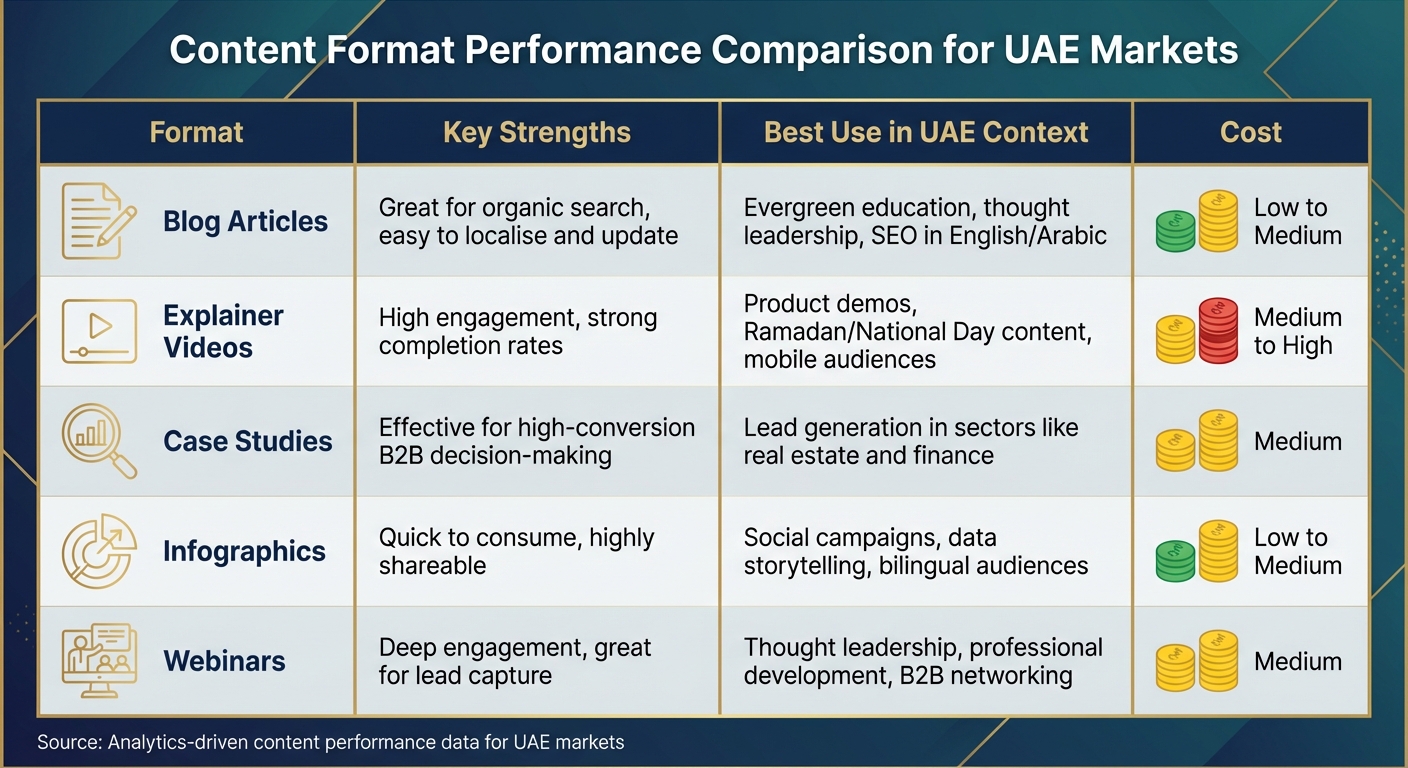
Content Format Performance Comparison for UAE Markets
Finding Content Ideas Through Analytics
Search data can be a goldmine for understanding what resonates with audiences in the UAE. Tools like Google Search Console help uncover opportunities where your site might rank for certain queries but fail to convert. For instance, if a high-value query generates plenty of impressions but few clicks, improving your content around that topic could help capture untapped demand.
Internal site searches are another treasure trove of insights. If visitors frequently search for terms like "Ramadan opening hours" or "AED pricing plans", it signals clear content gaps that need attention. According to Google's research, 89% of B2B researchers rely on the internet during their decision-making process, conducting an average of 12 searches before engaging with a specific brand's website.
Social listening is equally important. Platforms popular in the UAE - such as Instagram, LinkedIn, TikTok, and X - can reveal trending discussions around local events like property launches, exhibitions, or school calendars. Pairing this data with a competitor content audit can help you identify themes that are both timely and locally relevant. From there, you can turn these insights into a well-prioritised list of content ideas tailored to your audience's needs.
These analytics-driven insights are invaluable for shaping your content calendar and ensuring your topics are both timely and engaging.
Building Content Calendars with Analytics
Analytics are your best friend when it comes to planning a content calendar. By analysing 12–24 months of data, you can identify patterns in traffic and engagement around key dates like Ramadan, Eid, UAE National Day (2 December), and major shopping festivals. For instance, interest in Ramadan-related content often starts climbing weeks before the crescent sighting, offering a window to publish educational pieces early, followed by targeted offers closer to the event.
Timing matters, too. During Ramadan, engagement typically peaks during suhoor and post-iftar hours, rather than during standard working times. By digging deeper into your analytics - segmenting by emirate, language, and device - you can refine your approach. For example, if data shows that weekly thought-leadership posts perform better among B2B audiences in Dubai Internet City compared to daily updates, you can adjust your publishing frequency for better results.
Integrating analytics with CRM and sales tools takes it a step further. By linking content performance to AED-based metrics like revenue per session or lead value, you can prioritise high-impact topics and formats. This ensures that your content calendar not only engages your audience but also aligns with your business goals.
Comparing Content Formats and Approaches
Once you’ve nailed down your content ideas and calendar, analytics can guide you in choosing the best format for each topic. Standardising key performance indicators (KPIs) - such as engagement rate, time spent on content, scroll depth, video completion rate, and conversion rates tied to AED outcomes - helps you consistently evaluate what works. Breaking down this data by device, language, location, traffic source, and customer lifecycle stage can reveal valuable patterns.
For instance, analytics might show that Arabic short-form videos perform well in Sharjah and Ajman, driving high engagement and awareness, while long-form English case studies resonate more with B2B decision-makers in Abu Dhabi. It’s worth noting that video consumption in MENA, including the UAE, ranks among the highest globally. YouTube reports that users in this region often watch over an hour of video per person daily.
Here’s a quick look at how different formats perform in the UAE context:
| Format | Key Strengths | Best Use in UAE Context | Cost |
|---|---|---|---|
| Blog articles | Great for organic search, easy to localise and update | Evergreen education, thought leadership, SEO in English/Arabic | Low to medium |
| Explainer videos | High engagement, strong completion rates | Product demos, Ramadan/National Day content, mobile audiences | Medium to high |
| Case studies | Effective for high-conversion B2B decision-making | Lead generation in sectors like real estate and finance | Medium |
| Infographics | Quick to consume, highly shareable | Social campaigns, data storytelling, bilingual audiences | Low to medium |
| Webinars | Deep engagement, great for lead capture | Thought leadership, professional development, B2B networking | Medium |
Experimentation is key. For example, testing the same topic as a blog, short video, or infographic can help you identify the best-performing format for your goals. According to HubSpot, updating and republishing older blog posts with fresh content can increase organic traffic by up to 106%. This kind of data-driven approach ensures your formats align with audience preferences and funnel stages, rather than relying on guesswork.
Making Analytics Part of Your Content Process
Creating Feedback Loops
To truly optimise your content strategy, it’s essential to weave analytics into your regular workflow. Successful teams in the UAE often schedule consistent review cycles - weekly for active campaigns and monthly for evergreen content. The focus isn’t on vanity metrics but on actionable data tied to business goals, such as engagement rates, conversion paths, and how content drives AED revenue or qualified leads.
Blend quantitative metrics like scroll depth, exit rates, and form completions with qualitative insights gathered from Arabic and English user interviews, on-site surveys, and social media feedback. For instance, if a blog post about property investment in Dubai attracts significant traffic but generates few enquiries, user feedback might highlight the need for clearer calls-to-action or more localised contact options, such as WhatsApp.
Use these insights to refine your content calendar. Give priority to topics, formats, and channels that yield strong returns, and consider reworking or retiring underperforming assets. Segmenting your data can uncover audience-specific trends - content that resonates with expats in Dubai might require a different tone or approach for audiences in Abu Dhabi or Sharjah. Advanced teams often set up real-time alerts in collaboration tools, ensuring that any major performance changes immediately trigger reviews and optimisation tasks.
This process naturally sets the stage for testing specific content elements.
Testing Content Elements
A structured testing approach takes the guesswork out of content decisions. Start with a clear hypothesis, such as, “An Arabic-first headline will increase clicks on the call-to-action (CTA) by 10%.” Identify a primary KPI like click-through rate, form completions, or WhatsApp interactions. Then, create two or three variations, divide your traffic randomly, and run the test until you gather enough data for meaningful results.
Focus your testing on high-priority assets - landing pages for paid AED campaigns, product pages, and lead-generation pages. Within these, refine elements that enhance clarity and motivation. For example, headlines addressing local challenges, CTAs tailored to UAE preferences (like WhatsApp or phone calls), and trust signals such as Arabic testimonials or local partner logos can make a big difference. Use historical analytics to target pages with strong traffic but low conversion rates, as these are prime candidates for improvement.
You might also test bilingual versus English-only layouts, Arabic-first navigation, or optimised email send times. Segment your results by device (mobile is dominant in the UAE), language, and traffic source to ensure accurate insights. Since many UAE websites have modest organic traffic, simpler A/B tests over longer durations can often be more effective than complex multivariate experiments.
Once your tests confirm improvements, AI tools can help fine-tune your content delivery further.
Using AI and Predictive Analytics
With a consistent data foundation - such as standardised UTM parameters, precise event tracking, and clear content mapping - AI and predictive analytics can elevate your strategy. These tools can predict high-performing topics, flag underperforming content, automate tagging, and recommend next steps to improve personalisation and efficiency.
AI also enables dynamic content adaptation, tailoring blocks and CTAs based on factors like device type, location, and language. Success can be measured by higher engagement rates, increased click-throughs on personalised modules, improved conversion rates, and better lead quality.
In the UAE, it’s crucial that AI models consider local cultural and seasonal nuances, such as Ramadan, Eid, and major shopping festivals, which significantly influence user behaviour. A consultancy like Wick can assist in building a comprehensive analytics framework. Their Four Pillar Framework integrates data from websites, SEO, content, social media, and marketing automation into a unified view. They also help implement AI-driven personalisation strategies that resonate with local audiences. This approach transforms analytics from a periodic task into an ongoing capability, ensuring that data consistently informs your content calendar, channel strategies, and budget planning.
Conclusion
Analytics transforms content creation from a purely creative effort into a measurable business strategy. By linking every blog post, video, and social media campaign to specific KPIs - like qualified leads, conversion rates, or revenue in AED - organisations in the UAE can pinpoint which content truly drives results.
Getting to know your UAE audience through data is key. Metrics like mobile usage (which is dominant), language preferences (Arabic or English), peak engagement times, and location-specific behaviours provide a clear picture of what connects with Emiratis, Dubai-based expats, and audiences in Abu Dhabi and Sharjah. This data helps marketers refine their topics, formats, and publishing schedules based on real audience behaviour rather than guesswork. Teams that regularly analyse their content are more likely to achieve their goals and operate more effectively. These insights pave the way for ongoing improvements, ensuring that every content decision is rooted in solid data.
Frequent reviews, A/B testing, and feedback loops are essential for boosting engagement and conversion rates. Even small data-driven tweaks - like updating underperforming pages, reusing popular articles, or shifting budgets to proven formats - can lead to meaningful results over time.
Taking this a step further, advanced tools like AI can help businesses predict content performance. As AI and predictive analytics evolve, UAE companies can determine which topics and formats are likely to succeed before investing heavily in production. This paves the way for personalised experiences at scale, catering to the UAE's diverse audiences. A consultancy like Wick can support organisations in building a robust analytics framework, connecting insights from SEO, content, social media, and marketing automation into one cohesive strategy for smarter decisions.
The most successful brands in the UAE view analytics as a cornerstone of their content strategy. Every dirham spent on content is tied directly to strategic objectives, proving that analytics is the crucial link between creative ideas and measurable outcomes.
FAQs
How does analytics help tailor content for UAE audiences?
Analytics offers a window into the preferences and behaviours of audiences in the UAE by examining local engagement trends, mapping customer journeys, and recognising cultural and linguistic subtleties.
Using this data, businesses can craft content that genuinely connects with the UAE market, aligning with regional norms and audience expectations. This not only strengthens engagement but also enhances content performance, paving the way for consistent growth.
What tools are essential for building an effective content analytics system?
To set up a strong content analytics system, you'll want to combine AI-powered analytics tools, integrated data platforms, and behavioural tracking systems. These elements work together to collect and analyse audience data effectively. Adding customer journey mapping and automated reporting tools can give you a clearer picture of audience preferences, helping you fine-tune your content for better results.
Wick’s Four Pillar Framework brings all these tools together into a seamless digital ecosystem, enabling businesses in the UAE to craft strategies rooted in data for sustainable growth.
How does personalised content strategy drive revenue growth?
Crafting personalised content strategies is an effective way to strengthen connections with your audience, which can directly impact revenue growth. When businesses align content with individual preferences, they can significantly enhance customer engagement and loyalty. This often translates into higher conversion rates and more repeat purchases.
The integration of AI-driven personalisation takes this approach a step further. By delivering content that's highly relevant to each user, businesses can create more engaging experiences. This not only encourages users to spend more time interacting with the content but also fosters trust - two key factors that can drive sales and ensure steady revenue growth.