
Blog / Analytics Features to Look for in Martech Tools
Analytics Features to Look for in Martech Tools
When choosing a marketing analytics tool for the UAE, focus on features that align with your goals and market dynamics. Here's what matters most:
- Data Integration: Connect multiple platforms (CRM, advertising, analytics) to unify data and avoid errors.
- Attribution Modeling: Identify which campaigns drive results by analyzing the complete customer journey.
- Real-Time Reporting: Quickly adjust campaigns to changing market conditions, especially during key events like Ramadan.
- Scalability: Ensure the tool can handle growing data and deliver year-over-year insights.
For UAE businesses, where digital advertising is valued at AED 12.1 billion and privacy regulations are tightening, selecting the right tool is crucial. Tools like Wick, Tool A, and Tool B each excel in different areas, from integration to predictive analytics. The right choice depends on your business size, technical capacity, and specific needs.
Quick Comparison:
| Feature | Wick | Tool A | Tool B |
|---|---|---|---|
| Data Integration | Unified Four Pillar Framework | Automated, API-driven | Pre-built connectors, no-code |
| Attribution Modeling | Customer journey mapping | PRISMA model | Multi-channel insights |
| Real-Time Reporting | High-stakes campaign tracking | Hourly/daily refresh schedules | Direct cloud sync for updates |
| Scalability | AI-driven personalisation | Flexible pricing, free trial | Handles large data volumes |
Choose a platform that simplifies data management, improves ROI tracking, and supports your growth in the UAE market.
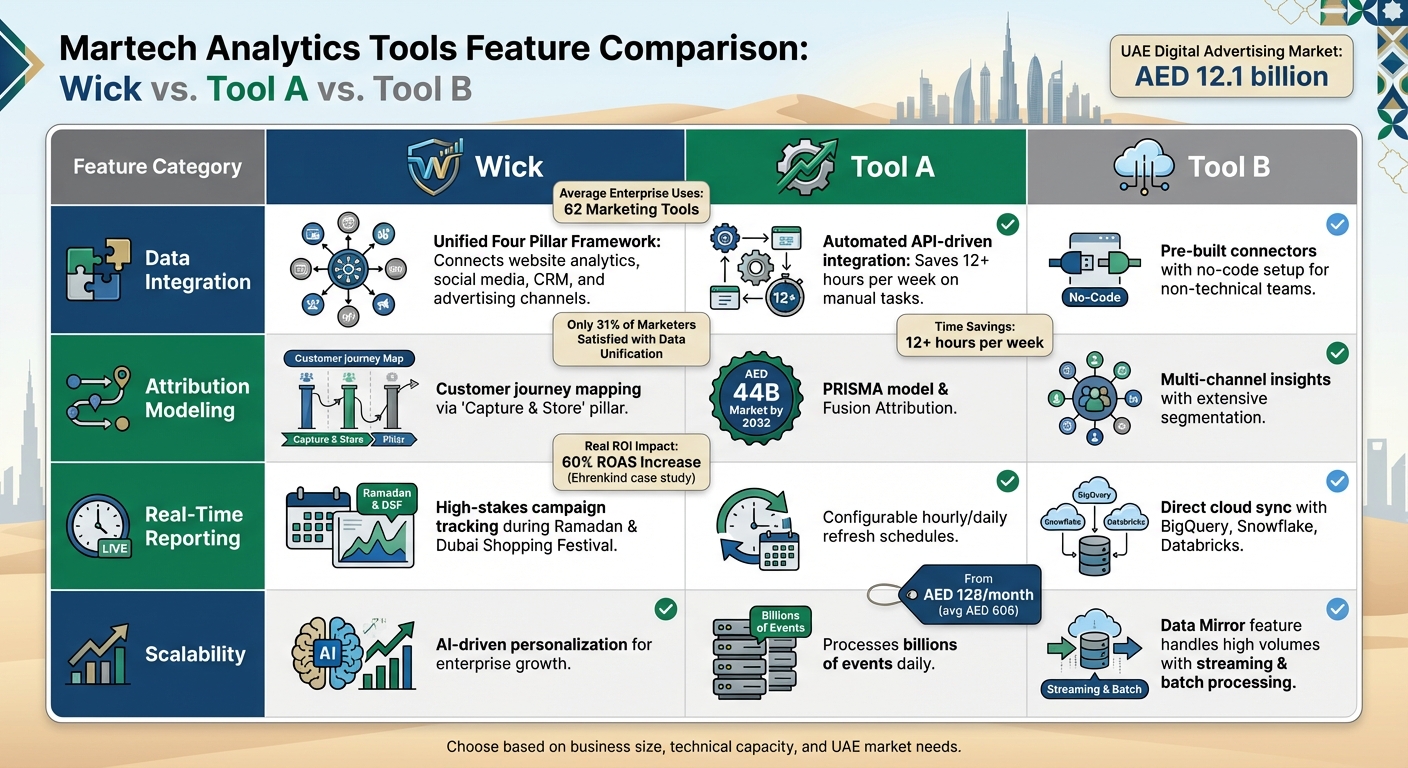
Martech Analytics Tools Comparison: Key Features for UAE Businesses
Marketing Analytics: Case Studies & My Favorite Tools
Core Analytics Features for Evaluation
When selecting a martech platform for the UAE market, it's crucial to focus on analytics features that deliver actionable insights and measurable results. With the average enterprise juggling 62 marketing tools, platforms must excel at consolidating data, attributing revenue accurately, and adapting to changing market conditions. Here’s a closer look at four key analytics features: data integration, attribution modeling, real-time reporting, and scalability.
Data Integration
Data integration is essential for eliminating inconsistencies that arise from mismatched definitions across tools. For instance, one platform might count any form submission as a "lead", while another requires sales team qualification - resulting in tedious, manual reconciliation. This fragmentation is a widespread issue, with only 31% of marketers satisfied with their data unification efforts despite using an average of 10 data sources. A notable example is Alaska Airlines, which in 2025 used the Amperity Customer Data Platform to unify customer profiles. This integration enabled highly personalised pre-trip messaging, driving a 198% increase in conversion rates.
Attribution Modeling
Once data is unified, attribution models help identify which marketing touchpoints genuinely influence sales. These models go beyond surface-level correlations, uncovering opportunities to optimise ad spend by 20–30%. They also address a common pitfall: undervaluing awareness campaigns that don’t receive last-click credit. As Clay Cohen, VP of Marketing at Measured, highlights:
"Marketing analytics tools are the foundation of modern, data-driven marketing. By combining cross-channel analytics, incrementality testing, and Media Mix Modeling, you can move beyond guesswork and make every marketing dollar accountable".
Real-Time Reporting
Real-time reporting is critical for protecting budgets and maximising ROI. In the UAE, where market dynamics can shift quickly, even a short reporting delay can lead to missed opportunities. Real-time data empowers marketers to adjust bids, reallocate budgets, and refine creative assets during peak times. Currently, 46% of marketers review performance reports weekly, while 25% do so monthly. Linda Grönlund, Performance and Growth Marketing Manager at Supermetrics, explains:
"Real-time ad analytics shows what's happening in your campaigns as it happens. With timely data, you can adjust bids, shift budgets, and improve creative in hours rather than waiting for the next reporting cycle".
Scalability
Finally, scalability ensures that analytics capabilities grow alongside your business. Storing 2–3 years of data enables year-over-year comparisons, offering valuable context for decision-making. Automated data cleaning further enhances reliability by eliminating errors that could lead to flawed conclusions. High-performing marketing teams with connected data and automated processes report 29% cost-efficiency gains and an 18% increase in sales. Together, these features elevate analytics from a basic reporting function to a powerful tool for strategic growth and competitive differentiation.
1. Wick

Data Integration
Wick focuses on bringing together data from various sources to eliminate fragmentation. Its Four Pillar Framework connects website analytics, social media platforms, CRM systems, and advertising channels into a single, unified structure. For businesses in the UAE, which often juggle multiple touchpoints across both Arabic and English platforms, this creates a seamless digital ecosystem. By avoiding mismatched definitions and manual reconciliation, companies can ensure their data is accurate and actionable. This unified setup is essential for precise performance attribution.
Attribution Modeling
Through its "Capture & Store" pillar, Wick maps out the entire customer journey to identify the most impactful touchpoints. This allows UAE brands to move beyond basic last-click attribution models and gain a deeper understanding of which campaigns truly drive results. By analysing the complete customer journey, businesses can focus their budgets on high-performing strategies while cutting back on channels that fail to deliver measurable outcomes.
Real-Time Reporting
In a fast-moving market like the UAE, real-time insights are crucial. Wick's performance tracking services provide the tools needed to monitor campaigns as they happen. For example, during high-stakes shopping periods like Ramadan or the Dubai Shopping Festival, marketers can quickly identify underperforming campaigns and reallocate budgets on the spot. This proactive approach ensures that marketing spend is protected and ROI is maximised when it matters most.
Scalability
As data volumes grow and customer segments expand, Wick's enterprise-level services are designed to scale. The consultancy uses AI-driven personalisation and marketing automation to handle the increasing complexity of managing multiple channels and diverse customer bases. This scalability is particularly vital in the UAE, where brands must adapt to a rapidly changing digital environment to stay competitive. By implementing robust infrastructure, businesses can keep pace with growth and avoid falling behind.
2. Tool A
Data Integration
Tool A simplifies data management by automatically pulling and standardising information from multiple platforms. It connects directly to advertising channels like Google, Facebook, and TikTok, analytics tools such as GA4 and Adobe, CRM systems including Salesforce and HubSpot, and e-commerce platforms like Shopify. This eliminates the need for manual CSV exports, saving time and reducing errors. For businesses in the UAE running campaigns in both Arabic and English, this automation can save over 12 hours per week on tedious manual tasks. The tool also adapts to API changes automatically, ensuring seamless data pipelines. With configurable refresh schedules (hourly or daily), marketers always have access to the most current data. This streamlined integration supports accurate attribution, essential for assessing marketing effectiveness.
Attribution Modeling
Tool A employs its PRISMA model and Fusion Attribution method to provide a comprehensive view of marketing performance. By consolidating data from web, email, social media, CRM, and advertising platforms into centralised dashboards, it delivers a detailed picture of each touchpoint's contribution. This approach enables businesses to move beyond basic attribution models, which is particularly relevant as the global multi-touch attribution software market is expected to grow to nearly AED 44 billion by 2032. For UAE marketers, these insights are invaluable for fine-tuning campaigns and improving ROI.
Scalability
Tool A is built to handle the needs of growing enterprises in the UAE, offering a cost-efficient and scalable solution. It processes billions of events daily while maintaining lightning-fast query speeds. The tool integrates both online and offline data sources, including CRM and call centre data, using Customer Journey Analytics. Pricing is flexible, starting at AED 128 per month and averaging AED 606, with a 15-day free trial available. This allows UAE businesses to test its capabilities before committing.
sbb-itb-058f46d
3. Tool B
Data Integration
Tool B simplifies the process of connecting to major marketing platforms through its pre-built connectors, which automatically extract and standardise data. It integrates seamlessly with advertising channels like Google, Facebook, and TikTok, as well as analytics tools such as GA4 and CRM systems like Salesforce and HubSpot. Designed with non-technical users in mind, the platform allows teams to configure dashboards without needing SQL skills or engineering expertise. This no-code approach is especially beneficial for marketing teams in the UAE, enabling them to consolidate data effortlessly without depending on IT support. Additionally, the platform is designed to grow with expanding marketing operations, making it a reliable choice for businesses scaling up.
Scalability
For large enterprises managing intricate, multi-channel customer journeys, Tool B offers extensive segmentation and data-slicing options. It efficiently handles high data volumes by unifying data from both online and offline sources through streaming, batch processing, and direct connectors. One standout feature is the "Data Mirror", which allows direct synchronisation with cloud warehouses like BigQuery, Snowflake, and Databricks. This feature is particularly valuable for businesses that manage their own data infrastructure. UAE enterprises expanding their multi-channel strategies can benefit from Tool B's ability to scale seamlessly, ensuring consistent performance even as operations grow more complex.
Advantages and Disadvantages
Analytics platforms often walk a fine line between offering advanced features and maintaining ease of use. For instance, Google Analytics 4 provides a robust free tier and seamless integration with Google Ads, but its event-based model can pose a steep learning curve for marketers. On the other hand, Adobe Analytics offers highly flexible data modeling through its Analysis Workspace but requires significant expertise and comes with enterprise-level pricing. Comparing these tools highlights their strengths and limitations, making it clear that no single platform fits every need.
In the UAE, fragmented data remains a persistent challenge. Addressing this, Wick's Four Pillar Framework helps businesses overcome issues like data silos and fragmented insights. By integrating analytics with website development, SEO, and marketing automation, Wick creates a unified ecosystem. This approach is especially critical in a region where only 52% of CMOs can effectively demonstrate the value of their marketing investments.
Different tools cater to varying needs. Tool A excels in tracking detailed user behavior, while Tool B simplifies multi-platform data integration for non-technical teams. However, aligning tool complexity with team capabilities is crucial. For example, analysts often spend over 50% of their time performing more than 1,000 manual copy-paste actions weekly when updating reports. This highlights the importance of platforms that balance advanced analytics with accessibility for users.
Real-world examples further illustrate the impact of an effective analytics setup. In 2023, the e-commerce brand Ehrenkind achieved a 60% increase in ROAS by leveraging Admetrics' precise conversion tracking to optimise data fed back to ad networks. As Philipp Richter, Performance Marketing Manager, stated:
"We achieved a remarkable 60% increase in ROAS".
This case demonstrates how strong analytics directly influence profitability - an essential factor, especially as marketing budgets are expected to plateau at around 7.7% of overall company revenue by 2025.
The trade-offs remain evident: advanced features like multi-touch attribution and Bayesian experimentation come with a steeper learning curve, while more user-friendly platforms may lack robust data transformation capabilities. With only 18% of marketers expressing high confidence in their attribution data by 2025, finding tools that combine analytical depth with ease of use is crucial. For businesses in the UAE's dynamic market, selecting the right analytics platform can make all the difference.
Conclusion
Choosing the right analytics platform boils down to aligning the tool's features with your organisation's goals, growth stage, and technical capabilities. For startups and SMBs in the UAE, it’s best to start with essential platforms that handle core tracking needs before moving to more advanced, enterprise-level solutions. Mid-sized businesses often gain the most from CRM-integrated tools, which directly link marketing efforts to the sales pipeline. Larger enterprises, on the other hand, require platforms that unify data across multiple channels while offering advanced governance features.
When budgeting, it’s important to account for more than just the platform’s cost. Expenses related to implementation, data storage, training, and ongoing maintenance can add up quickly. For enterprise-grade tools, implementation can take anywhere from three to six months. Given that marketers typically utilise only 33% of their martech capabilities, conducting regular audits to eliminate redundant tools can save resources. In fact, companies in the UAE lose AED 77.1 million annually on unused software licences.
Data privacy and integration are critical for organisations in the UAE. Analytics tools should prioritise the collection of first-party data and adhere to both local and international compliance standards, especially in highly regulated industries. Additionally, platforms that integrate seamlessly with existing CRM and financial systems make it easier to calculate key metrics like Customer Acquisition Cost (CAC) and Lifetime Value (LTV). Once privacy and integration are addressed, the next step is to focus on implementation.
Start by defining three to five clear, measurable business outcomes. Opt for platforms with pre-built API connectors and run pilot campaigns to ensure data accuracy. As Waqas Arshad from The Rank Masters emphasises:
"The winning teams aren't the ones with the most tools, they're the ones who can clearly answer: 'Which channels, campaigns, and product experiences are driving profitable, compounding growth?'"
For a more cohesive strategy, Wick's Four Pillar Framework integrates analytics with website development, SEO, and marketing automation. This approach is invaluable in a market where only 52% of CMOs can effectively prove marketing ROI. With the right analytics setup, your dashboards can evolve from displaying vanity metrics to driving meaningful growth.
FAQs
What essential analytics features should UAE businesses look for in martech tools?
When evaluating martech tools in the UAE, focus on features that align with the region’s fast-paced and varied digital landscape. Start by prioritising tools with data integration capabilities. These tools should pull data from multiple sources - like website analytics, social media platforms, CRM systems, and advertising channels - into one centralised hub. This ensures insights are both accurate and up-to-date.
Equally important are real-time reporting and multi-channel attribution. These features allow businesses to track performance across different platforms and understand which channels are driving results. Tools with predictive analytics and AI-driven insights take it a step further by helping businesses anticipate trends and fine-tune their campaigns for maximum impact.
Look for tools that offer data visualisation and personalised segmentation to make sense of complex data and target audiences more effectively. Seamless integration with automation technologies is another must-have - it streamlines workflows and boosts campaign efficiency. By focusing on these elements, businesses in the UAE can stay ahead in an ever-changing digital market.
Why is data integration essential for effective marketing analytics?
Data integration plays a crucial role in marketing analytics by bringing together scattered information from various sources - like CRM systems, social media platforms, web analytics tools, and advertising channels - into a single, centralised system. This approach breaks down data silos, eliminates inconsistencies, and provides a complete picture of your marketing activities.
With streamlined data flows and automated processes, integration reduces the need for manual tasks, minimises errors, and speeds up reporting. It also enables real-time insights, empowering marketers to make quicker, well-informed decisions and respond effectively to market shifts. A robust data integration framework not only improves accuracy but also drives higher ROI, enabling marketers to craft strategies that resonate with their audience.
Why is real-time reporting important for marketing campaigns in the UAE?
In the UAE's dynamic market, real-time reporting is a game-changer for marketing campaigns. It provides immediate insights into shifting market trends and customer behaviour, allowing businesses to make quick, informed decisions. This ensures their strategies stay relevant and effective in an ever-changing and competitive landscape.
Given the fast-paced nature of the UAE economy, having access to current data enables companies to adapt swiftly to changes. It helps fine-tune campaigns and deliver tailored experiences to their audience. This kind of responsiveness doesn’t just boost customer satisfaction - it also elevates campaign performance, paving the way for consistent growth.