
Blog / Top 7 Use Cases for AI in Predictive Analytics

Wick
December 27, 2025Top 7 Use Cases for AI in Predictive Analytics
AI-driven predictive analytics is transforming industries across the UAE, especially retail and real estate. By late 2025, 84% of GCC organisations had adopted AI in at least one business function, with retail leading at 75% adoption. This shift is enabling businesses to capture data for smarter decisions, reduce costs, and improve efficiency. Here’s a quick look at the top use cases:
- Personalised Recommendations: AI boosts retail conversion rates by 50% and revenue by 12% through tailored customer experiences.
- Dynamic Pricing in Real Estate: Automated Valuation Models (AVMs) deliver real-time property pricing, projected to grow the global AI real estate market to $303 billion by 2025.
- Customer Churn Prediction: AI-powered loyalty programmes reduce churn and increase revenue by 5%–15%.
- Inventory Forecasting: Retailers improve demand accuracy by 6.3%–9.2%, cutting overstocking and understocking risks.
- Tenant Turnover Prediction: AI enhances tenant retention, boosting net operating income by 10% or more.
- Targeted Marketing Campaigns: Personalised campaigns lower customer acquisition costs by 75% and increase lead conversion by 30%.
- Predictive Maintenance: AI helps UAE retailers avoid costly equipment failures, reducing energy costs by up to 25%.
AI adoption is no longer optional. With the UAE’s AI market projected to reach AED 170 billion by 2030, businesses that integrate these solutions will stay ahead in an increasingly competitive market.
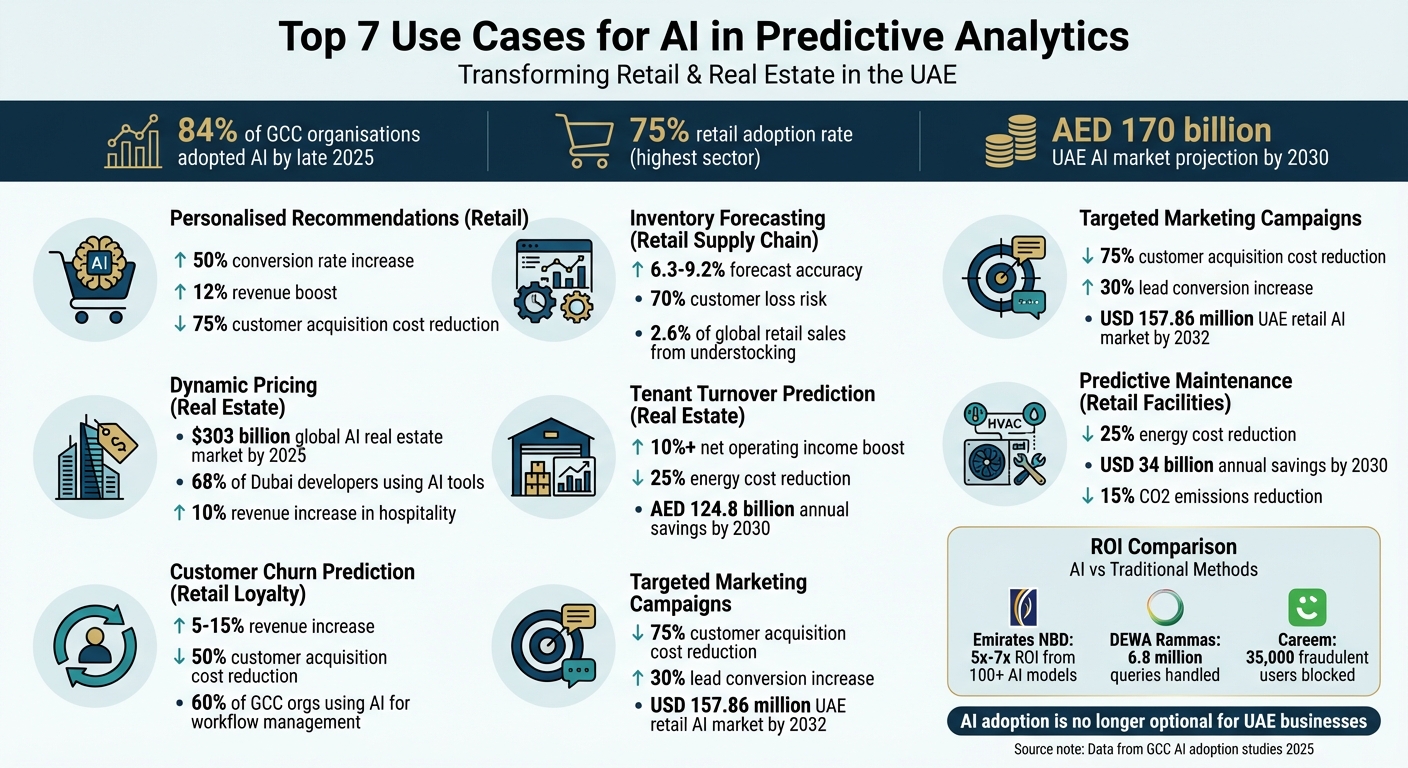
AI Predictive Analytics: 7 Use Cases with ROI Statistics for UAE Businesses
Predictive AI Explained: What Business Leaders Need to Know
1. Personalized Product Recommendations in Retail
In the past, retail recommendations were based on broad demographic trends and historical sales data. Now, AI has changed the game by analysing real-time customer behaviour, uncovering individual preferences that traditional methods often miss.
Accuracy of Predictions
The move from broad demographic categories to hyper-personalised recommendations is a game-changer. AI uses real behavioural data to create highly specific customer segments. Fahed Ghanim, CEO of Majid Al Futtaim Lifestyle, highlights this approach:
"Our customer strategy is built on a commitment to relevance. Through our immersive experiences, we strive not only to meet but also to anticipate customer expectations."
This level of segmentation has tangible results, with AI increasing conversion rates by 50% and boosting revenue by 12%.
Scalability for Large Data Sets
Managing millions of customer interactions is no small feat, and traditional systems often fall short. AI, supported by modular architectures and powerful cloud infrastructures, processes consumer data at remarkable speeds. Leading companies integrate data into AI models up to four times faster. This efficiency doesn’t just improve processes - it also slashes customer acquisition costs by as much as 75%.
Real-Time Adaptability
Retail moves fast, and outdated recommendations simply won’t cut it. Modern AI platforms excel at processing live data streams, tracking customer browsing and purchasing behaviours in real time. This allows them to constantly refine suggestions across both physical stores and digital platforms . The result? Greater agility and efficiency, with conversational chatbots now able to handle up to 80% of customer queries without human help.
2. Dynamic Pricing Optimisation in Real Estate
Pricing a property accurately has always been a tricky task. Traditional methods depend on manual appraisals that can quickly become outdated. But now, AI-powered Automated Valuation Models (AVMs) are changing the game. These systems continuously update property prices using live market data, recent sales, and neighbourhood trends. This shift to real-time, data-driven pricing is reshaping how real estate valuations are handled today.
Accuracy of Predictions
AI doesn’t just rely on past sales data. It dives deeper, analysing real-time demand, competitor listings, and property-specific features. Using computer vision, it can even assess finishes, layouts, and damage from images or videos. The result? Highly localised valuations that factor in details like nearby amenities and school ratings. In Dubai, for instance, 68% of real estate developers are already leveraging AI tools to predict market trends and identify lucrative opportunities.
Managing Large Data Sets
Handling large property portfolios generates enormous amounts of data, which can overwhelm human analysts. AI simplifies this by using modular architectures and centralised data systems that act as a single source of truth. Companies with these advanced systems are 2.5 times more likely to quickly adapt to new AI applications. This scalability can lead to substantial savings - AI could automate up to 37% of tasks in the real estate sector, potentially saving around USD 34 billion in operating costs by 2030.
Adapting in Real-Time
With ever-changing market conditions, pricing strategies need to evolve just as quickly. AI doesn't just process large datasets; it also ensures pricing adjusts dynamically. Algorithms modify rates in real time based on demand, seasonality, and customer preferences. This not only keeps prices competitive but also boosts operational efficiency. Ronald Kamdem, Head of U.S. REITs and Commercial Real Estate Research at Morgan Stanley, highlights this potential:
"Operating efficiencies, primarily through labour cost savings, represent the greatest opportunity for real estate companies to capitalise on AI in the next three to five years."
In Dubai's hospitality sector, similar AI-driven strategies have shown impressive results, increasing revenues by over 10% and cutting costs by more than 15%. Initiatives like Dubai's Smart City 2030 and the Real Estate Evolution Space (REES) Initiative further reinforce the push for data-driven property management.
3. Customer Churn Prediction in Retail Loyalty Programs
AI has transformed customer retention strategies, especially in loyalty programmes, by enabling proactive churn prediction. While these programmes generate massive amounts of customer data, many retailers still depend on outdated regression models that fail to capture the complexities of customer behaviour. AI, on the other hand, processes vast and varied datasets to identify early warning signs - like changes in purchase patterns or an uptick in customer support interactions - before a customer decides to leave. In the GCC, 75% of retail companies have integrated AI into at least one area of their business, making the region a leader in AI adoption. This shift is paving the way for loyalty programmes powered by real-time AI-driven interventions.
Accuracy of Predictions
Traditional regression models often fall short because they can't account for the complex, non-linear behaviours of customers. AI-powered machine learning models excel by analysing diverse data points, such as online browsing habits and in-store visits, to uncover deeper patterns and insights. These systems are continually improving, offering predictions that businesses can rely on. As McKinsey explains:
"With earlier models like GPT-2 or GPT-3, you could get outputs but not trust them blindly, whereas some of today's models are far more accurate and can support real business applications without manual processes."
Despite these advancements, 53% of organisations still cite inaccuracies in AI outputs as a major hurdle. This highlights the importance of strong data practices. High-performing companies - those attributing at least 5% of their earnings to AI - are nearly four times more likely to integrate clean, high-quality data into their systems quickly.
Real-Time Adaptability
Beyond accurate predictions, AI offers real-time adaptability, something static loyalty programmes struggle to achieve. AI creates a unified, 360-degree view of customer behaviour by connecting online and offline interactions. This allows for real-time responses. For instance, if a customer's engagement drops, the system can immediately send personalised offers or rewards tailored to their preferences. This dynamic approach can lower customer acquisition costs by up to 50% and increase total revenue by 5% to 15%. In the GCC, 60% of organisations are already leveraging AI tools to autonomously manage these intricate workflows.
Cost Efficiency in Implementation
The beauty of AI for churn prediction lies in its cost-effective implementation. Retailers can start with small-scale pilots - lasting just 2–3 months - to test the effectiveness of their AI models. These pilots typically cost between USD 10,000 and USD 14,000 (around AED 36,700–51,400). The UAE’s retail AI market is expected to grow from USD 16.82 million in 2023 to approximately USD 157.86 million by 2032, with an impressive compound annual growth rate of 28.21%. As Rakesh Ravuri, CTO at Publicis Sapient, puts it:
"If retailers aren't doing micro-experiments with generative AI, they will be left behind."
4. Inventory Demand Forecasting for Retail Supply Chains
Retailers are constantly juggling the fine line between overstocking and understocking. Overstocking ties up valuable capital, while understocking risks losing up to 70% of customers to competitors. AI-powered demand forecasting offers a solution by analysing massive datasets, transforming how supply chains operate across the GCC. This technology brings a new level of precision to predicting inventory needs.
Accuracy of Predictions
Traditional forecasting methods, which rely heavily on historical sales data and basic statistical tools, often falter when market conditions change. AI, on the other hand, integrates external factors like economic trends and social behaviours alongside historical data. Techniques such as gradient boosting help uncover complex patterns that traditional methods simply miss.
One major consumer packaged goods company saw an improvement of 6.3% to 9.2% in forecast accuracy when using machine learning to assist demand planning. Their system generates "ML-assisted forecasts" that predict the reliability of automated forecasts and notify planners only when human adjustments are needed. Dmytro Ivanov, a Machine Learning Engineer at Trinetix, emphasises the importance of this approach:
"The changing market and global realities have made demand planning a synonym of efficient supply chain management. Predicting demand helps companies build short- and long-term business strategies, optimise their inventory costs, foster customer loyalty, and withstand market competition."
Scalability for Large Data Sets
Retailers managing thousands of SKUs across multiple locations face the challenge of forecasting demand at scale. AI-powered deep meta-learning models automatically optimise variables, eliminating bias and leveraging vast datasets. Cloud-based platforms further enhance this capability by integrating diverse data sources and learning continuously from new inputs.
Companies that generate 20% or more of their earnings from AI are 2.5 times more likely to have modular data systems, allowing them to quickly adapt to new AI applications. AI also enables retailers to dive into granular details, like analysing demand for individual products on a daily or weekly basis. This is particularly valuable in the GCC, where 75% of retail companies have already adopted AI in at least one area of their operations.
Real-Time Adaptability
Static forecasts, whether annual or quarterly, are no longer sufficient in today’s fast-changing retail landscape. AI facilitates dynamic re-planning, adapting to local market conditions such as seasonal buying patterns during Ramadan or sudden geopolitical events. Simon Bowes, CVP Manufacturing Industry Strategy EMEA at Blue Yonder, explains:
"Middle East-based planners often face high volatility during global events like Ramadan or geopolitical shifts. AI tools allow for dynamic re-planning that accounts for local nuances and seasonal consumer behaviours."
With AI, planning systems can create a comprehensive view of supply and demand in seconds, enabling businesses to anticipate disruptions. These systems also send real-time alerts for forecast deviations, offering actionable recommendations to keep inventory aligned with demand. This agility not only streamlines inventory management but also bolsters operational resilience.
The UAE's AI market is expected to grow at a compound annual growth rate of 43.9% from 2024 to 2030, reaching AED 170.15 billion by the end of the decade.
Cost Efficiency in Implementation
AI applications in retail supply chains have the potential to deliver value equivalent to approximately 2.6% of global industry sales. For instance, a leading logistics company achieved a 30% productivity boost while reducing costs by optimising picking routes and materials handling through AI. These savings directly impact profitability.
Cost efficiency also comes from treating data as a product, using adaptable base data models. To maximise AI’s potential, retailers should invest in "analytics translators" - professionals who bridge the gap between technical AI teams and business-focused supply chain managers. This ensures that AI models remain relevant to real-world operations.
That said, 75% of GCC companies still lack effective AI change management programmes. Without proper training and communication strategies, even the best AI systems may fail to deliver their full potential. User-friendly dashboards and recommendation engines can help ease the transition to AI-powered workflows, reducing resistance and ensuring successful adoption.
5. Tenant Turnover Prediction in Real Estate Management
AI-powered tenant turnover prediction is transforming how property managers handle tenant retention. Instead of reacting to vacancies after tenants leave - a process that can be costly due to marketing expenses and lost rental income - AI allows managers to predict and address potential turnover proactively.
Accuracy of Predictions
AI enhances prediction reliability by analysing more complex tenant data than traditional methods. While older approaches might focus on straightforward factors like lease expiry dates or payment records, AI digs deeper, uncovering subtle behavioural patterns. By pairing the right algorithm with detailed data, it delivers more precise insights.
Through standardised Extract, Transform, and Load (ETL) processes, AI integrates diverse data sources - ranging from historical rental trends to macroeconomic conditions and property-specific details - into a unified framework. It even uses sentiment analysis to assess tenant communications, such as emails and maintenance requests, identifying early signs of dissatisfaction that manual reviews often miss.
For real estate companies, this approach can translate into significant gains. Improved tenant retention and streamlined operations can boost net operating income by 10% or more. Additionally, AI taps into unconventional data sources, like IoT sensors and computer vision, to analyse tenant behaviour and satisfaction levels more comprehensively.
Scalability for Large Data Sets
When managing hundreds or thousands of rental units, the volume of data can be overwhelming. AI excels at processing vast amounts of unstructured information, such as leasing documents and tenant requests, which would be time-intensive for human teams.
Predictive models can scan thousands of leases to identify patterns - like rent rates per square metre or renewal trends - creating structured insights that highlight turnover risks across an entire portfolio. Automated ETL processes ensure consistency by linking tenant data with broader economic indicators.
The global AI real estate market reflects this trend, with projections showing growth from AED 817.4 billion in 2024 to AED 1,113 billion by 2025. This surge is largely driven by the efficiency gains AI brings to tenant retention and operational workflows. Companies that quickly integrate data into AI models are nearly four times more likely to outperform their competitors.
Real-Time Adaptability
In today’s fast-paced property market, static annual reviews of tenant satisfaction are no longer sufficient. AI processes both historical and real-time data, enabling property managers to forecast trends, price shifts, and demand changes as they happen. This real-time adaptability allows managers to monitor tenant interactions and spot dissatisfaction before it escalates into a move-out notice.
In the GCC region, 60% of organisations are already using or testing AI systems to manage complex workflows. These tools can flag critical moments during lease negotiations, offering real-time coaching to employees handling tenant relationships.
AI-driven smart building technologies further enhance tenant experiences while reducing costs. For example, monitoring tenant behaviour can lower energy expenses by up to 25%. Automated Valuation Models (AVMs), which update with live market data, ensure rental pricing stays competitive and aligned with demand, offering both cost savings and operational improvements.
Cost Efficiency in Implementation
AI-driven tenant retention strategies deliver tangible financial benefits by minimising vacancy periods and reducing the costs associated with acquiring new tenants. By 2030, automation in real estate workflows is expected to save firms up to AED 124.8 billion annually.
For successful implementation, real estate firms need "analytics translators" who bridge the gap between technical data experts and business leaders. This ensures AI models align with tenant behaviours and organisational goals. Luca Turba, Principal at Roland Berger, summarises the value of AI:
"AI converts financial complexity into instant clarity."
To make the most of limited resources, firms should centralise AI expertise within a Centre of Excellence while deploying it across various functions. A practical way to start is by adopting a "2x2 approach", which involves tackling two quick-win use cases alongside two more ambitious projects. This strategy helps build momentum without overwhelming existing systems.
6. Targeted Marketing Campaign Personalisation
AI is reshaping how retail and real estate businesses in the GCC approach customer engagement, moving beyond one-size-fits-all strategies to deliver tailored and automated marketing solutions in real-time. By analysing customer behaviour, purchase history, and engagement patterns, AI enables businesses to craft personalised messages that resonate with individual preferences. This approach is particularly effective during high-demand periods like Ramadan and the Dubai Shopping Festival, where customer attention is at its peak.
Accuracy of Predictions
AI's predictive capabilities rely on advanced techniques like machine learning, regression analysis, and clustering. These tools allow businesses to uncover patterns that go beyond static historical data, providing continuously updated insights. Unlike older batch-processing methods, AI creates a dynamic feedback loop that adapts as new data becomes available. Generative AI adds another layer of precision by simulating future scenarios and generating synthetic data to improve training models. The emergence of agentic AI - tools designed for real-world applications - has further enhanced prediction accuracy, making it a valuable asset for businesses.
Scalability for Large Data Sets
Managing thousands of customer interactions across multiple channels can be overwhelming, but AI excels at processing vast amounts of unstructured data. The GCC region is heavily investing in AI infrastructure to support this capability. Initiatives like Abu Dhabi's G42 "Stargate" alliance and Saudi Arabia's HUMAIN data centres are setting the stage for handling large datasets. Retail, in particular, is leading the way, with a 75% AI adoption rate driven by extensive consumer data. Real-world examples include Careem's AI-driven fraud detection system, which blocked 35,000 fraudulent users in May 2023, and DEWA's virtual assistant "Rammas", which has handled over 6.8 million customer queries since its launch. These advancements enable businesses to adjust campaigns in real time, a critical advantage in today’s fast-moving markets.
Real-Time Adaptability
Static, pre-planned marketing campaigns no longer meet the demands of today’s dynamic market. AI allows marketers to continuously monitor and optimise campaign performance in real time, rather than relying on outdated, end-of-day reports. This capability is especially crucial for UAE retailers, where mobile wallet usage is expected to exceed 60% by 2024. AI can leverage data from various sources - such as foot traffic, weather conditions, and social trends - to refine targeting and enhance campaign effectiveness.
Cost Efficiency in Implementation
AI's ability to streamline audience targeting and automate campaign adjustments translates into significant cost savings. By using predictive modelling, businesses can reduce customer acquisition costs by up to 75% and improve lead conversion rates by over 30%. The UAE's retail-specific AI market is expected to grow dramatically, from USD 16.82 million in 2023 to USD 157.86 million by 2032. Starting with a pilot project can help businesses ease into AI adoption; such projects typically cost between USD 10,000 and USD 14,000 and run for 2–3 months. Generative AI tools, such as subject line generators and product finders, further reduce manual effort, enabling businesses to achieve personalised marketing at scale while maximising campaign results.
7. Predictive Maintenance for Retail Facilities
Retail facilities across the UAE - ranging from sprawling shopping malls to independent retail stores - depend heavily on systems like HVAC, refrigeration, and lighting. When these systems fail unexpectedly, the consequences can be steep: repairs, lost sales, and spoiled inventory. Enter AI-driven predictive maintenance, a smarter way to handle upkeep. By analysing real-time data, this approach predicts potential equipment failures before they happen. This is especially useful in the GCC's harsh climate, where cooling systems are pushed to their limits, accelerating wear and tear. The result? A shift from reactive repairs to planned, proactive interventions.
Accuracy of Predictions
Traditional maintenance relies on fixed schedules, which often miss the mark. AI, on the other hand, uses IoT sensors to track critical metrics like temperature, vibration, and energy consumption. Combining this data with historical repair logs, procurement records, and ERP systems, AI identifies patterns that signal potential breakdowns. As Deloitte highlights:
"By anticipating and avoiding a machine failure, the enterprise could prevent cascading impacts that could slow other operations and cause costly outages".
This data-driven precision transforms maintenance into a science, eliminating guesswork and reducing downtime.
Scalability for Large Data Sets
With accurate predictions in place, scalability becomes key for retail chains managing multiple locations. AI-powered systems can handle the unique needs of diverse facilities without overburdening IT infrastructure. Cloud-based platforms make scaling easy, eliminating the need for expensive on-site hardware. A notable example is The Blackstone Group, which implemented Schneider Electric's EcoStruxure Resource Advisor across 20 companies, saving millions in energy costs and cutting CO2 emissions by 15%. For retailers, starting small - perhaps by piloting predictive maintenance on a single HVAC system - can demonstrate ROI before rolling it out chain-wide. While only 31% of GCC businesses have fully integrated AI into their operations, a promising 89% plan to boost AI budgets to support expansion.
Real-Time Adaptability
Static maintenance schedules fall short when equipment or environmental conditions shift unexpectedly. AI bridges this gap by continuously monitoring systems and adjusting priorities in real time, avoiding reliance on outdated monthly inspections. In the UAE’s intense climate, where cooling systems face relentless strain, this adaptability is crucial. Digital twins - virtual replicas of physical assets - give facility managers a clear view of equipment health across multiple locations, enabling quick, informed decisions when conditions change. This real-time flexibility is part of a broader trend toward AI-driven facility management in GCC retail.
Cost Efficiency in Implementation
AI-powered predictive maintenance is a cost-saver. It extends the lifespan of equipment, reduces emergency repair costs, and delays the need for expensive replacements. By optimising spare parts inventory, it also frees up capital that would otherwise be tied up in contingencies. For example, Citycon’s Lippulaiva shopping centre in Finland saw a €3 million payback within five years after adopting Schneider Electric’s AI-driven microgrid system, which also cut annual CO2 emissions by 335 tCO2/year. On a larger scale, automation in facility management could save businesses up to USD 34 billion annually by 2030, with smart-building technology reducing energy costs by up to 25%. As Schneider Electric explains:
"AI improves the quality of service, the user experience, the execution of projects, and of course, significantly reduces costs".
AI vs Traditional Methods: Comparison Table
AI-driven predictive analytics has proven to outshine traditional methods in several critical areas. Take Emirates NBD, for instance - they developed over 100 AI models between 2021 and 2024, achieving an impressive 5x–7x return on investment (ROI). Similarly, DEWA’s AI-powered assistant, Rammas, handled a staggering 6.8 million queries, showcasing AI’s unmatched speed and efficiency. These examples highlight AI's ability to deliver faster, scalable solutions compared to traditional approaches.
The table below breaks down the advantages of AI over traditional methods, focusing on how these benefits play out in GCC-specific contexts:
| Metric | Traditional Methods | AI-Driven Predictive Analytics | GCC-Specific Impact |
|---|---|---|---|
| Accuracy | Manual, delayed reviews | Real-time machine learning for precise forecasts | 30%+ improvement in lead conversion for UAE property platforms |
| Scalability | Limited by human resources and isolated systems | Processes vast datasets across multiple locations seamlessly | Emirates NBD implemented 100+ models in just two years |
| Real-Time Processing | Slow, batch-based reporting with delays | Instant analysis enabling proactive decisions | DEWA’s Rammas handled 6.8 million queries in real time |
| Cost Efficiency | High operational costs due to manual labour | 20–25% reduction in expenses | Smart buildings in Dubai cut energy costs by up to 25% |
| ROI Potential | Gradual, linear returns | Exponential growth, achieving 5x–7x ROI | GCC refineries saved USD 1 per barrel using machine learning |
AI isn't just transforming retail; it’s revolutionising industrial sectors too. For example, Saudi Aramco developed a generative AI model with 250 billion parameters to optimise drilling plans, while its Fourth Industrial Revolution Centre achieved a 50% reduction in flare emissions since 2010. Traditional methods simply cannot match AI’s ability to process decades of operational data with such speed and precision.
In another striking example, Careem’s AI-based fraud detection system successfully blocked 35,000 fraudulent users - something unimaginable with manual processes. As Miguel Rio Tinto, Group Chief Digital and Information Officer at Emirates NBD, aptly stated:
"Advanced analytics and AI were the future growth engines to drive value from IT transformation investment".
Although AI requires a significant initial investment, the long-term financial benefits are undeniable. For instance, automation in facility management is projected to save USD 34 billion annually by 2030. With 89% of GCC organisations planning to boost their AI budgets, the momentum behind AI adoption is building rapidly. These advantages are setting the stage for sustained growth and innovation across the region.
Conclusion
AI-powered predictive analytics is reshaping how businesses in the GCC operate by replacing outdated, static methods with real-time, data-driven decision-making. Take Emirates NBD, for instance - they reported an impressive 5×–7× ROI from their AI initiatives. In the real estate sector, automation is expected to bring annual savings of up to AED 125 billion (around USD 34 billion) by 2030. This shift is paving the way for UAE businesses to integrate scalable AI solutions across their entire operations.
For industries like retail and real estate in the UAE, the direction is unmistakable. With 84% of GCC organisations already using AI by late 2025, companies that limit themselves to experimental pilots risk falling behind competitors who fully embrace AI across their processes. The message is clear: scaling AI is no longer optional - it's essential.
As highlighted in examples from retail and real estate, AI-driven analytics consistently delivers better results than traditional approaches. From improving inventory forecasts and predicting tenant turnover to tailoring customer experiences, AI enables businesses to respond swiftly to market demands. With the UAE's AI market expected to reach AED 170 billion by 2030, those who adopt AI early will set the benchmarks for the future.
FAQs
How does AI enhance customer retention in retail loyalty programmes?
AI is reshaping retail loyalty programmes by diving deep into customer data to predict churn and design highly personalised rewards and offers. This strategy fits perfectly with the UAE shoppers' demand for tailored experiences, strengthening customer loyalty and retention.
Using predictive analytics, businesses can stay one step ahead - anticipating customer needs, engaging at the right moments, and offering incentives that truly align with individual preferences. This not only enhances customer satisfaction but also fosters a stronger, more meaningful connection between brands and their audience.
How does AI enhance dynamic pricing in the real estate market?
AI-powered dynamic pricing allows real estate companies to tweak property rents or sale prices in real-time, responding to demand patterns, buyer behaviour, and market shifts. Using advanced algorithms, businesses can fine-tune pricing strategies to boost revenue, minimise vacancies, and keep prices aligned with current market realities.
This method proves especially useful in fast-paced markets like the UAE, where demand and prices can change quickly. By offering data-driven insights and automating price updates, AI helps firms maintain a competitive edge while improving efficiency and profitability.
How does AI-powered predictive maintenance help UAE retailers save costs?
AI-powered predictive maintenance combines IoT sensors with machine learning to predict potential failures in critical store equipment like refrigeration units, HVAC systems, and POS terminals. By tackling problems before they lead to breakdowns, retailers in the UAE can sidestep costly disruptions, prevent lost sales, and protect perishable inventory.
This method offers several cost-saving benefits. Identifying faults early can prevent unplanned outages, potentially saving tens of thousands of dirhams for each incident. Predictive models also streamline spare-part management, reducing excess inventory and storage expenses. On top of that, AI can optimise energy-heavy equipment, cutting energy costs by as much as 15% while extending the lifespan of assets, which helps minimise long-term replacement expenses.
Wick’s data analytics services make it easy to integrate predictive maintenance into a retailer’s digital operations. With real-time insights, unified maintenance alerts, and cost dashboards, retailers can achieve maximum efficiency and stay ahead of potential issues.