

Blog / 5 AI Tools for Scalable Workflow Automation
5 AI Tools for Scalable Workflow Automation
Looking to automate your workflows and save time? Here are five AI tools designed to streamline operations for businesses in the UAE and beyond. From no-code platforms to advanced AI agents, these tools can handle tasks like data entry, lead management, and customer support - all while cutting costs and boosting efficiency.
Key Takeaways:
- Gumloop: No-code AI workflows with pre-built templates, ideal for SMEs managing tasks like contract reviews and content optimisation. Plans start at USD 37/month.
- Zapier: Connects 8,000+ apps for automation without coding. Great for syncing e-commerce platforms and CRMs. Plans start at USD 29.99/month.
- n8n: Open-source, self-hosted automation for technical teams. Perfect for UAE businesses needing data control and compliance.
- Vellum AI: Tailored for building AI agents with governance tools, suitable for enterprises managing complex operations.
- Lindy: AI-powered virtual assistants for sales and support, handling tasks in Arabic and English. Plans start at USD 39.99/month.
Quick Comparison Table:
| Tool | Best For | Key Features | Starting Price |
|---|---|---|---|
| Gumloop | SMEs, marketing teams | No-code workflows, LLM integration, templates | USD 37/month |
| Zapier | Non-technical users | 8,000+ app integrations, AI steps | USD 29.99/month |
| n8n | Technical teams, IT departments | Open-source, self-hosted, unlimited workflows | Free/self-hosted |
| Vellum AI | Enterprises | AI agents, governance, monitoring | USD 25/month |
| Lindy | Sales and support teams | AI assistants, natural-language commands | USD 39.99/month |
These tools address common business needs like bilingual workflows, local compliance, and high-volume automation. Whether you're a startup or an enterprise, there's an option to suit your goals.
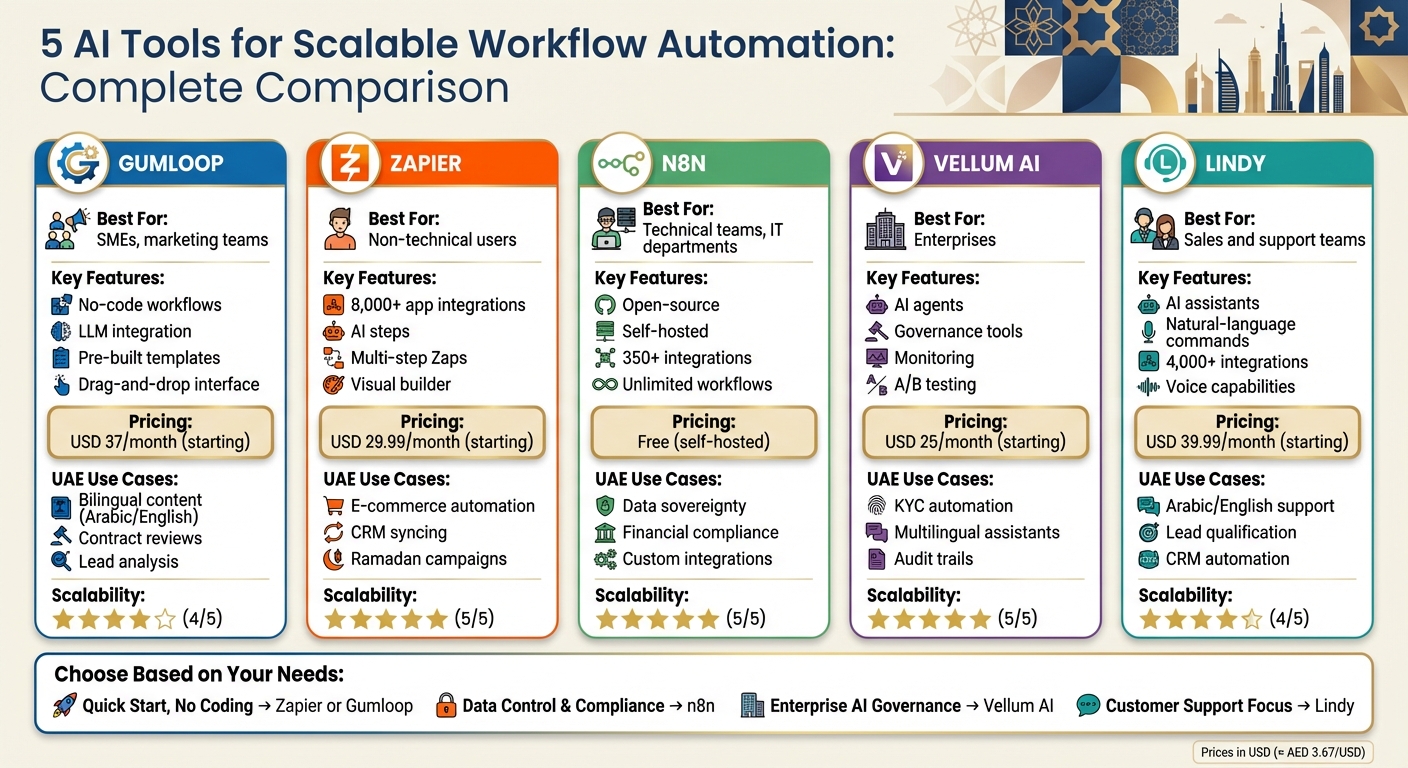
AI Workflow Automation Tools Comparison: Features, Pricing & Best Use Cases
1. Gumloop
Key Capabilities
Gumloop is a no-code AI workflow builder that simplifies automation through an intuitive drag-and-drop interface. By connecting tools, data sources, and AI models as modular "nodes", it allows users to design workflows without the hassle of managing separate API keys for major language models. This makes it especially convenient for marketing and operations teams. Gumloop also provides pre-built templates for tasks like internal link analysis, legal contract reviews, and lead website analysis, speeding up deployment. Its embedded AI assistant, Gummie, translates natural language prompts into workflows, making it accessible even for non-technical teams. Trusted by top industry players, Gumloop is tailored to meet the needs of both large enterprises and independent creators.
Scalability Benefits
Thanks to its node-based architecture, Gumloop can handle everything from straightforward automations to intricate, multi-step workflows. Reusable templates not only save time but also help standardise processes across key departments like marketing, sales, and operations. For advanced users, features such as subflows and an enhanced interface allow complex processes to be broken into smaller, more manageable parts. By integrating multiple tools and AI models within a single platform, teams can efficiently expand their capabilities without juggling multiple systems.
UAE-Centric Use Cases
Gumloop is well-suited to meet the specific needs of businesses in the UAE. For marketing and media agencies, its internal linking template can optimise large bilingual content libraries, ensuring effective SEO for campaigns targeting both Arabic and English-speaking audiences across the GCC. Legal and real estate firms can leverage the legal contract analyser template to streamline the review of tenancy contracts, supplier agreements, and DIFC/ADGM documentation. B2B and SaaS companies operating in AED-denominated markets can connect Gumloop's lead-analysis workflows to their account-based marketing strategies. Its no-code interface is particularly useful for diverse teams, enabling professionals beyond engineers to create workflows that align with local workweek schedules and public holidays.
Pricing Structure
Gumloop offers a free plan alongside paid tiers ranging from USD 37 to 97 per month, which unlock higher usage limits and advanced features for production-level workloads. The free plan is great for testing and small-scale internal automations. For UAE businesses, the cost can be justified by the time saved on tasks like contract reviews, content management, and lead research. Reports generated through the platform can also be localised with metric units and regional timestamp formats, even though billing is handled in USD.
2. Zapier
Key Capabilities
Zapier is a no-code automation platform that connects over 8,000 apps and services through workflows called "Zaps". These Zaps combine triggers and actions to create seamless processes. Using its visual builder, teams can design multi-step automations without needing to code, although it also supports JavaScript and Python for advanced customisation.
The platform has integrated AI-driven features, making automation even smarter. For instance, AI steps can summarise text, classify data, or generate content within workflows. Zapier also offers AI Agents that handle complex tasks by leveraging language models. One standout feature is the AI copilot, which can turn simple natural-language instructions like "qualify leads and send them to CRM" into draft automations. Teams can then refine these drafts visually, making the setup process accessible even for those without technical expertise. Additionally, Zapier supports conditional logic, branching, filters, and webhooks, enabling organisations to design intricate, logic-based workflows that scale effortlessly.
Scalability Benefits
Zapier’s extensive integration library allows businesses to standardise automation across departments such as marketing, sales, finance, and operations. This means companies can grow without needing to expand their teams proportionally. Many SaaS tools come with built-in Zapier connectors, making it easier to onboard new platforms and maintain integrations over time. The platform also handles scheduled automations, error management, and notifications (via Slack or email), ensuring workflows remain stable even as demands increase. To maintain efficiency as workflows expand, businesses can adopt clear naming conventions and organise Zaps into central folders. These features are especially useful for organisations in the UAE, where businesses often aim for streamlined operations to support rapid growth.
UAE-Centric Use Cases
In the UAE’s real estate industry, agencies can use Zapier to automate lead management. For example, they can capture leads from property portals or social media ads, evaluate budgets and location preferences using AI, and route the leads to agents in a CRM. Follow-ups can be automated using bilingual templates in Arabic and English, ensuring seamless communication with clients.
In e-commerce, merchants can integrate platforms like Shopify or local payment gateways with marketing tools. This enables automations such as triggering personalised emails or WhatsApp campaigns based on order value (in AED) or product categories. These campaigns can be tailored to specific customer segments, enhancing engagement.
Marketing consultancies like Wick can streamline client onboarding by automating workflows that gather marketing data, set up workspaces, share pre-read materials, and notify teams via Slack or Microsoft Teams. These workflows can be scheduled to align with the Gulf workweek (Monday to Friday) and Gulf Standard Time (UTC+4), ensuring smooth regional coordination.
For businesses serving bilingual audiences, Zapier’s AI steps can detect language preferences and generate responses accordingly. Automated workflows can also include approval steps, where AI-generated content is sent to marketing or compliance teams for review before publication. This ensures that content aligns with the UAE’s emphasis on reputational and regulatory considerations.
Pricing Structure
Zapier operates on a freemium model, with a free tier and paid plans starting at approximately USD 29.99 per month (around AED 110). The free plan works well for testing or basic personal workflows, while the Starter and Professional plans offer higher task limits, multi-step Zaps, and advanced features like filters. For larger organisations, the Team and Company plans provide even greater task volumes, shared workspaces, single sign-on, and enterprise-level governance, with pricing customised to meet specific needs.
As UAE businesses scale their automations, it’s essential to estimate monthly task usage - whether it’s the number of leads processed, orders synced, or AI-enhanced messages sent. This helps avoid unexpected costs while selecting the right plan to support growth. Converting pricing to AED and regularly monitoring automation usage can ensure smooth operations without surprises.
3. n8n
Key Capabilities
n8n is an open-source, low-code automation platform designed for technical teams that want full control over their workflows. Unlike tools that operate only in the cloud, n8n allows you to run automations on your own servers or infrastructure, giving you complete ownership over your data and processes. Using a visual canvas, you can drag and connect nodes to build workflows. Each node represents a specific action, such as pulling CRM data, sending messages, or performing AI-based tasks.
The platform supports over 350 native integrations with popular tools like Slack, Google Sheets, Notion, and various databases. If you need additional functionality, you can use JavaScript or TypeScript to create custom nodes or make API calls. This flexibility is especially useful for integrating services specific to the UAE, such as payment gateways like Telr or logistics providers like Aramex, which may not have ready-made connectors in other platforms.
n8n also integrates with OpenAI and other language models, enabling AI-driven capabilities. This allows you to automate tasks like summarising documents, categorising customer queries, generating content, or making decisions based on AI analysis. For businesses operating in both Arabic and English, n8n can handle bilingual workflows. For instance, you can set up a process to automatically translate Arabic support emails, assess their urgency, and route them to the appropriate team. This makes it easier to manage high-volume operations efficiently, as outlined in the scalability section below.
Scalability Benefits
n8n's self-hosted deployment gives you complete control, removing usage limits and vendor lock-in. It supports horizontal scaling with features like queueing, workflow execution management, and the ability to add more worker instances as demand grows. Running n8n on your own infrastructure - whether on a local server or a UAE-region cloud provider like AWS Middle East - lets you handle thousands of workflow executions without worrying about per-task fees or arbitrary limits. You can integrate external databases and Redis queues to ensure reliable performance for production-level workloads.
Because it's open-source, your development team can customise n8n to meet specific needs. This could include adding security features to comply with UAE data protection laws or building integrations tailored to local business processes. Additionally, a strong community ecosystem speeds up implementation. With over 5,000 community-created workflow templates, you can quickly adopt proven solutions for common tasks like CRM syncing, invoice processing, and marketing automation. These templates reduce setup time and provide reliable blueprints for even the most complex automations.
UAE-Centric Use Cases
In Dubai's e-commerce sector, n8n can streamline order fulfilment by updating inventory, generating invoices with 5% VAT in AED, and triggering local shipment requests. Hosting the platform on your own servers ensures sensitive customer and payment data stays secure, addressing data sovereignty concerns.
For financial services firms in Abu Dhabi, n8n can automate compliance workflows while adhering to ADGM regulations. By hosting workflows locally, firms maintain full control over transaction data and audit trails. During peak trading hours, n8n handles high-volume processing seamlessly, running continuously on Gulf Standard Time (UTC+4) without the delays or data transfer issues associated with overseas cloud services.
Marketing agencies like Wick can use n8n as a central hub to connect websites, CRMs, ad platforms, and analytics tools. Workflows can capture leads from Arabic and English landing pages, enrich them with demographic data, score them using AI, and distribute them via WhatsApp Business API or SMS. These automations respect local preferences, such as communication methods and work schedules aligned with the Gulf workweek.
Pricing Structure
n8n's pricing depends on the deployment model. The self-hosted version is free and open-source, meaning your main costs will be infrastructure-related - servers, storage, databases, and technical resources for maintenance. For UAE-based organisations with existing IT infrastructure or local cloud accounts, this approach can be far more cost-effective than per-task pricing, especially for large-scale operations.
The n8n Cloud option offers a managed service with usage-based pricing tied to workflow executions and resource consumption. It includes a free trial so you can test workflows before committing to a paid plan. While costs vary depending on usage, the cloud option removes the need to manage infrastructure, making it a good fit for teams that prefer convenience. For example, you can convert pricing from USD to AED (approximately AED 3.67/USD) and evaluate execution volumes - whether you're processing hundreds of leads daily, syncing thousands of orders, or running continuous data pipelines. For high-volume needs, self-hosting often provides better value, while cloud plans are ideal for teams prioritising ease of use over infrastructure management.
4. Vellum AI
Key Capabilities
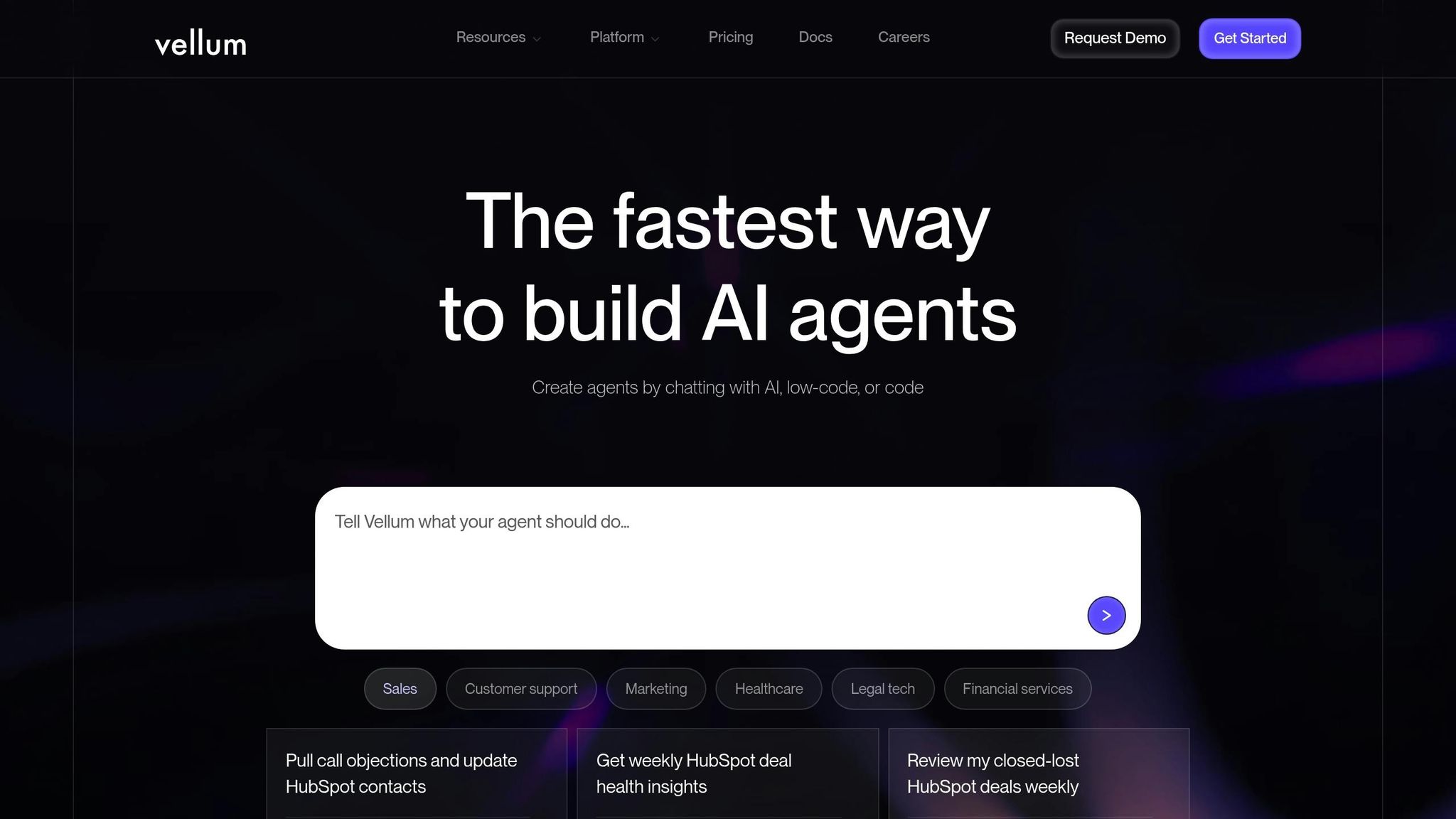
Vellum AI is a low-code platform designed to build, test, and manage advanced AI workflows and agents. It’s tailored for teams that need to create production-ready, multi-step AI processes that use large language models, interact with external APIs, and maintain strict governance standards. Unlike tools that simply connect SaaS applications, Vellum AI is built for more complex tasks, allowing AI agents to make decisions with oversight baked in. This makes it particularly useful for organisations aiming to standardise AI processes while ensuring precision and control.
The platform combines a visual workflow builder with developer-friendly tools like SDKs, integrated evaluations, tracing, and environment management. These features make it easier for teams to collaborate effectively. Users can A/B test prompts, track the performance of different versions, and monitor agent behaviour over time using built-in monitoring tools. It also supports separate environments - such as development, staging, and production - so teams can safely test changes and roll them back if necessary.
Scalability Benefits
Vellum AI is described as ideal for teams looking to standardise AI workflows across their organisation, enabling rapid development and scalability without sacrificing accuracy. The platform’s infrastructure is built to handle high-volume, multi-step AI tasks across various departments, making it suitable for production-level automation. As more teams integrate AI agents into workflows that involve customer data and core business processes, centralised governance and audit readiness become increasingly important.
Its support for reusable components and shared workflows allows different departments - such as marketing, operations, and customer service - to build on existing logic rather than starting from scratch. This approach not only saves time but also ensures consistency. Additionally, the platform’s robust monitoring and evaluation tools help organisations refine their AI processes as they scale.
These features make Vellum AI a strong choice for businesses across the UAE’s diverse industries.
UAE‑Centric Use Cases
In the UAE, Vellum AI offers practical applications across various sectors. For financial services in Dubai and Abu Dhabi, AI agents can summarise KYC documents, classify transaction notes, or address internal policy questions while maintaining audit trails that align with local regulations. Government entities can deploy multilingual virtual assistants to handle enquiries and process forms in both Arabic and English.
In real estate and property management, agents can assist with tenant queries, route maintenance requests, or summarise contracts by combining large language model (LLM) reasoning with external property management APIs. Tourism and hospitality businesses can use concierge-style agents to manage guest queries across time zones, integrating seamlessly with booking and CRM systems while ensuring accuracy and appropriate tone through close monitoring. Vellum’s focus on governance, monitoring, and versioning makes it particularly suited for the UAE’s regulated and high-stakes environments.
A consultancy like Wick, which specialises in building digital marketing ecosystems and AI-driven personalisation, could utilise Vellum as the backbone for its AI solutions. For instance, Wick could create AI content assistants to generate and localise marketing copy for UAE audiences, develop lead qualification agents to score inbound leads and integrate them into CRMs, or build personalisation engines that combine analytics with LLM outputs to deliver tailored messaging.
Pricing Structure
Vellum offers a free plan for those just starting out, with paid plans beginning at USD 25 per month (approximately AED 90–95). For startups and enterprises, custom pricing options are available, which may be based on usage or the number of seats. For businesses in the UAE, the free and lower-cost plans provide a risk-free way to experiment with AI agents and validate their use cases before committing to a larger deployment. Companies should evaluate their expected workflow volume and team size to estimate costs, while also factoring in potential savings from improved efficiency and reduced manual labour in areas like customer service and compliance.
sbb-itb-058f46d
5. Lindy
Key Capabilities
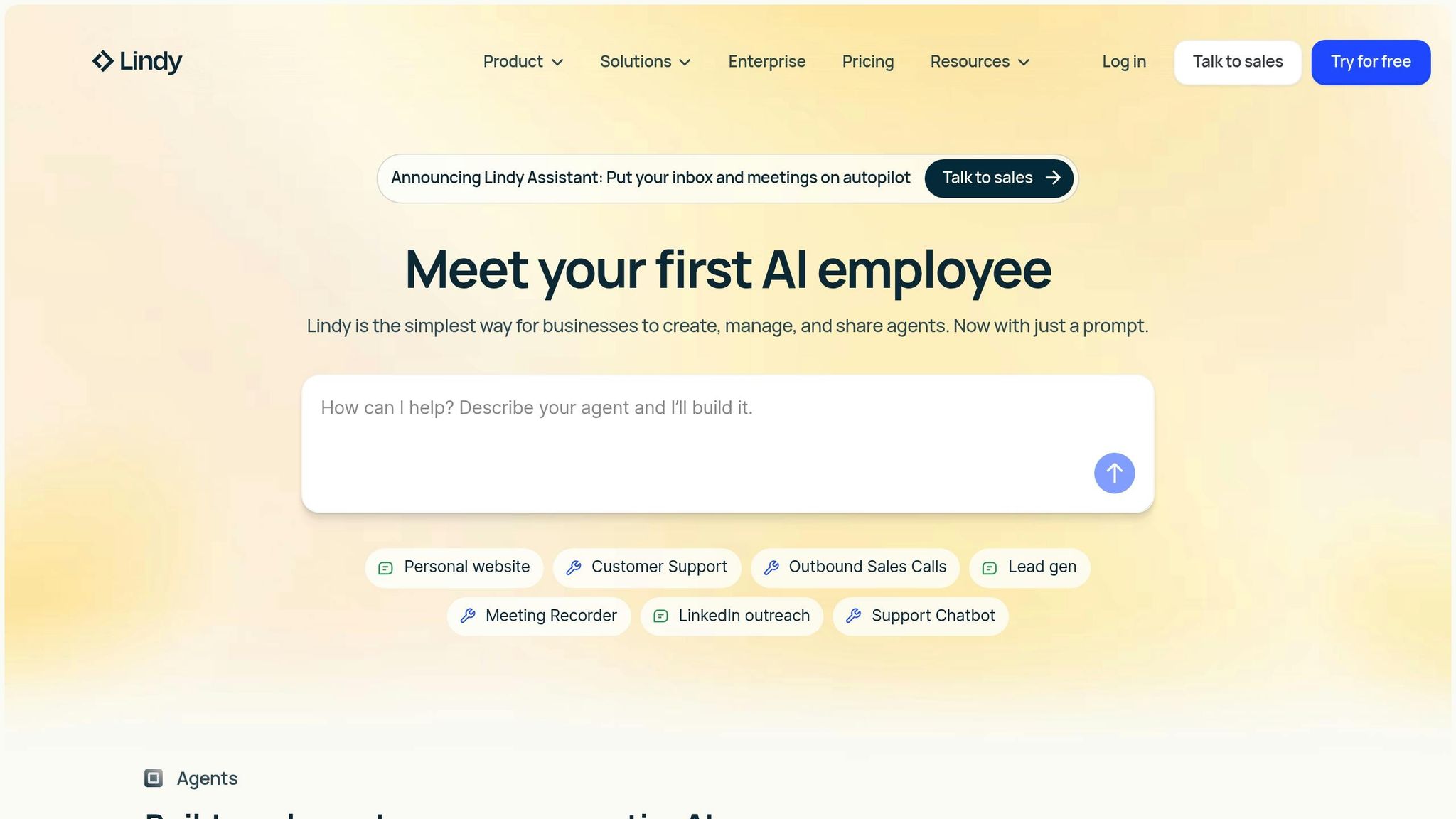
Lindy creates AI-powered employees that help businesses streamline tasks in sales, customer support, and operations. Rather than just linking apps, Lindy builds AI teammates capable of reading and writing emails, updating CRM records, qualifying leads, scheduling meetings, crafting personalised responses, and managing multi-step workflows - all through natural-language commands. Even non-technical users can easily define and adjust agent roles in plain English. With over 4,000 integrations, Lindy works seamlessly with popular tools like Gmail, HubSpot, Salesforce, Slack, Notion, and Google Sheets. It also includes AI voice capabilities, making it versatile for both email and voice-based interactions. This user-friendly system ensures businesses can scale effortlessly as their workload grows.
Scalability Benefits
Lindy simplifies scaling by using role-based automation, eliminating the need for complicated flowcharts. Its natural-language setup allows businesses to quickly deploy and adjust workflows as task volumes rise. Independent reviews consistently place Lindy among the top tools for automating sales operations and customer support. This combination of functionality and simplicity makes it an excellent choice for UAE businesses aiming to expand their customer-facing operations during high-demand periods or across different time zones.
UAE-Centric Use Cases
Lindy is particularly well-suited for UAE businesses, offering practical applications tailored to the local market. For instance, in the e-commerce sector, companies can leverage Lindy during Ramadan sales peaks to automate customer support. By integrating with platforms like Noon or Amazon.ae, Lindy can handle inquiries in both Arabic and English using AI voice capabilities. Additionally, a consultancy like Wick, which specialises in building data-driven marketing ecosystems, could use Lindy agents to automate lead qualification, nurturing, and routing directly into CRMs. This creates a seamless handoff from marketing efforts to sales conversion.
Pricing Structure
Lindy provides a free plan for testing agents before committing to a subscription. Paid plans start at around AED 150–185 per month (USD 39.99–49.99), making it affordable for UAE SMEs to experiment with agents like Sales or Support while tracking efficiency improvements. This competitive pricing makes Lindy an appealing option for growing businesses in Dubai’s tech hubs and across the Emirates.
I built an AI Agent in 43 min to automate my workflows (Zero Coding)
Tool Comparison Overview
Choosing the right automation tool involves aligning it with your team's expertise, scalability requirements, and budget. This article examines five platforms tailored for various audiences and use cases in the UAE market. The table below summarises their core focus areas, scalability options, pricing, and UAE-specific applications.
| Tool | Main Focus | Target Users | Scalability Features | Pricing Model | Relevant UAE Applications |
|---|---|---|---|---|---|
| Gumloop | AI-driven visual workflows with built-in LLMs and templates | Solo creators, marketing teams, and SMEs needing AI workflows without API management | Visual canvas, pre-built templates, and simple workflow setup | Free plan; paid plans from USD 37–97/month | Multilingual content automation (Arabic/English); internal contract analysis (free zone vs. mainland); lead qualification for real estate and hospitality |
| Zapier | No-code workflow automation with 8,000+ app integrations | Non-technical users, operations and marketing teams, and SMEs seeking ready-to-use automations | Extensive app integrations, multi-step workflows, and AI-enhanced templates | Free tier; paid plans from USD 29.99/month | Connecting regional e-commerce platforms and payment gateways; syncing leads from social media to CRMs; automating Ramadan campaign notifications |
| n8n | Self-hosted, open-source automation for technical users | Developers, data engineers, and IT teams prioritising data residency and compliance | Self-hosting, high workflow volume handling, and 5,000+ community templates | Free trial; paid plans for production workflows | Self-hosted workflows for UAE/GCC-regulated sectors like finance and healthcare; custom integrations with on-premise systems for government entities |
| Vellum AI | Enterprise-grade AI agents with governance and testing | Engineering, data, and product teams building scalable AI agents | SDKs, controlled environments, versioning, and performance monitoring | Free plan; paid plans from USD 25/month, with enterprise/custom pricing | Centralising AI agents for large enterprises; standardising customer service bots across brands; monitoring Arabic language AI models |
| Lindy | AI "employee" builder for sales and customer support | Sales and customer support leaders, RevOps teams scaling operations | Natural-language workflow iteration, role-based automation, and thousands of integrations | Free plan; paid plans from USD 39.99–49.99/month | AI "employees" for WhatsApp, email, and call support; triaging Arabic and English queries for airlines, property developers, and retail; automating CRM updates for B2B sales teams |
These tools address key UAE business needs, from bilingual workflows to local data residency.
For UAE SMEs using CRM, WhatsApp, and marketing platforms, Gumloop or Zapier offer quick, no-code automation solutions. On the other hand, n8n is ideal for mid-size and large organisations with dedicated IT teams requiring control over infrastructure and data residency - an essential factor for banks, healthcare providers, and government-related entities. Vellum AI supports large enterprises managing complex AI governance and performance tracking, while Lindy is perfect for fast-growing SMEs and mid-market companies looking to deploy AI agents for sales and customer support without immediately increasing headcount.
These platforms integrate seamlessly with CRM, analytics, and content tools. A consultancy like Wick, which specialises in digital marketing, automation, and AI-driven strategies, can assist UAE businesses in designing and optimising workflows across tools. For instance, Wick might configure a combination of Gumloop, Zapier, and Lindy to create a unified, data-driven growth strategy for sectors such as tourism, real estate, or retail.
When selecting a tool, UAE businesses should evaluate factors such as hosting options (cloud vs. self-hosted), compatibility with regionally popular tools and payment systems, scalability features (limits on tasks, workflows, and users), and pricing structures (per-task, per-user, or enterprise contracts). Since vendors list prices in USD, converting these to AED can simplify internal budgeting and approvals.
Conclusion
The five platforms highlighted in this article - Gumloop, Zapier, n8n, Vellum AI, and Lindy - offer UAE businesses a versatile automation toolkit. These tools cater to everything from simple no-code workflows to advanced AI solutions, all while addressing the UAE's unique operational and regulatory environment. By leveraging these platforms, organisations can reduce manual tasks, maintain consistency, and scale their operations without increasing costs or headcount.
For UAE-based SMEs and marketing teams, Zapier and Gumloop provide an excellent starting point. Their user-friendly interfaces and wide range of integrations make them ideal for quick, impactful results. On the other hand, businesses with technical teams or stricter data residency requirements - like banks, healthcare providers, or government-linked entities - might find n8n's self-hosting capabilities or Vellum AI's governance tools more suitable. Lindy, with its ability to handle tasks in both Arabic and English, is a great fit for fast-growing sales and support teams looking to streamline customer interactions and CRM updates. These initial wins can set the stage for a broader, more strategic automation framework.
The key to unlocking the full potential of automation lies in integrating these tools into a cohesive digital strategy. By connecting workflows to CRM systems and analytics platforms, businesses can ensure automation not only saves time but also drives revenue and aligns with the UAE market's demands. For those seeking guidance, a consultancy like Wick can assist in aligning automation projects with overarching digital goals, building on the success stories shared earlier.
To transition from small-scale experimentation to organisation-wide automation, start by identifying 3–5 high-impact workflows. Use visual builders to prototype these processes, then measure improvements in time savings and error reduction before standardising them. Metrics like response times, cost per lead, and hours saved per week can help quantify the benefits and provide a clear case for scaling up.
Automation should be viewed as an ongoing journey that grows with your business. Assign clear ownership, encourage team input for new automation ideas, and allocate a recurring AED budget for experimentation and refinement. Regular performance reviews and governance checks will ensure that workflows remain effective and reliable as your organisation - and the UAE's digital landscape - continues to evolve.
FAQs
How can AI tools like Gumloop and Zapier help businesses in the UAE operate more efficiently?
AI tools like Gumloop and Zapier are reshaping the way businesses in the UAE handle their operations. By automating repetitive tasks and connecting multiple digital platforms, these tools reduce the need for manual work. The result? Faster processes and improved data accuracy that save time and minimise errors.
Wick takes this a step further with its AI-powered automation strategy. It helps businesses build integrated digital ecosystems tailored to their needs. This approach allows companies to refine their marketing strategies, boost customer engagement, and handle data more efficiently - all while catering to the specific demands of the UAE market.
What is the difference between self-hosted and cloud-based automation platforms?
Self-hosted automation platforms, such as n8n, operate directly on your own infrastructure. This setup gives you complete control over your data and allows for extensive customisation. That said, it does come with its challenges - manual updates, ongoing maintenance, and scalability limitations unless you invest heavily in resources.
In contrast, cloud-based platforms are managed by external providers. They offer automatic updates, effortless scalability, and the convenience of remote access. However, this ease of use comes at the expense of having less direct control over your data and infrastructure.
The choice between these two options boils down to your specific business needs, the resources at your disposal, and how you weigh control against convenience.
How does Lindy support bilingual customer service in Arabic and English?
Lindy provides seamless bilingual customer support in both Arabic and English by utilising AI-powered language processing tools. These tools enable the system to precisely comprehend, interpret, and respond in both languages, ensuring clear and effective communication.
By breaking down language barriers, Lindy helps businesses deliver smooth and reliable support to a wide range of audiences across the UAE and beyond.