

Blog / AI Tools for Marketing ROI Measurement
AI Tools for Marketing ROI Measurement
Measuring marketing ROI is a challenge for 78% of Dubai fintech CMOs despite the UAE’s tech-savvy population (99% online, 97% smartphone usage). AI tools are solving this by offering real-time insights, accurate attribution, and predictive analytics, helping marketers track key metrics like Customer Lifetime Value (CLV), Cost Per Acquisition (CPA), and Return on Ad Spend (ROAS).
Key Takeaways:
- AI simplifies ROI tracking: Tools like Google Analytics 4 (GA4) and Power BI integrate data across platforms, ensuring every dirham spent is tied to measurable outcomes.
- Focus on high-impact metrics: CLV identifies valuable customers, CPA evaluates acquisition costs, and ROAS confirms revenue efficiency.
- AI-driven frameworks: Marketing Mix Modelling (MMM) and Multi-Touch Attribution (MTA) combine to provide both high-level and detailed ROI insights.
- Privacy compliance: Tools align with UAE’s Personal Data Protection Law (PDPL), ensuring data security.
AI transforms fragmented marketing data into actionable insights, helping UAE businesses optimise budgets and drive revenue growth.
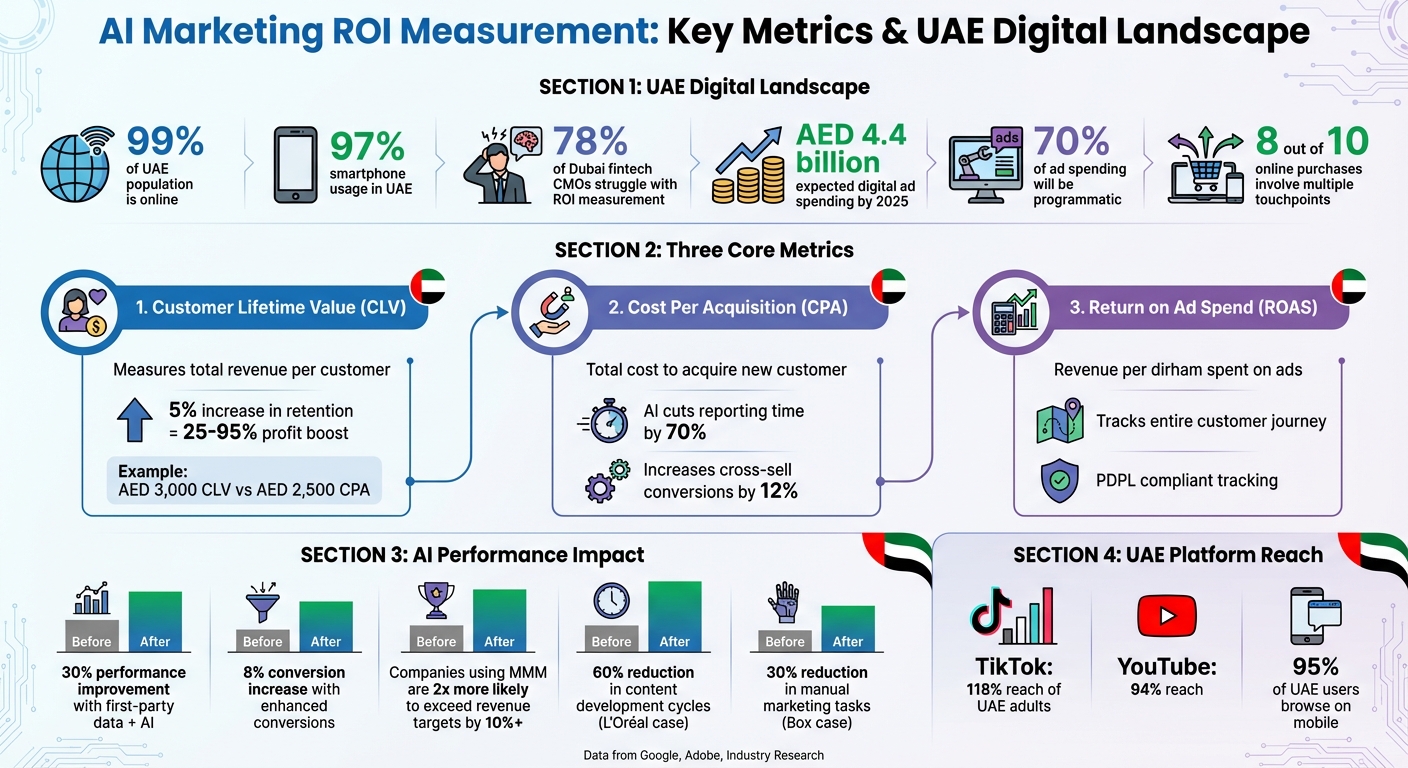
AI Marketing ROI Measurement: Key Metrics and UAE Digital Landscape Statistics
Measuring ROI of AI-Driven Campaigns | Exclusive Lesson
Key Metrics for Measuring Marketing ROI with AI Tools
Tracking the right metrics can turn guesswork into strategic growth, especially for businesses in the UAE. With digital ad spending in the UAE expected to surpass AED 4.4 billion by 2025 - 70% of which will be programmatic - it’s crucial to go beyond surface-level metrics like impressions and clicks. Instead, focus on numbers that directly impact your revenue.
When it comes to measuring marketing ROI with AI tools, three metrics stand out: Customer Lifetime Value (CLV), Cost Per Acquisition (CPA), and Return on Ad Spend (ROAS). Together, these metrics offer a clear picture of how your marketing efforts are performing. CLV helps identify your most valuable customers, CPA shows how efficiently you're bringing them in, and ROAS measures the revenue generated for every dirham spent on ads. This data-driven approach enables CFOs to make smarter budget decisions.
AI tools bring these metrics to life by integrating data from your CRM, website analytics, and ad platforms. They can predict future trends and flag potential issues before they hurt your budget. Research shows that marketers leveraging first-party data with AI tools see a 30% improvement in performance compared to those who don’t. For UAE businesses, where 99% of the population is online, this level of real-time insight is a game-changer. Let’s dive into how CLV, CPA, and ROAS work as the foundation of AI-powered ROI measurement.
Customer Lifetime Value (CLV)
CLV measures the total revenue a customer is expected to generate throughout their relationship with your business. AI calculates this by analyzing customer behavior patterns, such as purchase frequency, average order value, engagement levels, and even the likelihood of churn. Advanced machine learning models can estimate individual CLV accurately, even when data is limited. This allows you to identify high-value customers for upselling and flag at-risk ones for retention.
The financial impact of focusing on CLV is huge. Studies show that increasing customer retention by just 5% can boost profits by 25% to 95%. AI tools can also suggest the next best actions, such as triggering automated responses when a customer’s activity drops or when they abandon a cart. By combining data from your CRM, support tickets, and product usage, AI offers a 360-degree view of your customers, helping you understand who your best customers are and why they stick around - or leave.
For businesses in the UAE, where acquisition costs are rising, comparing CLV to CPA is essential. For example, if an Instagram campaign delivers a CLV of AED 3,000 but costs AED 2,500 per acquisition, the margin is too slim. AI tools can highlight these insights, allowing you to redirect your budget to channels with a better CLV-to-CPA ratio.
Cost Per Acquisition (CPA)
CPA measures the total cost of acquiring a new customer, including ad spend, creative production, and platform fees. This metric is critical for evaluating whether your growth strategy is sustainable. In the UAE, where smartphone usage is extremely high, AI tools optimise CPA by using data-driven attribution models instead of outdated last-click methods. These models assign credit to all touchpoints in a customer’s journey - whether it’s a TikTok ad, a WhatsApp click, or a Google search - giving you a complete picture of what drives conversions.
AI also helps by detecting anomalies in real time, such as sudden spikes in cost-per-click (CPC), budget overruns, or audience fatigue. Predictive models can forecast short-term KPIs, enabling you to make quick adjustments. Industry data suggests AI-powered reporting can cut reporting time by 70% and increase cross-sell conversions by 12%.
For non-ecommerce businesses, which are common in the UAE’s B2B and professional services sectors, AI tools can assign monetary values to leads. For instance, if one in ten leads converts for AED 1,000, you can set a lead value of AED 100 in GA4 to track ROI more effectively. This turns abstract metrics like "form submissions" into tangible revenue figures. Additionally, with 95% of UAE users browsing on mobile, AI can identify whether mobile acquisition costs are inflated due to poor user experience.
Return on Ad Spend (ROAS)
ROAS focuses on the revenue generated for every dirham spent on advertising. While CPA measures acquisition efficiency, ROAS confirms whether your ad spend is driving actual revenue. AI tools track the entire customer journey, from the first ad impression to the final purchase, across all major digital channels.
Traditional last-click models often miss the cumulative impact of multiple interactions. AI-driven attribution models, like those in GA4, distribute credit proportionally across all interactions that contribute to a conversion. This approach ensures your budget is allocated based on true revenue impact rather than the last click alone.
Compliance is another critical factor. GA4’s privacy-first design aligns with the UAE’s Personal Data Protection Law (PDPL), allowing businesses to track anonymised, consent-based data without legal risks. For UAE companies, this means ROAS can be measured accurately while maintaining customer trust and adhering to local regulations.
AI Frameworks for Accurate ROI Tracking
Measuring marketing ROI accurately requires AI frameworks that go beyond basic tracking. Two essential approaches - Marketing Mix Modelling (MMM) and Multi-Touch Attribution (MTA) - work together to provide a comprehensive view. MMM offers a high-level perspective by analysing aggregated data like spending, sales, and seasonal trends. On the other hand, MTA focuses on the finer details, tracking individual customer interactions in real time. Modern AI tools integrate these two approaches using bi-directional transfer learning, ensuring consistency between strategic planning and day-to-day optimisation for businesses in the UAE. MTA enriches MMM with detailed user-level data, while MMM helps refine MTA's evaluation of touchpoints. This unified method is especially important in the UAE, where 8 out of 10 online purchases involve multiple touchpoints.
"Each measurement method has its own blind spots. But when layered together, they start to fill in the gaps left by one another. It's like stacking slices of Swiss cheese - each piece has holes, but when you stack the pieces, the holes close." - Matt Scharf, Vice President at Adobe
Let’s take a closer look at how MMM and MTA operate to achieve precise ROI attribution.
Marketing Mix Modelling for ROI Attribution
MMM uses historical data to evaluate how different marketing channels contribute to revenue. It takes into account external factors like seasonality, competitor actions, and economic conditions. AI-driven MMMs employ advanced multiplicative nonlinear regression models, which capture the complex interplay between channels. For example, they can reveal how TV ads and social media campaigns amplify each other’s impact. Older additive methods often miss these synergies, leading to significant errors in conversion estimates.
The benefits of accurate MMM are clear. Companies that prioritise MMM are more than twice as likely to exceed their revenue targets by at least 10%. Tools like Google’s open-source Meridian framework integrate granular digital signals - such as search query volumes, reach, and frequency - allowing for precise measurement of both online and offline channels. AI also enables scenario simulations, helping businesses test different budget allocations before committing resources.
Privacy is another strength of MMM. Since it doesn’t depend on cookies or personal data, it fully complies with the UAE’s Personal Data Protection Law (PDPL). MMM can also work alongside incrementality testing, which compares exposed and control groups to confirm whether campaigns drive results that wouldn’t happen naturally. This ensures the models capture true causal relationships, not just correlations.
Multi-Touch Attribution Models
While MMM provides long-term strategic insights, MTA focuses on real-time, tactical data. It assigns credit to every customer interaction leading up to a conversion, using data-driven attribution to assess each touchpoint’s actual impact. AI models pinpoint the combinations of interactions that deliver the best ROI, enabling quick budget adjustments.
"Both types of paths - converting and non-converting - are important in building multi-touch attribution models. The contrast between the two tells us if a marketing touchpoint is effective in driving a conversion… or not." - Bowen Wang, AI/ML Engineering Manager at Adobe
For businesses in the UAE, MTA offers the granularity needed for tactical decision-making. However, it does have its limitations. MTA struggles with offline channels like TV or radio and faces challenges due to privacy regulations and the decline of third-party cookies. As a result, savvy marketers use MTA for short-term digital optimisation while relying on MMM for broader, cross-channel strategies. For instance, advertisers using enhanced conversions for leads - feeding first-party data into MTA models - see an 8% increase in conversions compared to those using standard imports. Additionally, integrating first-party data from CRMs with AI-powered MTA can boost performance by up to 30%.
sbb-itb-058f46d
Top AI Tools for Marketing ROI Measurement
Building on our earlier discussion about key ROI metrics and AI frameworks, let’s dive into some standout AI tools that are reshaping how businesses measure and optimise marketing performance. For companies in the GCC, where smartphone penetration is an impressive 97% in the UAE, and digital channels dominate, these platforms can help transform marketing efforts into precise, data-driven strategies.
Google Analytics 4 (GA4) is a game-changer with its Data-Driven Attribution engine. Unlike outdated last-click models, GA4 uses machine learning to assign credit to every touchpoint based on its role in driving conversions. Its Predictive Audiences feature identifies users most likely to convert, while the Scenario Planner helps marketers allocate budgets more effectively across channels. For instance, a retailer reported a significant boost in sales after leveraging GA4’s predictive insights. Plus, its privacy-first design ensures compliance with the UAE’s Personal Data Protection Law (PDPL). Combined, these features enable real-time, visually rich analysis that takes the guesswork out of ROI measurement.
Power BI and Looker Studio excel at turning raw data into actionable insights through interactive dashboards. These tools include real-time anomaly detection, which flags sudden drops in qualified leads or unexpected changes in ROAS, helping marketers act before budgets spiral out of control. Visual tools like heatmaps can break down performance by Emirate, while bar charts compare ROAS across platforms like WhatsApp, TikTok, and YouTube. TikTok, for instance, reaches an estimated 118% of UAE adults due to multiple account usage. By integrating AI-driven anomaly detection with automated reporting, businesses can cut reporting time by up to 70%, allowing teams to focus on strategic initiatives.
SurferSEO and Answer Engine Optimisation (AEO) tools extend ROI tracking into emerging areas like Search Everywhere Optimisation (SEVO). These tools monitor brand mentions across AI-powered platforms like ChatGPT and Google AI Overviews, providing insights into how brands perform in non-traditional search contexts. Additionally, creating content rich in entities enhances brand visibility and helps convert interactions that don’t follow traditional search patterns.
"The earlier you get these systems and tools in place, the more data you will have to power all future AI integrations." - Think with Google Editorial Team
Together, these tools form the foundation of a cohesive AI-driven strategy, aligning perfectly with Wick’s Four Pillar Framework. By adopting them, businesses can unlock new levels of precision and efficiency in their marketing efforts.
Implementing Wick's Four Pillar Framework with AI Tools
Wick's Four Pillar Framework brings AI tools together into a cohesive digital ecosystem for businesses in the GCC region. Instead of treating AI initiatives as standalone experiments, this strategy connects projects to create a ripple effect of benefits - like bolstering brand trust, improving team efficiency, and driving revenue growth. By uniting these efforts, companies can achieve more consistent and scalable gains.
Build & Fill: Maximising Website and Content Performance
The Build & Fill pillar focuses on developing impactful digital assets and tracking their direct contribution to revenue. Wick uses GA4's data-driven attribution to identify key actions - such as WhatsApp clicks, lead form submissions, and demo bookings - as conversions, assigning each a monetary value.
For content optimisation, tools like SurferSEO ensure articles perform well not only in traditional search results but also on AI-powered platforms like ChatGPT and Google AI Overviews. This strategy, known as Answer Engine Optimisation (AEO), is becoming increasingly important as AI platforms prioritise structured, entity-rich content. Incorporating structured FAQPage schema further boosts the chances of brand mentions.
"The earlier you get these systems and tools in place, the more data you will have to power all future AI integrations." - L'Oréal, which demonstrated the impact of AI by reducing content development cycles by 60% using generative AI.
Automated dashboards built with Looker Studio integrate GA4 data in real time, eliminating the need for manual CSV exports. This provides instant insights into which content drives conversions. Such automation can cut reporting time by up to 70%, allowing marketing teams to shift their focus from data wrangling to strategic planning. The next step? Using predictive AI to personalise outreach and amplify marketing ROI.
Tailor & Automate: Customised Marketing at Scale
The Tailor & Automate pillar uses predictive AI to create personalised experiences on a large scale. Wick identifies high-value customers through behavioural data and builds "seed audiences", which AI then expands into look-alike segments for real-time outreach on platforms like TikTok (reaching 118% of UAE adults) and YouTube (with 94% reach). This ensures marketing messages are delivered to the right audience at the right time, increasing conversion rates while reducing wasted effort.
Businesses that use first-party customer data to power AI see a 30% boost in performance compared to those that don't. Wick leverages Google Ads Data Manager to unify data from CRMs and apps, creating a feedback loop that continuously enhances targeting precision. For instance, Box, a cloud storage company, used AI-powered workflow automation to cut manual marketing tasks by 30%, enabling teams to focus on strategic goals. Similarly, Wick employs autonomous agents via platforms like Cubeo AI to handle repetitive tasks - such as lead enrichment, competitor tracking, and budget adjustments - ensuring campaigns evolve in real time without constant human input.
"Your first-party data is your key competitive edge, serving as the fuel to optimise your campaigns, reach the right audience at the right time, and boost performance." - Kamal Janardhan, Senior Director, Product Management, Analytics, Insights, and Measurement, Google
Conclusion
GCC businesses are at a pivotal moment: adopting AI-driven measurement is no longer optional - it's essential to stay competitive. Companies leveraging first-party data with AI have already seen a 30% boost in performance.
"The more we can speak the language of return on investments (ROI), the more we elevate marketing from a cost centre to a strategic growth partner." - Wassim Derbi, Head of Strategic Marketing and Brand Communication, Hyundai UAE and Genesis UAE
In the UAE, where internet usage is nearly universal and digital spending continues to soar, precision in marketing is not just a goal - it's a necessity. Wick's Four Pillar Framework offers a way to achieve this precision by seamlessly integrating AI tools into a cohesive system. Instead of treating attribution models, predictive analytics, and automation as isolated efforts, this unified approach delivers compounded benefits like stronger brand trust, better team productivity, and measurable revenue growth.
But insights alone won't drive success - execution matters. Brands in the GCC that embrace agility stand to gain the most. This means launching campaigns swiftly, experimenting with multiple creative options, and refining strategies based on real-time data rather than waiting for perfection. Using strategies like Wick's Four Pillar Framework, businesses can turn speed and adaptability into measurable ROI. Start by establishing performance benchmarks, consolidating your data streams, and implementing tools like GA4 for data-driven attribution or Google's Meridian for Marketing Mix Modelling.
AI is transforming marketing ROI, linking every dirham spent to concrete outcomes - whether it's leads, sales, bookings, or app installs.
FAQs
How do AI tools help UAE businesses comply with the PDPL while measuring marketing ROI?
AI tools play a crucial role in ensuring compliance with the UAE’s Personal Data Protection Law (PDPL), as outlined in Federal Decree-Law No. 45 of 2021. These tools are designed with privacy-by-design principles, meaning they classify personal data from UAE residents and ensure it’s processed solely for the purposes that users have explicitly consented to. Features like consent-management systems help capture user preferences - whether through cookies or forms - while maintaining a detailed audit trail to meet regulatory requirements.
Moreover, these platforms implement data-minimisation practices, ensuring that only necessary data is retained. They automatically anonymise or delete information once its retention period expires. AI tools also simplify Data Subject Access Requests (DSARs), empowering individuals to request corrections, deletions, or even data portability with ease.
Advanced solutions, such as those integrated into Wick’s Four-Pillar Framework, come pre-configured for PDPL compliance. They can generate audit-ready reports in AED (e.g., AED 1,000) and reflect dates in the UAE’s DD-MM-YYYY format (e.g., 20-01-2026). This gives GCC marketers the confidence to optimise their ROI while staying fully aligned with UAE privacy laws.
What are the advantages of combining Marketing Mix Modelling (MMM) and Multi-Touch Attribution (MTA) for measuring marketing ROI?
Using Marketing Mix Modelling (MMM) and Multi-Touch Attribution (MTA) together creates a well-rounded approach to analysing and improving marketing ROI. MMM focuses on providing a broader, long-term perspective by evaluating the effectiveness of various marketing channels. Meanwhile, MTA dives deeper, offering precise insights into how specific customer interactions influence conversions.
When these two methods are combined, you get the best of both worlds: a strategic, big-picture view of your overall marketing efforts, paired with detailed insights into individual customer journeys. This combination helps you make smarter budgeting choices, optimise resource allocation, and scale your campaigns more effectively - an approach that’s especially valuable in dynamic and diverse markets like the UAE.
How does AI enhance the accuracy and speed of measuring Customer Lifetime Value (CLV)?
AI-powered tools make calculating Customer Lifetime Value (CLV) faster and easier by analysing real-time data like transactions, customer behaviours, and demographics. These tools rely on advanced algorithms to spot patterns, such as potential churn risks or cross-sell opportunities, enabling businesses to prioritise high-value customer groups and allocate marketing budgets more efficiently.
By using unified data systems, AI tackles common challenges like data silos and ensures CLV calculations stay relevant, even with changing factors like seasonal trends (think Ramadan or UAE National Day) or new product launches. Businesses can even test scenarios - like how a 10% discount might affect specific customer groups - and make accurate, data-driven decisions in AED. Wick incorporates these insights into its Four-Pillar Framework, blending predictive analytics with tailored strategies to help UAE enterprises achieve long-term growth.