

Blog / AI in Real-Time Trigger Automation

Wick
December 27, 2025AI in Real-Time Trigger Automation
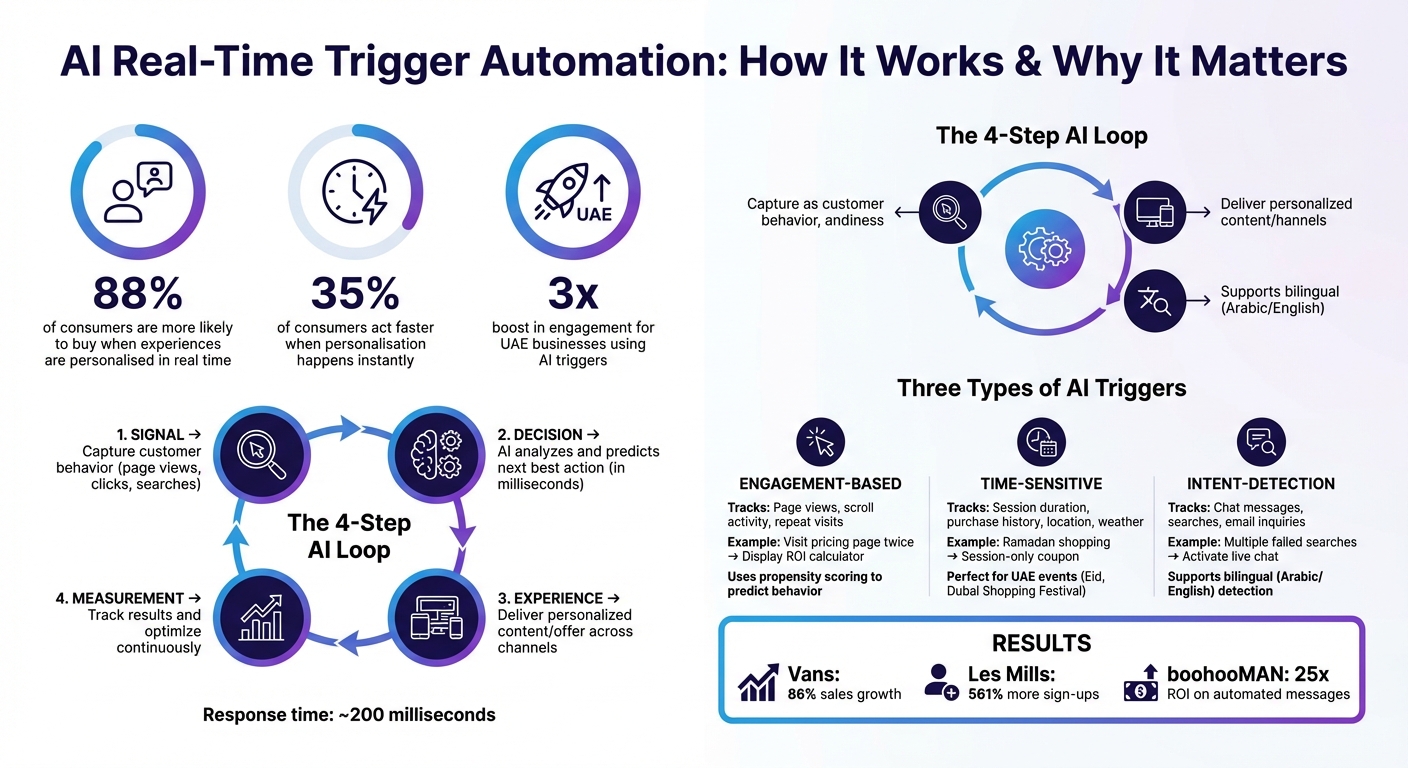
AI-powered real-time triggers are transforming how businesses engage customers, especially in the UAE. By processing live buyer signals in milliseconds, these systems create personalised experiences that drive higher engagement and sales. Here’s what you need to know:
- Why It Matters: 88% of consumers are more likely to buy when experiences are personalised in real time, and 35% act faster when this happens instantly.
- How It Works: AI follows a 4-step loop - Signal → Decision → Experience → Measurement - adapting to customer actions in milliseconds.
- Key Benefits for UAE Businesses: Industries like retail and real estate use AI triggers to handle bilingual communication, high-traffic events (e.g., Ramadan, Dubai Shopping Festival), and cart abandonment, boosting engagement by up to 3x.
- AI Technologies: Predictive analytics, natural language processing (NLP), and omnichannel orchestration enable smarter, faster responses across platforms.
- Results: Brands like Vans and Les Mills have seen up to 86% sales growth and 561% more sign-ups using AI-driven campaigns.
AI triggers are no longer optional - they’re essential for staying competitive in today’s customer-driven market.
AI Real-Time Trigger Automation: 4-Step Process and Key Benefits
This Is the Smartest Way to Use AI for Marketing in 2025
Main Types of AI-Powered Real-Time Triggers
AI-powered triggers can be grouped into three key categories, each designed to pick up on specific buyer behaviours and respond in a matter of milliseconds. Think of it like swapping out a fixed-schedule "bus" system for a personalised "chauffeur" - delivering customised actions exactly when they're needed. Here's a closer look at these trigger types and how they work in practice.
Engagement-Based Triggers
These triggers track live user behaviours - like page views, scroll activity, or repeat visits - and adjust the experience on the fly. For instance, if someone visits your pricing page twice, the system might display an ROI calculator or offer a concierge demo. Using propensity scoring, AI can predict whether a customer is likely to return or if they need an extra nudge, such as a discount, to finalise a purchase. This is particularly relevant in the UAE, where cart abandonment rates remain a challenge. By offering hyper-targeted interactions, businesses can meet the region's growing demand for fast and personalised digital experiences.
While engagement triggers focus on user activity, timing-based triggers zero in on urgency.
Time-Sensitive Triggers
Timing can make or break a sale. AI analyses factors like session duration, purchase history, and even external cues such as weather or location to determine the perfect moment for an action. For example, a session-start trigger might issue a coupon valid only until the session ends, creating a sense of urgency. This feature is especially impactful for UAE businesses during key events like Ramadan, Eid, or the Dubai Shopping Festival, where AI can deliver time-limited offers tailored to seasonal shopping habits.
Intent-Detection Triggers
These triggers dive into unstructured data - like chat messages, voice calls, or email enquiries - to understand user intent and respond instantly. For example, if a user searches your site multiple times without finding what they need, AI can step in with a live consultation offer. In the UAE's bilingual landscape, intent-detection triggers can also identify language preferences from browser settings or chat interactions, seamlessly connecting users to Arabic or English support. Additionally, if someone hovers over pricing tiers or asks about bulk discounts, AI can provide a personalised ROI estimate or link them to a sales rep - all in real time.
| Trigger Type | Behavioural Signal | Real-Time Action Example |
|---|---|---|
| Engagement | Repeat visits to pricing page | Display an ROI calculator or volume pricing module |
| Time-Sensitive | User visits during Ramadan | Offer a session-only coupon valid until browser closes |
| Intent-Detection | Multiple unsuccessful searches | Activate live chat for personalised assistance |
AI Technologies Behind Real-Time Trigger Automation
Real-time triggers rely heavily on AI to analyse, predict, and coordinate actions across various touchpoints in milliseconds. These technologies act as the backbone of real-time engagement, seamlessly connecting data analysis with immediate customer interaction. For businesses in the UAE, understanding these systems can help elevate basic automation into smarter, more responsive marketing workflows. Let’s dive into how machine learning powers these dynamic processes.
Predictive Analytics and Machine Learning
Machine learning replaces rigid, rule-based systems with adaptable, probability-driven decisions. Instead of waiting until a customer abandons their cart, machine learning models calculate a "propensity score" - a prediction of how likely a customer is to return. This method allows businesses to avoid unnecessary discounts for customers who would buy regardless, preserving profit margins while targeting genuine abandoners.
"Traditional automation tells you what happened... while AI tells you why it happened and what's likely to happen next." - Samir ElKamouny, Founder, Fetch and Funnel
AI systems process real-time events - like page views, scroll depth, and interactions - and generate personalised experiences in about 200 milliseconds. For instance, in 2024, fashion retailer boohooMAN used predictive analytics to identify the best outreach methods for inactive customers. By focusing on SMS as the ideal channel for specific segments, they achieved a 5x ROI on UK SMS campaigns and a 25x ROI on automated birthday messages. Similarly, in June 2025, news app Upday leveraged Braze's Predictive Churn models to identify users likely to leave. Personalised push notifications reactivated 528,000 users.
Reinforcement learning takes this a step further by running thousands of micro-experiments to optimise triggers. In 2024, interior design brand bimago replaced traditional A/B testing with AI-driven contextual personalisation. The system automatically selected the best banner for each user based on their history and current session data, resulting in a 44% boost in conversion rates.
Natural Language Processing (NLP)
Natural Language Processing (NLP) analyses customer interactions - like chat messages, search queries, and emails - to understand intent, sentiment, and urgency. For example, NLP can detect when a customer struggles with search and redirect them to live support in either Arabic or English.
"Real‑time marketing (RTM) is the practice of listening to live buyer signals and delivering the next best experience in the same session, often in milliseconds." - Vinay Raj, Author, Expertise AI
NLP also drives Natural Language Generation (NLG), which creates on-brand copy instantly. A great example is restaurant reservation platform The Fork, which used an AI Copywriting Assistant in June 2025 to diversify its messaging. Under the leadership of Global CRM Manager Raffaella Accogli, the team developed fresh campaign concepts while staying true to their brand voice, increasing engagement variety. Additionally, NLP supports translation across 95+ languages, ensuring personalised messages resonate with the UAE’s diverse expatriate population.
The technology also enables sentiment-based routing. When NLP detects negative sentiment in a chat or email, it can escalate the issue to senior agents immediately, turning potential complaints into opportunities for retention. With 74% of enterprises using generative AI reporting ROI within the first year, NLP-powered triggers are proving their worth. By integrating language insights, businesses can create seamless cross-channel interactions.
Omnichannel Orchestration
AI ensures the right message is sent via the right channel at the perfect time. Omnichannel orchestration synchronises triggers across email, mobile, web, in-app, and even in-store interactions to deliver consistent customer experiences. Unlike static workflows, this approach dynamically adapts based on live engagement signals.
For example, BlaBlaCar implemented "Action Paths" in June 2025 to automate cross-channel journeys. By analysing real-time actions like ride searches, the AI selected the best message and timing, leading to a 30% increase in bookings and a 48% rise in click rates. The system adjusted to each user’s behaviour, creating a personalised journey.
Consider a scenario where a mobile user receives a WhatsApp message, followed by a desktop notification. This kind of coordination ensures consistency across platforms - a necessity for UAE businesses catering to customers across multiple touchpoints. Real-time data processing has been shown to drive 23% higher revenue growth compared to batch-only methods.
| AI Technology | Primary Function | Marketing Application |
|---|---|---|
| Machine Learning | Predicts customer behaviour and calculates propensity scores | Identifies which cart abandoners need incentives versus those likely to return naturally |
| Natural Language Processing | Analyses text to understand intent, sentiment, and urgency | Detects search issues and triggers live chat; routes negative sentiment to senior agents |
| Omnichannel Orchestration | Coordinates triggers across multiple platforms | Dynamically selects the best channel and timing based on real-time engagement signals |
Implementing AI Triggers with Wick's Four Pillar Framework
Wick's Four Pillar Framework offers a structured way to implement AI-powered triggers, addressing the challenges of fragmented tools. This approach divides the process into clear stages: the Capture & Store phase for establishing a strong data foundation, the Tailor & Automate phase for creating responsive workflows, and an ongoing optimisation cycle to fine-tune performance. For businesses in the UAE, this framework ensures compliance with local regulations while supporting real-time engagement across multilingual audiences. By grounding real-time signals in reliable data and agile workflows, this method builds on earlier discussions. Let’s dive into how to create a solid data infrastructure for deploying AI triggers effectively.
Building Your Data Infrastructure
The Capture & Store phase is all about consolidating customer data from various touchpoints into a unified view. Start by auditing your data sources - CRMs, analytics platforms, e-commerce systems, and support tools - and ensure they connect to a Customer Data Platform (CDP) via APIs or native integrations. Event streaming plays a key role here, capturing detailed signals like page views, scroll depth, and product interactions, and queuing them for near-instant decision-making. Identity resolution then links fragmented records (e.g., anonymous clicks tied to known email addresses) into cohesive customer profiles.
For example, in September 2025, a logistics company in Dubai used AI automation to cut manual errors by 70% and improve processing speed by 60%.
Privacy compliance is critical. Embed consent flags into your data system to align with UAE Federal Decree-Law No. 45 on Personal Data Protection. Collect only the data necessary for personalisation, and routinely delete outdated information to stay compliant.
"AI, Data, and CRM are how we achieve the promise of speaking directly to consumers with the thing that matters most to them." - Doug Martin, Chief Brand and Disruptive Growth Officer at General Mills
Once your data is consolidated and compliant, the next step is to transform it into actionable workflows using the Tailor & Automate phase.
Setting Up Automation Workflows
The Tailor & Automate phase turns unified data into actionable workflows. Start by mapping out customer journeys to identify key moments - like onboarding, renewal periods, or signs of churn - and pair these moments with specific triggers. For instance, you could deploy an ROI calculator when a user repeatedly visits your pricing page. Begin with simple triggers, such as cart abandonment, and gradually move to more advanced scenarios like dynamic pricing.
Take Grubhub’s example from October 2025: the company tackled low student adoption of its Campus programme by using adaptive onboarding workflows. By monitoring engagement in real time, they nudged students to link campus cards or activate subscriptions, resulting in an 836% ROI increase, a 20% boost in total orders, and a 188% rise in Grubhub+ Student signups. Similarly, foodora optimised message send times across over 700 European cities, achieving a 41% conversion rate and a 6% increase in push direct opens.
To ensure success, incorporate holdout feedback loops to measure incremental improvements. Test AI triggers on a small scale - like personalised email subject lines or product recommendations - before rolling them out to larger campaigns. Define clear eligibility rules, set frequency limits, and maintain compliance to align automated actions with your brand’s standards. For UAE businesses, it’s especially important to support both Arabic and English languages and integrate seamlessly with local banking and ERP systems.
Rules-Based vs. AI-Driven Triggers: A Comparison
AI-driven triggers take marketing to the next level, offering the personalisation and responsiveness discussed earlier. Here’s how they differ from traditional rules-based triggers:
| Feature | Rules-Based Triggers | AI-Driven Triggers |
|---|---|---|
| Response Speed | Manual or batch processing; subject to data lag | Real-time responses in milliseconds (approx. 200 ms) |
| Personalisation | Broad segments using simple "if-then" logic | 1:1 personalisation with predictive analytics |
| Accuracy | Relies on heuristics; prone to errors (0.55%–4.0%) | Learns and improves continuously; reduces errors by up to 70% |
| Scalability | Becomes unmanageable as complexity increases | Handles enterprise-scale operations autonomously |
| Decision-Making | Static; follows rigid, pre-defined paths | Adaptive; evolves with data patterns |
For instance, in 2024, Vans used Google’s Performance Max AI campaigns to create personalised customer journeys. By tailoring messages to diverse audiences - skateboarders, parents, and more - Vans achieved a 46% increase in conversions and an 86% boost in sales compared to their previous approach.
"The longtime dream for marketers has been the 'right ad, right person, right place, right time.' Today that dream is closer to reality than ever before." - Marie Gulin-Merle, Global VP of Ads Marketing at Google
Measuring and Improving AI Trigger Performance
After implementing AI triggers, the real work begins: measuring their effectiveness and fine-tuning them for better results. For businesses in the UAE, this means going beyond surface-level metrics like the total number of conversations. Instead, focus on five categories that truly impact business value: Speed, Resolution, Experience, Business Impact, and Compliance.
For instance, retail brands should aim for response times under 0.8 seconds and customer satisfaction scores of 82 or higher. On the other hand, banking institutions should prioritise first call resolution rates of 82% or above and compliance accuracy of at least 95%. Companies achieving these benchmarks often see revenue growth up to 70% higher than their competitors.
In the UAE, it’s particularly important to ensure that Arabic intent recognition surpasses 90% and that local privacy laws are strictly adhered to. Technical performance is another key factor: monitor latency percentiles (like P95 and P99) instead of averages, especially during high-traffic events like the Dubai Shopping Festival.
"AI's role goes well beyond tracking results. Half of leaders use it to spot behavioural patterns - analysing browsing, purchase, and engagement signals to better personalise content and offers." - BCG
These metrics not only help track performance but also lay the foundation for continuous improvements.
Key Performance Metrics
For each type of AI trigger, it's essential to define clear benchmarks. For example, triggered emails typically see 70.5% higher open rates and 152% higher click-through rates than generic email campaigns. Abandoned cart emails, meanwhile, can recover anywhere from 10% to 30% of lost sales. In the UAE, where smartphone penetration exceeds 98%, action-based push notifications are 480% more likely to be opened than traditional time-based emails.
Predictive metrics are especially valuable. Instead of focusing solely on past performance, look at forward-looking indicators like predictive customer lifetime value (CLV) or propensity scores, which estimate the likelihood of a customer returning within 30 days. In 2024, top-performing companies resolved 85.6% of tickets using AI chatbots, cutting resolution times by nearly 39%. For UAE businesses, tracking deflection rates is crucial - anything below 70% in industries like retail or travel indicates underperformance, given the high demand for 24/7 self-service options.
Technical monitoring is also vital. Use synthetic monitoring from UAE-based data centres to anticipate network issues, particularly during Friday-Saturday service peaks. For compliance, ensure your systems maintain 99.99% uptime ("Four Nines") and that failover systems are located in separate Central Zones within the UAE to meet data residency requirements.
Once benchmarks are set, rigorous testing ensures ongoing optimisation.
Testing and Refining Your Triggers
A continuous testing cycle is key: set clear objectives, design hypotheses, establish guardrails, test, measure, and document results. For example, in 2025, Too Good To Go doubled its message conversion rates and increased purchases by 135% through AI-driven multivariate tests. These tests compared discount-led messages with value-driven notifications like nearby availability alerts.
Move beyond traditional A/B testing to more adaptive methods like Multi-Armed Bandits (MAB), which adjust traffic to the best-performing variants in real-time. BUGECE used intelligent timing to optimise message delivery, boosting email open rates by 63% and signup conversions by 32%. Similarly, Rappi leveraged WhatsApp to re-engage inactive users, achieving an 80% increase in purchases compared to a control group.
To minimise risks, consider "canary releases", where new AI triggers are rolled out to a small audience - 1% to 5% - before wider implementation. This approach helps identify potential issues early. Additionally, configure triggers to automatically cancel if a customer completes the desired action during the delay period, preventing redundant messages. Keep communication respectful by limiting messages to user-friendly hours, such as 9:00 AM to 9:00 PM.
Regular data audits are critical for maintaining the accuracy of machine learning models. Poor data quality is one of the biggest risks to AI performance. For UAE businesses, ensure AI systems can differentiate between Emirati Arabic and other regional dialects, such as Levantine or Egyptian Arabic. Feed these insights back into your Data Management Platform to improve future audience segmentation and lookalike modelling.
Conclusion
Real-time AI triggers are transforming marketing efficiency across the UAE, where 65% of consumers express a preference for personalised content. Unlike traditional "if-then" rule-based systems, this technology introduces dynamic, responsive systems capable of adapting to customer behaviour in fractions of a second. This speed ensures businesses can act on customer intent before opportunities slip away. Companies leveraging these solutions report impressive outcomes, including a 30% or more boost in conversion rates while simultaneously cutting marketing costs by 15–20%.
To unlock these benefits, businesses in cities like Dubai and Abu Dhabi need a well-integrated strategy. A unified framework is essential, tying together data systems, automated workflows, and ongoing refinements. Wick's Four Pillar Framework offers a solid foundation by addressing key challenges like fragmented data, linguistic diversity, and regulatory compliance. It consolidates customer data, creates intelligent, behaviour-driven triggers, and ensures adherence to UAE-specific standards. This includes bilingual support for Arabic and English, optimisation for events like Ramadan and the Dubai Shopping Festival, and alignment with regional privacy laws.
By adopting AI-driven automation, marketing teams can shift their focus from repetitive tasks to strategic initiatives. In fact, 71% of employees believe generative AI will eliminate tedious manual work. This allows human creativity to shape brand messaging and strategy, while AI takes care of real-time personalisation and optimal delivery timing. As Megan DeGruttola of Twilio aptly puts it:
"When it comes to personalisation, speed is no longer an advantage - it's a requirement."
The results speak for themselves. Brands in Dubai using AI tools have seen engagement rates triple, while 88% of consumers are more likely to make a purchase when experiences are personalised in real time. With 97% of brands planning to increase their AI budgets over the next five years, early adopters in the UAE are positioning themselves to lead, leaving competitors to catch up.
FAQs
How does AI improve real-time customer engagement in the UAE?
AI-powered real-time triggers can turn everyday customer interactions into highly personalised experiences. This is particularly relevant in the UAE’s fast-paced, multilingual environment. By analysing actions like website browsing, cart abandonment, or WhatsApp engagement, AI identifies the most relevant offers and delivers them instantly through the customer’s preferred channel. This tailored, on-the-spot approach not only increases customer engagement but also boosts conversion rates.
In the UAE, brands can use AI to align their strategies with key local events such as Ramadan, UAE National Day, or salary periods. For example, AI can automatically adapt language, visuals, and pricing in AED (e.g., offering discounts like AED 199) based on customer behaviour. Features like real-time cart reminders, location-specific notifications, and personalised product recommendations can increase engagement by up to 30%, especially during high-demand shopping seasons.
Wick incorporates these AI-driven triggers into a smooth marketing workflow, helping UAE businesses optimise their campaigns. It ensures cultural relevance in both Arabic and English while adhering to regional data privacy regulations. This creates a consistent, localised customer experience that drives better results and maximises ROI.
How does AI instantly analyse and respond to customer actions in real time?
AI uses cutting-edge tools like event-driven data streaming, real-time decision engines, and trigger-based automation to handle customer interactions in mere milliseconds. These technologies work by constantly processing and analysing data streams to spot behavioural trends and deliver tailored responses almost instantly.
This real-time responsiveness transforms marketing workflows, allowing businesses to connect with customers through timely and relevant interactions. By adopting AI-powered systems, companies can ensure smoother customer experiences that lead to improved outcomes.
How can businesses in the UAE ensure compliance when using AI-driven triggers?
To meet UAE regulations, businesses must ensure their AI-driven triggers align with the country’s AI ethics laws and industry-specific guidelines. This involves maintaining transparency in algorithm logic, conducting thorough impact assessments, and securing the necessary certifications for high-risk AI applications. Additionally, data must be stored within the UAE and handled according to the Federal Data Protection Law, with personal identifiers anonymised whenever possible.
Here’s how businesses can stay compliant:
- AI Impact Assessment: Identify and address potential risks or biases in AI systems.
- Mandatory Certifications: Obtain approvals from the Ministry of AI or relevant authorities for high-risk systems.
- Data Localisation and Security: Store all consumer data within the UAE, apply encryption, and keep audit logs for at least five years.
- Consumer Transparency: Provide notices in both Arabic and English, clearly explaining AI usage and offering opt-out options.
- Regular Monitoring and Audits: Continuously review systems to uphold ethical standards, focusing on bias, privacy, and security.
Wick’s expertise in data-driven marketing can support businesses in seamlessly incorporating these requirements into their operations, ensuring compliance while optimising AI-triggered actions for the UAE market.