

Blog / AI-Powered User Intent for Real-Time Content
AI-Powered User Intent for Real-Time Content
AI-powered user intent analysis is transforming how businesses understand and respond to customer needs. By analysing user actions like clicks, scrolls, and time spent on pages, AI identifies what users are searching for in real time. This enables dynamic content personalisation, which can increase engagement and drive higher revenue.
Key takeaways:
- Real-time personalisation: AI adapts content instantly based on user behaviour.
- Intent categories: Informational, navigational, commercial, and transactional intent guide tailored content strategies.
- Impact in the UAE: With 90% smartphone usage and 73% of users seeking personalised experiences, AI aligns with local expectations.
- Business results: Companies using AI-driven personalisation report up to 40% higher revenue and 44% improved engagement.
For UAE businesses, integrating AI tools like Customer Data Platforms (CDPs) and adapting them to local preferences - such as Arabic layouts and Ramadan campaigns - can significantly improve customer experiences while respecting privacy regulations.
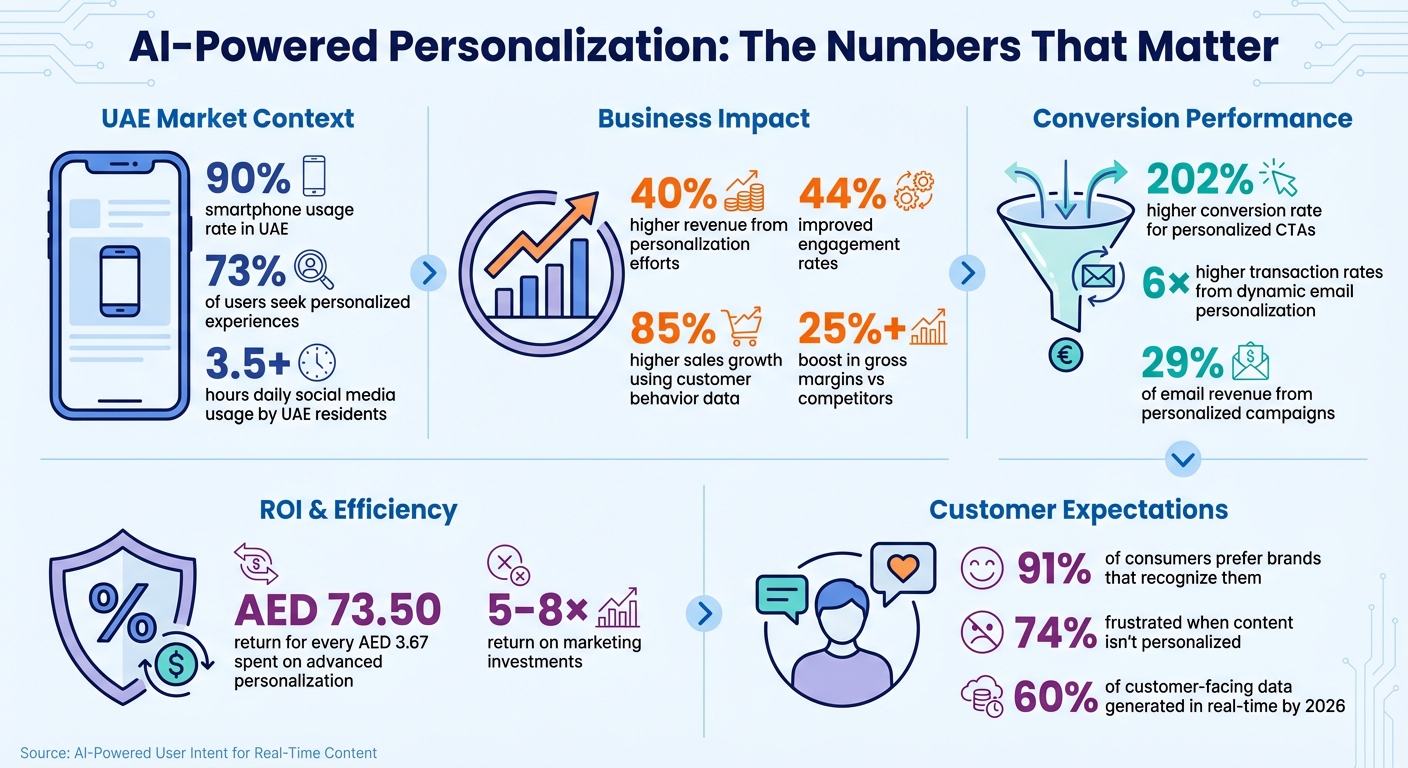
AI-Powered Personalization Impact: Key Statistics and Business Results
How AI Detects User Intent in Real-Time
How AI Identifies What Users Want
AI systems are like digital detectives, constantly analysing thousands of subtle behaviours to figure out what each visitor is looking for. These behaviours include clicks, hovering over items, how far someone scrolls, how long they stay on a page, and even their search patterns on the site. Without needing users to explicitly say what they want, AI pieces together their intentions based on these small but telling actions.
Gone are the days when systems relied solely on matching keywords. Advanced technologies like IntentGPT, powered by Large Language Models (LLMs), take analysis to a whole new level. They don’t just skim through a page - they dive deep, interpreting both the obvious and the hidden meanings in the content at a URL level. As Jaysen Gillespie from RTB House puts it:
IntentGPT reads and understands a page in its entirety, deriving deep meaning from the content... in near real time.
This ability to pull meaningful insights from complex environments allows AI to cut through the noise and focus on what matters.
But AI doesn’t stop there. It also enriches user profiles by factoring in contextual details like the device being used, the user’s location, the time they interact, and how they arrived at the site. Using this information, AI classifies intent into four main categories: Informational (seeking knowledge), Navigational (looking for a specific site), Commercial (researching products or services), and Transactional (ready to make a purchase). This categorisation is done instantly, enabling AI to adapt content on the fly. In competitive markets like the UAE, where delivering tailored experiences is key, this real-time classification ensures users see what they need before they lose interest.
Instant Data Processing for Personalisation
Once AI figures out user intent, it taps into high-speed infrastructure to customise content in real time. Technologies like Apache Kafka, Apache Flink, and databases such as Redis make this possible by ensuring that every interaction updates the user’s profile within milliseconds. This eliminates the need to wait for overnight batch processing, keeping everything up-to-the-minute.
AI doesn’t just respond to obvious triggers like cart abandonment or browsing specific categories. It also picks up on subtler patterns, such as changes in price sensitivity or hesitation that might signal a user is about to leave. For instance, if someone spends too much time on a pricing page or keeps searching for similar items, the system might step in with a timely nudge - maybe a discount offer or a helpful article - to keep them engaged. This proactive approach isn’t just about reacting to what users do; it’s about predicting their next move and staying one step ahead.
Types of User Intent and How They Shape Content
Informational, Navigational, and Transactional Intent
To create content that connects with users, it’s crucial to understand the different types of user intent and how they guide online behaviour.
- Informational intent: These users are looking for answers. Their searches often include phrases like "how to", "why does", or "what is." Content like tutorials, FAQs, and detailed guides works best for this group, helping them find the knowledge they’re after.
- Navigational intent: Here, users already know where they want to go. They’ll search for specific brands, services, or shortcuts, such as "Gmail" or "Amazon customer service", to get to their destination quickly.
- Transactional intent: These users are ready to act - whether it’s making a purchase, subscribing, or finding deals. They search for terms like "buy", "subscribe", or "discounts." Effective content for this intent includes clear pricing, seamless checkout processes, and tailored product recommendations.
- Commercial investigation: This type of intent sits between informational and transactional. Users are comparing their options, often searching for terms like "iPhone vs. Android" or reading reviews. AI can pick up on these moments by analysing actions like expanding FAQs or opening comparison pages.
As users move through these intent types, their needs change, and so should your content strategy.
How User Intent Changes Throughout the Buying Process
User intent isn’t static - it evolves as people move through the buying process. For example, someone might start with informational intent, researching a solution to their problem. Next, they could shift to commercial investigation, comparing products or services. Finally, they reach transactional intent, ready to make a purchase. AI tools can track these shifts in real time by observing user actions like clicks, searches, and even time spent on specific pages.
This evolution is influenced by factors like timing, device type, location, or external events such as seasonal sales or economic trends. As Dan Duke, Editor-in-Chief at Rellify, explains:
Understanding user intent isn't just about better rankings - it's about building meaningful connections.
AI plays a key role here, offering targeted responses at the right moments. For instance, it might provide ROI calculators to help hesitant buyers or send personalised offers to users who abandon their carts.
Brands that tailor their strategies to these shifting intents often see big results. Companies using intent-focused approaches have reported a 15% increase in enquiries driven by AI assistants. Additionally, those who adopted AI-search readiness strategies were twice as likely to appear in AI answer boxes, reclaiming 8–12% of revenue previously lost to zero-click searches. The takeaway? Aligning content with where users are in their journey can make all the difference.
How to Implement AI for Real-Time Content Personalisation
Technologies That Enable Personalisation
AI-driven personalisation relies heavily on a solid technical framework. A Customer Data Platform (CDP) plays a key role by consolidating first- and zero-party data into a unified, detailed customer profile. From there, machine learning algorithms take over, segmenting customers in real time and predicting individual needs rather than lumping users into broad categories. Adding to this is Dynamic Creative Optimisation (DCO), which dynamically combines elements like headlines, images, and calls-to-action to create unique, tailored content variations.
For businesses in the UAE, AI models need to address specific regional requirements. This includes optimising for Right-to-Left (RTL) Arabic layouts, using visuals that resonate culturally, and aligning campaigns with events like Ramadan and Eid. Additionally, the UAE's Personal Data Protection Law mandates clear opt-ins and transparent data handling, ensuring consumer trust remains intact.
A standout example is a campaign by IAS Media in the UAE. By analysing high-engagement TV slots and delivering customised creatives in Arabic, English, and Hindi, the campaign achieved impressive results: 3.2 million impressions in just 10 days, an 18% boost in click-through rates, and a 29% improvement in brand recall.
"Digital advertising in the UAE is no longer about reaching the most people - it's about reaching the right people, at the right time, with the right message." – IAS Media
While advanced technology forms the backbone of personalisation, tailoring these solutions to the local market ensures their effectiveness.
Wick's Approach to AI Personalisation
Wick takes this a step further by translating technical capabilities into culturally relevant, personalised content. Their Four Pillar Framework provides a structured approach for UAE businesses aiming to implement AI-driven personalisation.
The first pillar, Capture & Store, focuses on auditing and integrating data from multiple sources like CRM systems, websites, and email platforms into a robust CDP. This creates a clean, consolidated dataset that serves as the foundation for AI applications.
The second pillar, Tailor & Automate, uses AI algorithms to deliver personalised content across all customer touchpoints. This includes real-time triggers like offering discounts when a cart is abandoned or sending celebratory messages when a user completes a specific action.
Wick also ensures AI models are adapted to the UAE's unique needs. This includes incorporating Arabic glyph-compatible fonts, culturally respectful greetings like "Valued Guest", and optimising personalised interfaces for mobile devices, given the UAE's high smartphone usage. Fast loading times and mobile responsiveness are prioritised to enhance the user experience.
The benefits of personalisation are clear. Companies that excel in this area generate 40% more revenue from their efforts compared to average performers. Personalisation also delivers a 5–8× return on marketing investments. With 60% of customer-facing data being generated in real time, the ability to deliver dynamic, AI-powered personalisation has become not just a competitive edge but a necessity.
sbb-itb-058f46d
Benefits and Challenges of AI-Powered User Intent Analysis
Benefits: Higher Engagement and Conversions
The numbers speak for themselves: companies that excel at personalisation see 40% more revenue from these efforts. Using customer behaviour data can drive 85% higher sales growth and boost gross margins by over 25% compared to competitors. These figures highlight how tailored experiences resonate with customers on a deeper level, leading to measurable business success.
Personalised content is a game-changer. For instance, calls-to-action tailored to individual users convert at a 202% higher rate than generic ones. Similarly, email campaigns that use dynamic personalisation generate 6× higher transaction rates and contribute to nearly 29% of all email revenue. A great example of this impact is The Vitamin Shoppe’s use of Bloomreach’s AI personalisation in 2025. By optimising product category pages and delivering recommendations within just 0.1 seconds of user interaction, they achieved an 11% boost in their add-to-cart rate. Likewise, Grubhub’s "Taste of 2020 Year in Review" campaign, which leveraged 32 custom data attributes, resulted in a 100% increase in social media mentions and an 18% rise in word-of-mouth referrals.
Beyond short-term conversions, AI-driven intent analysis builds long-term customer loyalty. When brands consistently show they understand their customers’ unique preferences, they create emotional connections that translate into greater lifetime value. In fact, 91% of consumers say they’re more likely to shop with brands that recognise and remember them, and 73% expect companies to understand their individual needs. The financial payoff can be significant, with advanced personalisation delivering returns as high as AED 73.50 for every AED 3.67 spent. However, these benefits come with challenges, particularly in managing data and addressing privacy concerns.
Challenges: Data Quality and Privacy Concerns
Despite its potential, AI-powered intent analysis isn’t without hurdles. One major issue is data fragmentation. When customer information is scattered across various CRMs, email platforms, and web analytics tools, creating a unified view of user intent becomes a daunting task. SimpliSafe tackled this challenge in 2025 by automating data transfers from multiple platforms into a single system of unified user profiles. This integration saved them nearly a month of development time across four systems, showcasing how streamlined data management can improve efficiency.
Privacy concerns also loom large. The UAE’s Personal Data Protection Law requires businesses to obtain clear opt-ins and maintain transparency in their data practices. This adds complexity to balancing personalisation with regulatory compliance. Interestingly, 74% of customers express frustration when website content isn’t personalised. But, as Kevin Wang, Chief Product Officer at Braze, points out:
What makes these cases of mistaken personalization so jarring is that they undercut the customer relationship, revealing to people that your brand doesn't know them as well as they'd thought.
Another challenge is the "cold start" problem, where AI struggles to personalise for new users due to a lack of historical data. Brands can address this by focusing on immediate, in-session behaviours. Ultimately, the quality of AI-driven intent analysis depends on the data it’s built upon. Poorly tagged or inconsistent data can lead to irrelevant - and sometimes alienating - user experiences.
Episode 4 | The Visibility Brief: Why AI Personalization Finally Works
Conclusion: Achieving Real-Time Personalisation with AI and Wick
In the UAE, where consumers expect brands to deliver tailored, real-time interactions, businesses that excel in personalisation see a 40% boost in revenue. With UAE residents spending over 3.5 hours daily on social media, they anticipate brands to not just market but truly understand their preferences and needs. For companies operating here, this isn’t just about keeping up - it’s about setting the pace.
Adopting real-time, AI-driven personalisation requires a cohesive strategy. This means integrating first-party data across platforms, creating content that resonates with UAE audiences culturally, and ensuring compliance with the Personal Data Protection Law. It’s about building trust while delivering value.
Wick’s Four Pillar Framework offers UAE businesses a clear roadmap for implementing AI-powered personalisation. By connecting data through Customer Data Platforms and prioritising privacy-first systems, businesses can create a digital environment that anticipates customer needs. The impact is undeniable: Luisaviaroma.com reported a staggering 900% increase in automated email revenue in 2025, thanks to advanced profiling and real-time AI personalisation. This framework showcases what’s possible and highlights a path for redefining customer engagement in the region.
The future of customer experiences is clear. By 2026, 60% of all customer-facing data will be generated and contextualised in real time. For UAE businesses, acting now with the right tools and expertise isn’t just a choice - it’s the key to staying ahead. Start by unifying your data and embedding privacy into your systems to build trust and drive tangible growth. The opportunity is here; it’s time to seize it.
FAQs
How does AI identify whether a user is seeking information or ready to make a purchase?
AI can tell the difference between informational intent and transactional intent by examining the language and context of a user's query. For example, informational intent often comes with phrases like "how to," "what is," or "best ways," which suggest the user is looking for knowledge or advice. In contrast, transactional intent is marked by more action-oriented terms, such as product names, mentions of prices, or words like "buy," "order," or "checkout."
Using advanced semantic analysis and understanding contextual signals, AI can match these patterns to provide tailored, real-time content that directly addresses the user's specific needs.
What challenges do businesses in the UAE face when implementing AI-driven personalisation?
Bringing AI-driven personalisation to life in the UAE comes with its own set of hurdles. One major obstacle is adhering to the UAE Federal Data Protection Law, which mandates businesses to secure explicit consent, clearly define how data will be used, and enforce strict controls on cross-border data transfers. These requirements can complicate the shift from traditional databases to advanced, cloud-based systems that are essential for real-time AI processing.
Another issue is the fragmentation of data systems. Many companies face difficulties in unifying their first-party data across different channels. This challenge is even more pronounced in the UAE's multilingual environment, where businesses must cater to Arabic, English, and other languages - all while respecting cultural sensitivities. Without properly consolidated data, achieving precise personalisation becomes an uphill battle.
On top of that, delivering real-time personalised experiences requires a strong infrastructure and smooth integration of behavioural data - like geolocation or browsing activity - into AI models. Without scalable, API-driven systems in place, businesses risk delays, incomplete personalisation, and less relevant experiences for their customers.
Wick steps in to help UAE businesses tackle these challenges head-on, offering solutions that ensure compliance with local laws while building scalable systems tailored to the region's unique needs.
How can businesses in the UAE use AI for personalisation while complying with privacy laws?
To align with UAE privacy regulations while using AI for personalisation, businesses should integrate a privacy-by-design framework into their operations. Begin by evaluating how personal data is collected, stored, and processed to ensure it complies with the UAE Federal Data Protection Law. Always secure explicit and informed consent from users before handling their personal data, and make it easy for individuals to withdraw consent or request data deletion. Focus on using first-party data and apply methods like anonymisation to reduce potential risks.
In addition, businesses must follow the UAE’s AI ethical charter, which highlights the importance of fairness, transparency, and accountability. Provide a clear privacy notice that explains how AI handles user data and outlines the steps users can take to exercise their rights. Strengthen security by implementing measures such as encryption and access controls, and conduct regular audits of AI systems to identify and address any biases or risks of data misuse.
Appointing a Data Protection Officer or a dedicated compliance team is essential to stay informed about legal updates and ensure that international data transfers meet UAE standards. By adopting these practices, companies can offer personalised, AI-powered experiences while safeguarding user privacy and adhering to regulatory requirements. Wick’s expertise in data-driven marketing can help organisations establish compliant AI systems tailored to the UAE’s legal landscape.