
Blog / AI-Powered Incrementality Testing: How It Works
AI-Powered Incrementality Testing: How It Works
AI-powered incrementality testing helps marketers in the UAE measure the real impact of their campaigns by identifying which ads drive new sales versus those that simply credit existing ones. Traditional methods often inflate results by 20–40%, leading to wasted budgets. With AI, the process becomes automated and precise, enabling businesses to make smarter budget decisions, reduce waste, and improve Return on Ad Spend (ROAS) by 15–40%.
Key Points:
- What It Does: Measures the true effect of marketing by comparing groups exposed to ads versus those that aren’t.
- Why It Matters: Without it, brands risk wasting 23% of their ad spend.
- How AI Helps: Automates testing, processes large datasets, and delivers faster, more accurate results.
- UAE Relevance: Especially useful during Ramadan or the Dubai Shopping Festival, where competition is high and precise spend allocation is critical.
Quick Overview:
- Traditional Tracking Issue: Inflates results by up to 40%.
- AI Advantage: Automates testing, removes outliers, and provides real-time recommendations.
- Business Impact: Boosts ROAS by reallocating budgets based on incremental lift.
This privacy-first solution aligns with UAE market needs, helping businesses thrive in a competitive, data-driven environment.
How Geo-Lift Incrementality Testing Works
AI-Powered Incrementality vs. Manual Methods and A/B Testing
When it comes to measuring true marketing impact, AI takes testing methods to a whole new level compared to manual and A/B approaches. While A/B testing is great for fine-tuning creative elements, it doesn’t confirm whether your efforts are driving incremental business results. Manual incrementality testing, on the other hand, can deliver accurate insights but is notoriously slow and resource-heavy. AI-powered incrementality testing bridges this gap - quantifying causal impact while automating the entire process.
Here’s the limitation of A/B testing: it identifies the better-performing version but can’t tell if users converted because of your ad or if they would have converted anyway. As Phil Erickson, Principal Economist at Haus, explains:
"Incrementality measures how a change in strategy causes a change in business outcomes. For example, how would my revenue increase if I upped my ad budget by 10%?"
Manual incrementality testing answers this question but requires a lot of heavy lifting - data scientists need to design experiments, manage holdout groups, and crunch the numbers.
AI-powered testing streamlines this entire process. It automates test design, processes data, filters out anomalies, and delivers real-time reporting. Plus, AI-driven synthetic controls are 4x more precise than traditional matched-market tests. Recent innovations have even boosted the frequency of conclusive results by up to 50%.
Testing Methods Comparison
| Feature | AI-Powered Incrementality | Manual Incrementality Testing | Traditional A/B Testing |
|---|---|---|---|
| Setup Complexity | Low (Automated design/execution) | High (Requires data scientists) | Moderate (Platform-based) |
| Scale | High (Cross-channel, large data) | Low (Single-channel focus) | Moderate (Campaign-specific) |
| Speed | Real-time / Always-on | Slow (Lagging reports) | Fast (During test window) |
| Accuracy | High (Synthetic controls/ML) | Moderate (Prone to human error) | High (For specific variables) |
| Primary Use Case | Strategic budget allocation | Periodic channel validation | Tactical creative optimisation |
For UAE campaigns, especially during key events like Ramadan or the Dubai Shopping Festival, scalability and real-time insights are non-negotiable. AI thrives in these scenarios, handling large and fragmented datasets with ease. Manual methods, by contrast, often buckle under the weight of complexity and limited resources. The smart approach? Use AI-powered testing quarterly for strategic budget decisions, while relying on A/B testing daily to tweak and optimise creative elements.
How to Implement AI-Powered Incrementality Testing
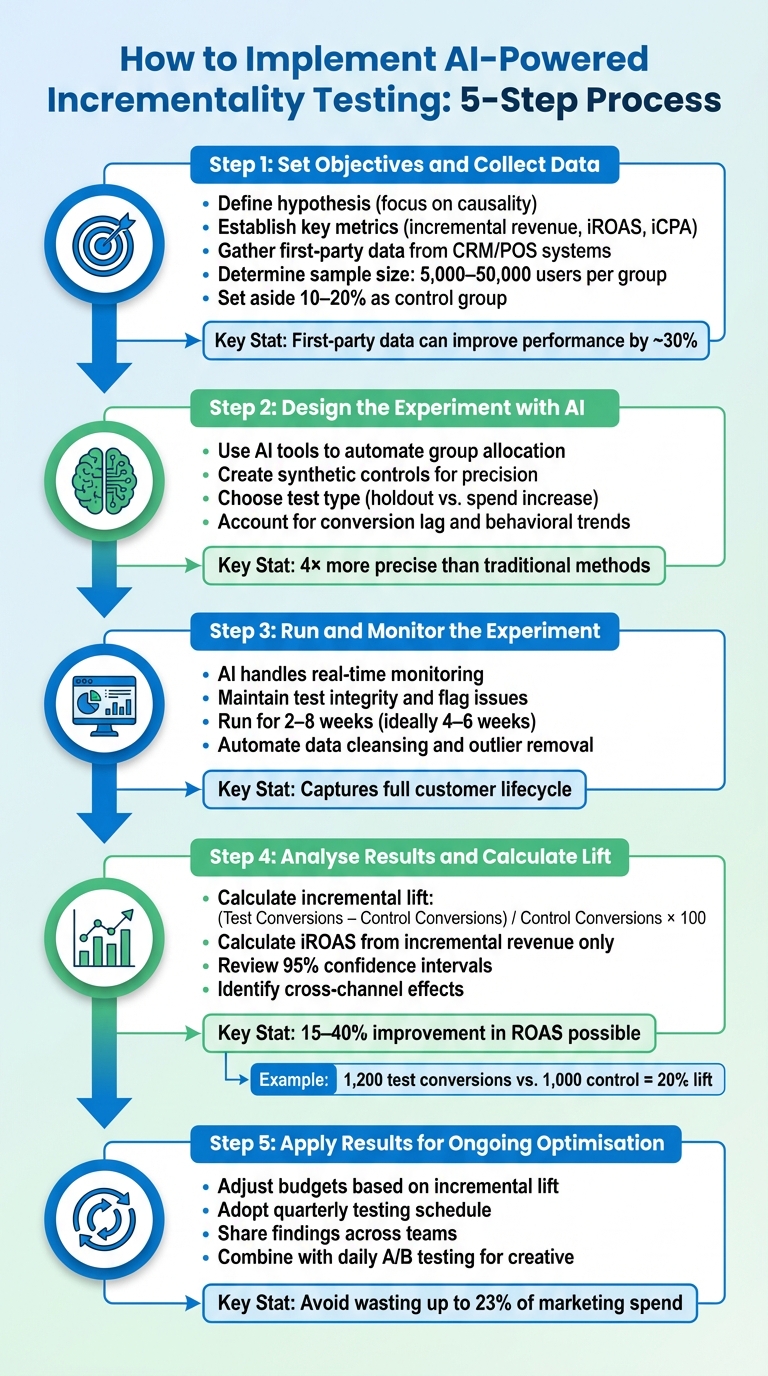
5-Step AI-Powered Incrementality Testing Implementation Process
Implementing AI-powered incrementality testing involves a structured approach that takes you from hypothesis formulation to actionable insights.
Step 1: Set Objectives and Collect Data
Start by clearly defining your hypothesis. Instead of asking general questions like, "Did we get conversions?" focus on causality: "Did this specific marketing effort lead to measurable business outcomes?" For example, you might hypothesise, "Increasing YouTube spend by 20% will result in a 10% increase in new user sign-ups" .
Establish key metrics such as incremental revenue, conversions, profit, iROAS, and iCPA to measure the true impact of your ads. This is crucial, as traditional attribution models can overestimate channel contributions by 20% to 40%.
Gather high-quality first-party data from your CRM, point-of-sale systems, or enhanced conversion tracking tools that connect offline sales to digital campaigns. This data serves as your "source of truth" and can improve performance by around 30% when integrated with platforms like Google Ads Data Manager .
Use a power calculator to determine the sample size (typically 5,000–50,000 users per group) and define your Minimum Detectable Effect (MDE). Set aside 10–20% of your target audience as a control group to establish a reliable baseline .
"Your first-party data is your key competitive edge, serving as the fuel to optimise your campaigns, reach the right audience at the right time, and boost performance."
- Kamal Janardhan, Senior Director at Google
Ensure alignment between your marketing and finance teams on the definition of "incremental revenue" to facilitate smooth budget adjustments post-test.
Step 2: Design the Experiment with AI
With objectives and data in place, use AI tools to design your experiment. AI simplifies the process by automating group allocation, determining optimal sample sizes, and setting the test duration needed to detect meaningful results. Advanced AI models use random assignment and bias control techniques, accounting for factors like conversion lag and behavioural trends, to ensure accurate outcomes.
For instance, while testing Meta ads during Ramadan, AI can create synthetic controls - mathematically matched groups - that improve test precision by up to four times compared to traditional methods . AI also enables multi-channel testing without data leakage, ensuring control group members aren't inadvertently exposed to the same ads across campaigns.
Choose the test type based on your goals. Mature brands might opt for holdout testing (pausing spend for a control group), while growth-focused brands may choose to increase spend in specific markets for testing. AI simulations can predict which strategies are most likely to drive incremental results.
Step 3: Run and Monitor the Experiment
Once the test is live, AI-powered tools handle real-time monitoring. These tools manage budget allocation, maintain test integrity, and flag issues like "drift" that could impact results . Running tests for 2 to 8 weeks - ideally 4 to 6 - captures the full customer lifecycle and accounts for conversion delays . Avoid running tests during major holidays or disruptive periods.
AI also automates data cleansing, removing outliers and resolving inconsistencies in fragmented datasets. This ensures the measured lift reflects each channel's actual contribution. To stay organised, create an annual testing plan to prioritise impactful channels and avoid overlapping tests during major promotions.
Step 4: Analyse Results and Calculate Lift
After the test ends, AI tools provide deeper insights than standard reporting. Calculate incremental lift using this formula:
(Test Conversions – Control Conversions) / Control Conversions × 100.
For example, if your test group achieves 1,200 conversions compared to 1,000 in the control group, the incremental lift is 20%.
For a clearer view of marketing impact, calculate Incremental ROAS (iROAS) by dividing only the incremental revenue by the spend. This approach eliminates the noise of sales that might have occurred without the campaign. Reallocating budgets based on incremental lift can improve overall ROAS by 15% to 40%.
AI also provides a 95% confidence interval for comparing test and control data. It can reveal secondary insights, such as cross-channel halo effects or signs of organic cannibalisation. Studies show that up to 50% of tested channels may exhibit cannibalisation.
"Understanding the incremental value of our marketing endeavours enables us to derive an accurate ROAS, turning insights into actionable strategies that drive our business forward with unmatched efficiency and effectiveness."
- Linnéa Gosh, Digital Marketing Analyst at Sleep Cycle
For long-term validation and forecasting, consider combining your results with Media Mix Modelling (MMM) .
Step 5: Apply Results for Ongoing Optimisation
With the results in hand, adjust budgets and refine future campaigns. For example, if YouTube shows a 25% incremental lift while Instagram delivers only 5%, shift your budget accordingly. Without incrementality testing, brands risk wasting up to 23% of their marketing spend on ineffective activities.
Adopt a quarterly testing schedule to keep insights relevant. Use AI-powered incrementality testing for strategic budget decisions, while reserving daily A/B testing for optimising creative elements. Share findings across marketing, finance, and product teams to align efforts and focus on measurable, data-driven growth. Consistently applying these insights ensures you maximise the incremental returns from your marketing investments.
sbb-itb-058f46d
How Wick Supports AI-Powered Incrementality Testing

Implementing AI-powered incrementality testing requires a blend of strategic planning, robust data integration, and ongoing refinement. Wick brings these elements together, offering UAE businesses the tools to enhance marketing measurement and effectiveness. Here's how their services deliver on this promise.
Wick's Incrementality Testing Services
Wick takes the principles of AI-powered incrementality testing and adapts them to deliver measurable results for businesses in the UAE. Their data analytics and AI-driven personalisation solutions manage the entire process, from experiment design to results analysis. By using synthetic controls, Wick achieves up to 4× higher precision than traditional matched-market tests. This method isolates the true impact of marketing campaigns by accounting for external factors like seasonality, promotions, and other market disruptions.
To ensure accuracy, Wick conducts power analyses to determine appropriate test budgets and durations, which typically range from two to eight weeks, achieving 80% statistical power. Automated data integrity checks are another key feature, as they review historical data and flag outliers to ensure reliable outcomes. These techniques are particularly suited to the UAE market, where unique seasonal trends - such as Ramadan or the summer tourism period - can significantly influence consumer behaviour.
Another standout aspect of Wick's approach is its reliance on aggregated geographic data rather than individual user tracking. This ensures compliance with privacy regulations while still delivering actionable insights. Additionally, Wick specialises in analysing omnichannel halo effects, demonstrating how digital ad spending can drive offline sales - a crucial consideration for businesses navigating both online and physical retail spaces.
Wick's Four Pillar Framework for Long-Term Growth
Wick incorporates insights from incrementality testing into its Four Pillar Framework, a comprehensive strategy designed to drive sustained growth. Each element of this framework builds on the results of their testing services.
- Build & Fill: Focuses on creating optimised websites and content informed by incremental performance data.
- Plan & Promote: Uses test insights to allocate budgets effectively across SEO, paid ads, and influencer campaigns, reducing the typical 23% spend waste.
- Capture & Store: Implements tools like customer data platforms and journey mapping to gather high-quality first-party data, feeding it back into the testing cycle for continuous improvement.
- Tailor & Automate: Leverages AI-driven personalisation and marketing automation to ensure every interaction delivers measurable value.
This holistic framework is particularly valuable for UAE businesses, where 88% of SMEs report increased revenue through AI adoption. By combining quarterly incrementality testing for strategic planning with daily attribution models for creative adjustments, Wick helps businesses achieve a 15% to 40% improvement in ROAS by reallocating budgets based on true incremental performance.
Wick's methods provide a clear path for UAE companies to not only measure their marketing efforts more effectively but also optimise them for long-term success.
Conclusion
Benefits of AI-Powered Incrementality Testing
AI-powered incrementality testing offers a clear path to more efficient and profitable marketing. By isolating the true causal impact of campaigns, it eliminates unnecessary spending and can drive a 15–40% uplift in ROAS. This approach doesn’t just save money - it ensures every dirham works harder for your business.
What’s more, this method aligns seamlessly with privacy-first standards. It provides accurate insights without relying on third-party cookies or user-level tracking, making it a reliable solution in an era of evolving regulations. With 73% of marketing leaders now recognising incrementality testing as essential - up from 41% in 2023 - it’s clear that this strategy is becoming a cornerstone for making smarter marketing investments.
Getting Started with Wick
Wick makes it easy to harness these benefits through its proven framework. With AI-driven personalisation and integrated data analytics, Wick offers end-to-end solutions to optimise budgets and scale campaigns, all while considering UAE-specific seasonal trends.
At the heart of Wick’s approach is its Four Pillar Framework, which embeds incrementality insights into every part of your digital marketing strategy. Whether you aim to fine-tune your budget, cut down on wasted spend, or amplify high-performing campaigns, Wick ensures your decisions are based on solid, evidence-backed data - not guesswork. Ready to take the next step? Visit thewickfirm.com and start transforming your campaigns with precision-driven insights.
FAQs
How does AI enhance the accuracy of incrementality testing?
AI improves the precision of incrementality testing by processing large datasets quickly and accurately. Through advanced machine learning, it identifies patterns and causal links, enabling marketers to pinpoint the actual incremental impact of their campaigns. This ensures decisions are firmly rooted in data.
By automating intricate calculations and minimising human errors, AI delivers practical insights that refine marketing strategies. This is particularly crucial in fast-evolving markets like the UAE, where accurately measuring campaign effectiveness plays a key role in achieving consistent growth.
Why is AI-powered incrementality testing important for marketers during competitive events in the UAE?
AI-powered incrementality testing plays a crucial role during competitive events in the UAE. It helps marketers uncover the true impact of their campaigns by separating authentic incremental conversions from baseline activity. This means businesses can allocate their marketing budgets more effectively, focusing on strategies that genuinely deliver results.
In a market as fast-paced as the UAE, where privacy rules and fierce competition add layers of complexity, this method becomes even more valuable. With AI, marketers can make smarter, data-backed decisions, optimise their ad spend in AED, and ensure their campaigns drive measurable success during key moments.
How can I effectively implement AI-powered incrementality testing?
To make the most of AI-powered incrementality testing, begin by setting up controlled experiments. This means creating treatment and control groups to clearly identify how your marketing efforts are influencing outcomes. Ensure you collect detailed data from all your marketing channels, covering both groups, so your analysis is as precise as possible.
Once your data is ready, use AI models to analyse it. These models can spot patterns and estimate the actual impact of your campaigns. The insights you gain can help you fine-tune your strategies, allocate resources more effectively, and make the most of your marketing budget.
It's important to keep testing, adjusting, and scaling the strategies that work. Over time, as the AI models learn and improve, they’ll deliver sharper insights, perfectly aligned with your business goals.