
Blog / AI-Powered Customer Journey Platforms: Top Picks
AI-Powered Customer Journey Platforms: Top Picks
AI-driven customer journey platforms are transforming how businesses in the UAE engage with their customers. These tools use advanced analytics and real-time insights to personalize interactions across channels like WhatsApp, email, and SMS. With over 90% smartphone penetration in the UAE, customers expect tailored experiences, and businesses adopting these platforms report up to 20% revenue growth and 40% customer advocacy improvements.
Here’s what you need to know:
- Personalisation: Platforms use AI to create highly targeted messaging in English and Arabic, increasing conversion rates by up to 624% compared to traditional campaigns.
- Real-Time Insights: Data delays are reduced by 90%, enabling businesses to act on customer behavior instantly.
- Multi-Channel Integration: AI ensures consistent communication across email, WhatsApp, websites, and in-store experiences, eliminating repetitive interactions.
- Proven ROI: Businesses like Emirates Airlines and TKD Lingerie have achieved impressive results, such as 40X return on ad spend and faster customer service.
Quick Comparison
| Platform | Personalisation Depth | Analytics Capabilities | Ease of Integration | Scalability |
|---|---|---|---|---|
| Insider One | High (1:1 Recs) | Predictive & Journey Analytics | High (100+ APIs) | Enterprise-grade |
| Braze | High (Real-time AI) | Real-time Experimentation | Medium (API-heavy) | High (Mobile-scale) |
| Blueshift | High (SKU-level AI) | Attribution & Cohorts | High (Warehouse-native) | Mid-market to Enterprise |
| Salesforce | Medium to High (Einstein AI) | Deep (Tableau/Data Cloud) | High (SF Ecosystem) | Enterprise-grade |
| HubSpot | Basic to Medium | Standard CRM Reporting | High (Native Marketplace) | SMB to Mid-market |
| GrowthLoop | High (Same-session AI) | Agentic Recommendations | High (Warehouse-native) | Enterprise-grade |
| Zigment | High (Tone Analysis) | Real-time Conversation Graph | High (API-first) | SMB to Enterprise |
| MoEngage | High (Merlin AI) | Insights-led Funnels/Paths | High (No-code Personalisation) | High (1T+ data points) |
Choosing the right platform depends on your business goals, existing tech stack, and customer preferences. For UAE businesses, platforms with native support for WhatsApp and bilingual messaging are ideal. Start by defining your objectives, testing scalability, and calculating ROI to ensure the platform meets your needs.
Benefits of AI-Driven Customer Journey Automation
Personalisation at Scale
AI has reshaped how brands connect with their audiences by tailoring communications in real time. Instead of relying on generic mass messaging, these systems adapt content based on a user’s most recent interactions. For example, triggered messages - those sent in response to specific actions - achieve conversion rates that are 624% higher than traditional batch emails. This is particularly valuable in the UAE, where businesses often cater to multilingual audiences in English and Arabic, making every interaction feel uniquely crafted without requiring manual effort.
Generative AI takes personalisation even further, creating highly tailored variations of text, visuals, and offers based on customer segments or individual behaviours. Companies leveraging advanced analytics have reported a 62% increase in the number of personalised campaigns they can execute. And the results are impressive: triggered messaging flows can increase repeat purchases by up to 30 times compared to generic campaigns. This level of personalisation enables businesses to make decisions faster and more effectively, all powered by AI.
Data-Driven Decision Making
AI doesn’t just enhance personalisation - it also transforms decision-making through real-time analytics. These insights allow brands to refine customer interactions dynamically, turning static customer journeys into responsive systems that can instantly identify and address friction points. By reducing data latency by as much as 90%, AI enables companies to act on insights almost immediately, a critical advantage in fast-paced markets like the UAE, where immediacy is key.
Companies that adopt AI-driven journey orchestration report tangible benefits, including 10–20% revenue growth and 15–25% cost savings. These platforms use AI to monitor subtle behaviours, such as a customer revisiting a pricing page multiple times within an hour, and automatically trigger the most effective response. The decision-making engine evaluates incoming data against predictive models to determine the best next step, ensuring every interaction is both timely and relevant.
Multi-Channel Integration
AI also ensures seamless communication across multiple channels, eliminating the frustration of customers having to repeat themselves when switching between platforms. With AI, details like conversation history, account status, and intent follow the customer across every interaction. By analysing behavioural patterns, AI predicts the "Next Best Channel" for engagement, ensuring that messages reach users where they’re most likely to respond.
Timing is another critical factor. AI employs send-time optimisation, delivering messages at the precise moment a recipient is most likely to engage. This ensures that coordination happens not just across different channels but also at the right time. Today, the average brand manages campaigns across ten touchpoints, demonstrating the importance of unified and consistent messaging.
Top AI-Powered Customer Journey Platforms
Multi-Channel Personalisation by Wick
Wick's Four Pillar Framework equips UAE businesses with AI-driven tools to automate and personalise customer journeys. This framework spans four critical areas: Build & Fill (website creation, content production, social media management), Plan & Promote (SEO, paid ads, influencer campaigns), Capture & Store (data analytics, customer journey mapping), and Tailor & Automate (personalisation strategies, marketing automation). By connecting these elements, Wick ensures that every customer interaction - whether through email, WhatsApp, or social media - is both relevant and data-driven.
A standout feature of Wick's approach is its Single Customer View (SCV), which integrates behavioural, transactional, and operational data in real time. This is particularly valuable in the UAE, where businesses often cater to both English- and Arabic-speaking audiences. With its Customer Data Platform (CDP) and strategic consulting, Wick helps businesses transform static customer journeys into adaptive systems that respond instantly to customer actions. This capability is especially beneficial in the UAE's dynamic retail and hospitality sectors.
Let’s now explore how advanced analytics can uncover and address pain points in the customer journey.
Journey Analytics and Optimisation
Modern platforms offer analytics that go far beyond simple data visualisation. Tools like Adobe Customer Journey Analytics can process vast amounts of data to identify where customers experience friction or drop off during their journey. These platforms create a dynamic map of customer behaviour as they browse, click, or make inquiries, enabling businesses to respond to changes in intent in real time. This ability to act quickly is a game-changer during busy periods such as Ramadan, when customer activity spikes.
"I've always had a vision of looking at marketing data more holistically from an account perspective - not an easy task when dealing with global clients and organisations."
- Karen Hopkins, Global CMO, EY
Oracle Marketing takes this a step further by offering data models tailored to industries like retail and restaurants, which are major players in the UAE economy. These platforms use AI and machine learning for predictive analytics and lead scoring, helping businesses anticipate customer needs even before they’re voiced. Companies that adopt these journey orchestration tools often report revenue growth of 10–20% and operational cost savings of 15–25%.
While analytics identify the issues, real-time automation ensures they are addressed without delay.
Real-Time Engagement and Automation
Real-time engagement platforms are designed to interpret subtle customer cues - like tone, intent, and hesitation - and trigger automated responses at the perfect moment. Zigment's agentic AI, for instance, uses dynamic conversation paths to guide customers effectively. This approach resonates strongly in the UAE, where 65% of consumers expect businesses to communicate proactively. These systems excel at delivering timely, context-aware responses, enhancing customer satisfaction.
For businesses in the UAE, integrating WhatsApp through the Business API has become indispensable. TKD Lingerie, a women-led brand, achieved a staggering 40X return on ad spend by February 2026 by using an omnichannel platform with WhatsApp Broadcast features for virtual fittings and personalised marketing. Similarly, Emirates Airlines streamlined its customer service by automating WhatsApp communications, reducing wait times and allowing human agents to focus on complex queries. These examples highlight how automated messaging and tailored content across multiple channels can revolutionise customer engagement in the region.
Customer Journey Maps & AI: Turn skeptics into fans
sbb-itb-058f46d
Platform Features Comparison
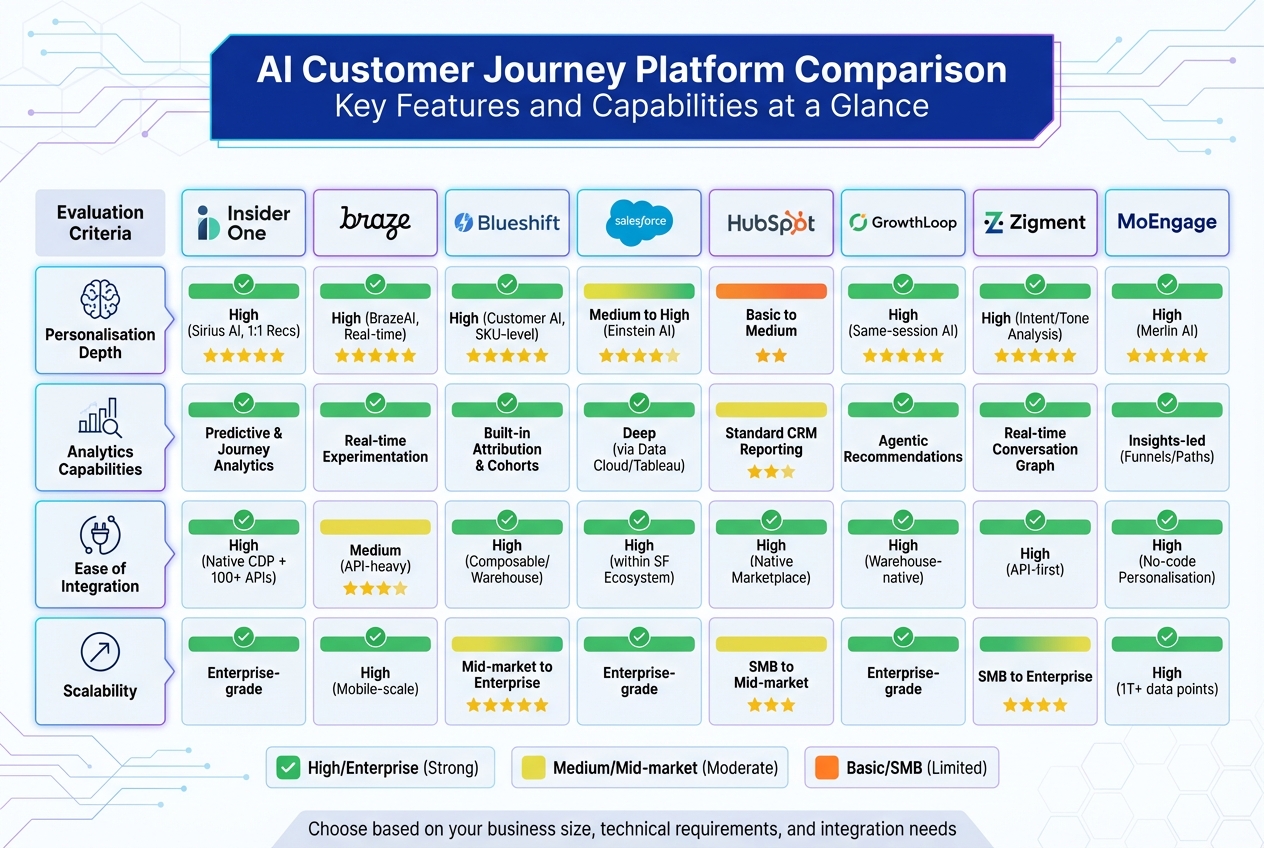
AI Customer Journey Platforms Comparison: Features and Capabilities
Comparison Criteria
To help businesses make informed decisions, the table below offers a straightforward comparison of key features across leading AI-powered customer journey platforms. Each platform is evaluated based on four important factors: personalisation depth (how detailed and intelligent the AI-driven recommendations are), analytics capabilities (the depth of insights and predictive tools available), ease of integration (how seamlessly the platform connects to existing systems), and scalability (the platform's ability to grow with your business).
| Platform | Personalisation Depth | Analytics Capabilities | Ease of Integration | Scalability |
|---|---|---|---|---|
| Insider One | High (Sirius AI, 1:1 Recs) | Predictive & Journey Analytics | High (Native CDP + 100+ APIs) | Enterprise-grade |
| Braze | High (BrazeAI, Real-time) | Real-time Experimentation | Medium (API-heavy) | High (Mobile-scale) |
| Blueshift | High (Customer AI, SKU-level) | Built-in Attribution & Cohorts | High (Composable/Warehouse) | Mid-market to Enterprise |
| Salesforce | Medium to High (Einstein AI) | Deep (via Data Cloud/Tableau) | High (within SF Ecosystem) | Enterprise-grade |
| HubSpot | Basic to Medium | Standard CRM Reporting | High (Native Marketplace) | SMB to Mid-market |
| GrowthLoop | High (Same-session AI) | Agentic Recommendations | High (Warehouse-native) | Enterprise-grade |
| Zigment | High (Intent/Tone Analysis) | Real-time Conversation Graph | High (API-first) | SMB to Enterprise |
| MoEngage | High (Merlin AI) | Insights-led (Funnels/Paths) | High (No-code Personalisation) | High (1T+ data points) |
These dimensions highlight not only the technical capabilities of each platform but also their potential to drive better customer engagement and measurable returns. For example, Insider One and MoEngage stand out in data processing, with MoEngage handling over 1 trillion data points monthly and sending 30 million messages per minute. Braze, on the other hand, shines with its mobile-first approach and real-time triggers.
For businesses already embedded in the Salesforce ecosystem, Salesforce offers seamless integration with its Data Cloud and Tableau for advanced analytics. Meanwhile, platforms like Blueshift and GrowthLoop cater to companies prioritising warehouse-native solutions, connecting directly to cloud data lakes such as Snowflake and BigQuery.
Zigment takes a unique approach by focusing on conversational AI, interpreting tone and intent in real time. For smaller businesses, HubSpot provides an accessible entry point with a free tier and starter plans starting at AED 73/month (around $20/month).
Ultimately, AI-driven cross-channel marketing is proving its value, with 80% of marketing leaders reporting increased customer lifetime value as a result. Selecting the right platform depends on aligning its features with your business's specific goals and infrastructure.
How to Select the Right Platform
Assessing Business Needs and Goals
Start by clearly defining your goals with measurable outcomes. For example, you might aim to cut service costs, reduce customer churn, or boost conversion rates. Emirates NBD set an ambitious target of achieving a 5–7x ROI on its AI initiatives during its partnership with McKinsey from 2021 to 2024. To achieve this, the bank hired over 70 analytics experts and developed more than 100 models focused on hyper-personalisation for its 20 million customers. This kind of clarity allows businesses to focus on platforms that align with their specific objectives.
Next, take a deep dive into your existing technology stack. Map out all customer touchpoints - CRM systems, contact centres, customer data platforms (CDPs), and billing systems. Identify areas where data silos or latency issues may be holding you back. If you operate in regulated industries like finance or healthcare, ensure the platform complies with local data residency and privacy regulations .
Also, think about channel preferences. In the UAE, customers commonly use WhatsApp and mobile push notifications for communication. Platforms with native support for these channels can save you the hassle of integrating third-party tools . Look for platforms that leverage predictive AI to recommend next-best actions, assess churn likelihood, and optimise message timing based on live behavioural data. This can be more effective than relying solely on rule-based automation .
Once you’ve established your goals and assessed your tech stack, evaluate how well potential platforms integrate with your existing systems.
Evaluating Integration and Scalability
The ability of a platform to integrate seamlessly with your current tools is essential for smooth operations. Look for platforms that offer pre-built connectors for popular CRMs like Salesforce or HubSpot, as well as contact centre tools. This can help you avoid costly custom integrations . Additionally, ensure the platform can handle real-time events, such as cart abandonment, without delays - even under heavy traffic .
"Make the wrong journey orchestration platform choice, and you could double-pay for features or get trapped in software that won't stretch." – Rebekah Carter, Published Author, CX Today
Scalability is another critical factor. Check whether the platform is "warehouse-native", meaning it connects directly to systems like Snowflake or BigQuery, or if it requires duplicating data unnecessarily. Confirm it can manage your expected event volume and concurrent sessions without performance issues. To test this, run a small-scale pilot. For instance, trial the platform on a specific journey, such as a renewal process or abandoned cart workflow, and compare results with a control group. This can help you identify potential problems and measure ROI.
Once integration and scalability are verified, it’s time to consider the financial implications.
Budget and ROI Considerations
Selecting a platform with advanced AI capabilities requires careful financial planning. Calculate the total cost of ownership, which includes licence fees, integration and infrastructure costs, ongoing expenses for model maintenance, compliance audits, and even data cleaning and identity matching . With the UAE accounting for just 0.4% of the global AI talent pool, you should also factor in higher costs for recruiting and retaining skilled engineers.
Use a three-part ROI framework to evaluate the platform’s value:
- Efficiency: Savings in time and costs.
- Growth: Increased revenue and customer acquisition.
- Risk: Mitigation of compliance issues and fines.
Establish baseline metrics before implementation. Without clear "before-and-after" data, ROI becomes more of a story than a concrete financial measure. In the UAE, 44% of businesses expect to see returns on AI investments within a year, but only 37% of finance leaders report achieving positive ROI so far . This gap underscores the importance of setting realistic expectations and tracking results rigorously.
For calculating ROI, use this formula:
ROI (%) = [(Total Value Delivered – Total Investment) / Total Investment] x 100.
Pricing models often depend on factors like event volume, throughput, or the number of active users. Entry-level platforms may start at around AED 73 per month for smaller businesses, while enterprise solutions typically require custom pricing .
Conclusion
The analysis above highlights a clear trend: AI-powered customer journey platforms are becoming essential for businesses in the UAE aiming to remain competitive. These platforms bring together data from multiple channels - like WhatsApp, email, social media, and in-store interactions - into a single, unified view. This is especially important in a market where customers often research online but prefer to complete their purchases in physical stores.
The transition from static workflows to systems that can sense customer intent in real time is transforming how brands engage with their audiences. Instead of relying on generic messages sent to broad segments, AI platforms can now process customer behaviour in under 50 milliseconds, delivering highly personalised responses at critical moments of hesitation. This level of hyper-personalisation has been shown to increase revenue by 40%, while AI-driven cart recovery rates outperform industry standards, achieving success rates between 30–40%.
These platforms also excel in localising experiences. By decoding various Arabic dialects with impressive sentiment accuracy, they enable UAE brands to connect with customers in a way that feels authentic and culturally relevant, driving measurable results. Businesses using these AI engines have reported a 238% increase in positive sentiment and a staggering 900% rise in response rates.
The roadmap for businesses is straightforward. Focus on platforms that natively support regional channels like WhatsApp and AI voice calls, ensure seamless integration with existing systems, and prioritise tools that can demonstrate measurable outcomes. With 100% of surveyed Middle Eastern businesses favouring off-the-shelf AI solutions, the demand is clearly for proven tools that deliver results efficiently. Opt for a platform that not only aligns with your business objectives but also scales with your growth and respects the cultural context of your audience.
FAQs
How do AI-powered customer journey platforms enhance personalised experiences in the UAE?
AI-powered customer journey platforms are reshaping how businesses in the UAE deliver personalised experiences. By leveraging advanced data analytics and automation, these platforms customise interactions across websites, social media, and other digital channels. They combine data from various sources to account for local nuances, such as language dialects and regional preferences, ensuring their approach resonates with UAE consumers.
In a market where customers demand seamless and meaningful interactions, AI offers real-time insights into preferences and behaviours. This allows businesses to respond quickly and with empathy, creating a more engaging experience. By aligning with the region's values and fostering genuine emotional connections, these platforms not only build trust and loyalty but also support scalable, culturally attuned personalisation that meets the expectations of UAE audiences.
What should UAE businesses look for in an AI-powered customer journey platform?
When choosing an AI-powered customer journey platform, businesses in the UAE should prioritise smooth integration with existing systems like CRMs and marketing tools. This ensures a centralised and comprehensive view of customer data, which is crucial for delivering personalised experiences and making informed, timely decisions.
It's equally important to select a platform that adheres to the UAE’s data privacy laws and offers Arabic language support. These features help businesses cater to local preferences and maintain compliance with regional regulations. Tools with capabilities such as AI-driven analytics, process automation, and real-time tracking can significantly enhance customer engagement and reduce churn.
Lastly, look for platforms that provide scalability, flexibility, and clear pricing structures. These elements allow businesses to adapt to growth and technological shifts while ensuring they optimise their return on investment.
How do AI-powered customer journey platforms work with existing systems to ensure smooth integration?
AI-powered customer journey platforms are built to work effortlessly with your existing tools. They connect with systems like CRMs, marketing automation platforms, and data warehouses using APIs and data connectors. This setup allows for real-time data sharing, giving you a complete, unified view of customer interactions across every touchpoint.
What makes these platforms even more powerful is their bi-directional data flow. They not only pull data from your systems but also push valuable insights back, ensuring consistent and personalised customer experiences. Whether through pre-built connectors, SDKs, or custom APIs, these platforms can fit smoothly into different organisational setups and workflows. This means businesses can make the most of their existing infrastructure to deliver better customer experiences.