

Blog / How AI Optimizes Multichannel Customer Journeys
How AI Optimizes Multichannel Customer Journeys
AI is reshaping how businesses manage customer interactions across platforms like websites, apps, emails, and physical stores. By connecting fragmented data into a single customer view, AI enables companies to predict behaviours, personalise experiences, and improve engagement. This approach is particularly relevant in the UAE, where 67% of consumers are frustrated with generic interactions, and tailored experiences can increase revenue by 5–15% while cutting service costs by 20–30%.
Key takeaways:
- AI unifies customer data from multiple channels into one profile.
- It identifies pain points, predicts behaviours, and suggests the best actions.
- Real-time personalisation improves engagement and reduces churn.
- UAE businesses using AI report threefold revenue growth and higher customer satisfaction.
AI tools like predictive analytics and journey orchestration are helping brands deliver timely, personalised interactions that meet the expectations of UAE’s digitally-savvy consumers. With the UAE National AI Strategy 2031 driving innovation, adopting AI-powered customer journeys is a smart move for businesses aiming to stay competitive.
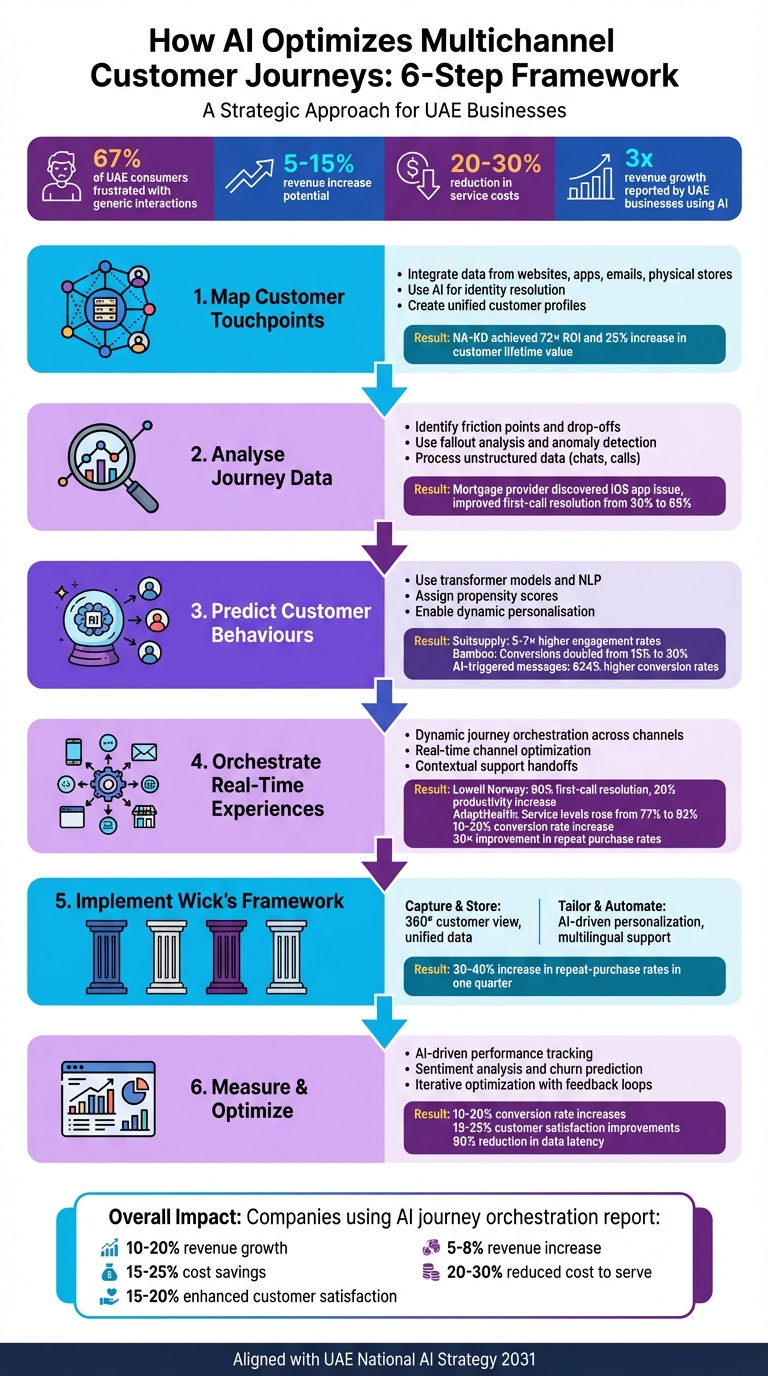
6-Step AI-Powered Multichannel Customer Journey Optimization Framework
The Role of Generative AI in Multi-Channel CX Strategies
Step 1: Map Customer Touchpoints Across Channels with AI
To truly understand your customers, you need to map every interaction they have with your brand. Unlike traditional analytics, which often focus on isolated sessions or devices, AI takes a broader approach. It tracks individuals across their entire journey, connecting every touchpoint - whether it's a website visit, an email click, a social media interaction, or even a trip to a physical store. The goal is to create a seamless, continuous view of each customer’s experience. Let’s dive into how AI makes this possible by integrating data from multiple channels into a unified perspective.
Using AI for Channel Integration
AI tools are designed to piece together data from various channels into a single, unified customer profile. This process, known as identity resolution, links identifiers like email addresses, device IDs, and cookies, while also incorporating offline interactions such as call centre logs or in-store transactions. Instead of treating customers as separate visitors across platforms, AI ensures their interactions are combined into one cohesive journey.
These platforms don’t just unify data - they also provide real-time insights. They visualise the entire customer journey, highlighting friction points and drop-offs. Real-time machine learning then steps in to detect anomalies and pinpoint exactly where customers might abandon their journey.
Take the example of the fashion brand NA-KD. In 2025, they used Insider One's customer data platform to unify data from their website, mobile app, email, and SMS. By creating personalised experiences based on unified profiles, they boosted customer lifetime value by 25% and achieved a staggering 72× ROI within just 12 months. Similarly, Generali, a financial services company, implemented a unified lead validation journey across their website, email, push notifications, and SMS. The result? A 3× increase in leads and a 20% reduction in their sales cycle length.
Building Unified Customer Profiles
AI doesn’t just collect data - it creates unified customer profiles that act as a single source of truth. These profiles merge explicit data, like purchase history or form submissions, with behavioural signals, such as browsing habits and engagement times. By breaking down data silos across email, apps, and websites, teams can make decisions based on a complete understanding of their customers.
Unified profiles are invaluable for identifying where customers might disengage - whether it’s an abandoned cart or a confusing navigation experience. They also unlock predictive capabilities. AI can assess churn risk, calculate customer lifetime value, and even suggest the Next Best Experience for each individual. With 88% of customers saying the experience a company provides is just as important as its products, these insights are critical for staying competitive, especially in dynamic markets like the UAE.
"Adobe Customer Journey Analytics is purpose-built for enterprise teams who need to align marketing, product, and analytics on a single source of truth."
- Adobe
To get started, focus on unifying your core data sources, such as website analytics, CRM, and transaction records. Use standardised naming conventions to keep everything organised. Once unified profiles are in place, you can harness these insights to predict behaviours and deliver real-time, personalised experiences.
Step 2: Analyse Journey Data for Pain Points and Patterns
After mapping out customer touchpoints, the next crucial step is figuring out where the customer journey falters. AI-powered analytics go beyond simply showing what happened - they dive into why customers face challenges. These tools identify where users abandon their journey and highlight friction points that could be costing you revenue. Instead of sifting through endless reports manually, AI detects anomalies and patterns in large datasets, uncovering insights that might otherwise go unnoticed. This analysis paves the way for targeted improvements across various channels.
Spotting Friction and Drop-Offs
AI tools use fallout and flow analysis to chart customers' step-by-step journeys, pinpointing exactly where they drop off or take unexpected detours - for instance, leaving a landing page without further interaction after clicking through from an email. Real-time anomaly detection continuously monitors data streams, with machine learning algorithms flagging issues like sudden spikes in cart abandonment or "rage clicks" (when users repeatedly click out of frustration). These signals often point to technical glitches or confusing interfaces that need immediate attention.
Take the example of a leading mortgage provider in June 2022. Their AI-driven analysis revealed that refinancing costs had doubled, and self-service rates had plummeted. The culprit? Users of the iOS version of their mobile app were unable to upload required documents. This led to a sharp decline in first-call resolution rates - from 65% to just 30%. Armed with this insight, the CX team quickly alerted IT and implemented a workaround communication for affected users, successfully reducing contact centre overflow.
AI also processes unstructured data, such as transcripts from support chats and call centres, to identify emotional pain points. This is especially critical in markets like the UAE, where 88% of customers say the experience a company provides is just as important as its products or services.
Comparing Pain Points Across Channels
Once general friction points are identified, it's time to assess their impact across different channels. AI helps prioritise these issues by estimating the potential revenue boost or conversion improvement that could result from addressing them. The table below highlights common pain points across channels, demonstrating how AI detects them and their potential business impact:
| Channel | Common Pain Point | AI Detection Method | Impact Score |
|---|---|---|---|
| High Unsubscribe Rate | Predictive churn modelling & sentiment analysis | Medium | |
| Website | Cart Abandonment | Fallout analysis & anomaly detection | High |
| Mobile App | Feature Non-Adoption | Usage drop-off path analysis | Medium |
| Call Centre | High Interaction Effort | Cross-channel correlation (e.g., web error → call) | High |
| In-Store | Disconnected Experience | Identity stitching (linking POS to digital profile) | High |
Pay close attention to how issues in one channel can ripple across others. For example, a spike in call centre activity might stem from a confusing step in the mobile app checkout process. AI connects these dots, uncovering root causes that might otherwise remain hidden. With 94% of business leaders agreeing that their organisations need to extract more value from their data, leveraging these insights is essential for staying ahead in today’s competitive, digital-first world.
Step 3: Predict Customer Behaviours and Personalise Experiences
Once you've identified customer pain points, the next step is to anticipate their actions. AI has evolved beyond just analysing past behaviour - it now predicts future actions like the likelihood of a purchase or the risk of churn. This ability to forecast empowers businesses to engage customers more effectively, delivering the right message, on the right platform, at the perfect moment. Instead of a one-size-fits-all approach, you can now create tailored experiences that align with each customer's unique journey.
How Predictive AI Works
Predictive AI digs deep into customer data, identifying patterns to forecast specific actions. For instance, transformer models track sequences of behaviour - like browsing reviews, adding items to a cart, and opening emails - to predict outcomes such as a purchase or potential churn. At the same time, Natural Language Processing (NLP) analyses unstructured data from sources like social media, chat logs, and reviews to pick up on emotional cues. Frustration might signal a risk of churn, while urgency could indicate an intent to buy.
The system assigns each customer a propensity score, indicating how likely they are to take a particular action - whether that’s making a purchase, cancelling a subscription, or responding to an offer. These scores adapt in real-time as new data comes in. By combining structured information like purchase history with unstructured sentiment data, AI refines its recommendations using reinforcement learning, constantly improving based on what has worked (or failed) in the past.
Take Suitsupply, for example. The brand implemented personalised email campaigns that used live customer signals, achieving engagement rates 5–7× higher and conversion rates 5–10× higher than standard messaging. Similarly, Bamboo saw conversions double year-over-year - from 15% to over 30% - by targeting high-intent users with relevant messaging. They also reduced abandoned deposits by 12% using predictive scoring.
This kind of insight fuels dynamic personalisation, making customer interactions more meaningful and effective.
Dynamic Personalisation
Dynamic personalisation takes predictive insights and turns them into action. AI adapts content in real time, tailoring messages by channel to suit each customer. For example, AI-triggered messages can deliver 624% higher conversion rates compared to generic email blasts. Moreover, AI-powered messaging flows can increase repeat purchase rates by up to 30× compared to standard campaigns.
ZEN.COM leveraged AI to rank push notifications and select deep links based on recent app activity, resulting in a 50% year-over-year increase in active users within the app. This approach is especially relevant in the UAE, where 71% of consumers expect personalised interactions from companies.
To start, focus on high-impact use cases like recovering abandoned carts or converting free trials into paid subscriptions. These initiatives can yield measurable ROI within 30–60 days. Be sure to measure the performance of AI-driven predictions against a control group to accurately track revenue impact. Additionally, implement AI guardrails to maintain balance - automated controls can ensure brand consistency, enforce region-specific "quiet hours" for SMS, and set frequency caps to avoid over-messaging while staying compliant.
sbb-itb-058f46d
Step 4: Orchestrate Real-Time Multichannel Experiences with AI
Once you've predicted customer behaviour, the next step is to act on those insights in real time, across multiple channels. Predicting behaviour is just the beginning; the real value comes from taking immediate, coordinated actions that span different touchpoints. AI makes this possible by turning predictions into smooth, connected experiences - whether it's a chatbot conversation that leads to a follow-up email or a mobile app notification that anticipates customer needs before they even voice them. The goal is to deliver the right interaction, through the best channel, exactly when it's needed.
These real-time actions enable dynamic orchestration, where AI doesn't just respond but also predicts the next best step to enhance the customer journey.
Dynamic Journey Orchestration
AI-powered orchestration stands apart from traditional marketing automation. Instead of relying on rigid, pre-set workflows, AI adjusts on the fly, responding to real-time customer behaviour. For example, if a customer abandons their online shopping cart, the system identifies this behaviour and determines the best follow-up action - like sending a personalised SMS if the customer is more likely to engage with text messages.
"Journey orchestration goes beyond traditional personalisation techniques. It leverages real-time customer journey data from every channel, source or system." - Genesys
This approach ensures a seamless transition from prediction to execution. AI maintains context across all channels, linking interactions to provide a consistent experience. For instance, a chatbot conversation can seamlessly connect to a phone call, giving the agent access to the customer’s full journey. Companies like Lowell Norway have successfully implemented this strategy across inbound calls, outbound communications, IVR, email, and chat. The results? A 90% first-call resolution rate and a 20% increase in agent productivity. Similarly, AdaptHealth saw service levels rise from 77% to 92% and boosted agent productivity by 60% within a year by adopting AI-driven orchestration.
AI Orchestration Techniques and Metrics
AI employs various techniques to achieve different outcomes. The table below outlines how specific methods align with measurable results:
| AI Technique | Description | Impact on Key Metrics |
|---|---|---|
| Predictive Next-Best-Action | Analyses hundreds of potential actions to choose the one most likely to achieve a desired outcome | 10–20% increase in conversion rates |
| Real-Time Channel Optimisation | Automatically selects the channel most likely to engage the user | 30× improvement in repeat purchase rates |
| Contextual Support Handoffs | Transfers real-time web or app activity data to live agents during channel transitions | 90% first-call resolution |
| Sentiment-Triggered Escalation | Detects customer frustration using NLP and routes them to a priority agent | 15–25% boost in customer satisfaction |
To get started, integrate a unified data layer using a CDP (Customer Data Platform) that combines real-time CRM, web analytics, and support data. It's also a good idea to set up control groups, where about 10% of your audience is routed through default channels. This allows you to compare AI-driven results with a baseline. This approach is especially relevant in the UAE, where 71% of consumers expect tailored experiences. Businesses that adopt journey orchestration often report 10–20% revenue growth and 15–25% cost savings, making it a smart move for companies looking to stay competitive in today's multichannel world.
Step 5: Implement Wick's Four Pillar Framework for Multichannel Optimisation

To turn AI insights into lasting business growth, UAE companies need a strong, adaptable system. Enter Wick's Four Pillar Framework, a strategy designed to unify data, automate personalisation, and create seamless experiences across every channel. This framework focuses on two key areas for multichannel optimisation: Capture & Store and Tailor & Automate. It builds on the real-time orchestration mentioned earlier by creating a solid, unified data foundation for continuous improvement.
Capture & Store: Using Data Analytics for Better Insights
The first step to effective optimisation is bringing all your data together. Many UAE businesses juggle customer information across multiple platforms - CRM systems, website analytics, WhatsApp chats, email campaigns, and even in-store transactions. Wick simplifies this by consolidating everything into a single 360° view of the customer. This ensures that teams across marketing, sales, and support are all working with the same insights.
As highlighted during the journey mapping stage, having a unified view of your data is essential for spotting problem areas. For instance, a funnel analysis might show that mobile users often abandon their carts. Insights like this could reveal that SMS reminders perform better than email in re-engaging these customers. In the UAE, where 67% of consumers express frustration when interactions aren't personalised, such insights are not just helpful - they're critical. Companies that focus on customer experience tend to see revenue growth that's three times higher than their competitors.
Tailor & Automate: AI-Driven Personalisation
Once the data is unified, Wick uses AI to deliver personalised customer interactions in real time. By predicting actions like purchases, cart abandonment, or churn, Wick's AI tools enable businesses to send timely, relevant messages across multiple channels.
This approach has already shown measurable success, boosting customer lifetime value and generating more leads. In the UAE, where consumers appreciate fast, AI-powered service, automation must also cater to multilingual needs, including Arabic-friendly layouts. Wick's framework ensures that personalisation works effortlessly across languages and platforms - be it WhatsApp, email, or mobile app notifications. UAE brands that incorporate loyalty data into automated workflows have seen repeat-purchase rates climb by 30% to 40% within just one quarter.
Step 6: Measure Success and Continuously Optimise with AI
Launching AI-powered multichannel customer journeys is just the beginning. The real challenge lies in tracking progress and fine-tuning strategies to stay ahead. In the UAE, where 71% of consumers expect personalised experiences, businesses can't rely on intuition alone. AI analytics offers the tools to monitor key performance indicators (KPIs) like customer satisfaction, retention, and engagement - turning insights into actionable improvements.
AI-Driven Performance Tracking
With a unified customer view, AI-powered analytics provides a complete picture of performance. Unlike traditional tools that focus on isolated channels or sessions, AI integrates customer data across devices and platforms, creating a single, cohesive profile. This unified view enables UAE businesses to measure KPIs across all touchpoints, whether online or offline.
AI takes this a step further with tools like sentiment analysis, powered by Natural Language Processing (NLP). By scanning emails, chats, and social media posts in real time, it identifies customer emotions - whether frustration or satisfaction - without waiting for surveys. Predictive churn models also analyse behavioural patterns to flag at-risk customers before they cancel. The results speak for themselves: businesses using AI-driven journey orchestration have reported conversion rate increases of 10% to 20% and customer satisfaction improvements ranging from 15% to 25%. Adobe Customer Journey Analytics users have even achieved a 90% reduction in data latency, enabling quicker, more informed decisions.
Another standout feature is algorithmic attribution, which assigns credit to every interaction - be it a WhatsApp message, an email, or an in-app notification - so businesses can see what truly drives conversions. AI also employs anomaly detection to flag unusual trends, like a sudden drop in mobile conversions. These insights complement earlier strategies, ensuring every aspect of the customer journey is optimised.
Iterative Optimisation
The insights gained from AI-powered tracking aren't static - they fuel continuous improvement. AI doesn’t just measure performance; it actively enhances it. Through feedback loops, businesses can refine their strategies over time. Customer signals trigger AI-driven actions, and the resulting data is fed back into the system to improve future decisions. This ongoing cycle ensures that multichannel journeys evolve to meet changing customer needs.
To measure AI's impact effectively, always establish a control group (around 10% of your audience) to compare AI-driven results with standard approaches. Monitor both business outcomes, like customer lifetime value and conversion rates, and operational metrics, such as decision latency and model accuracy, to ensure the system delivers both technically and commercially.
"I've always had a vision of looking at marketing data more holistically from an account perspective - not an easy task when dealing with global clients and organisations. Adobe solutions work together to help us connect teams and find more proactive ways to work with clients"
- Karen Hopkins, Global CMO at EY
In the UAE, triggered messages powered by real-time data outperform traditional email blasts with a staggering 624% higher conversion rate. To stay competitive, businesses must regularly retrain AI models to adapt to changing customer behaviours. AI-driven flow analysis can also identify where customers encounter obstacles or abandon processes across channels. This proactive approach ensures data isn’t just collected - it’s transformed into meaningful actions that drive growth.
Conclusion
AI-powered multichannel optimisation is reshaping how businesses in the UAE engage with their customers. By identifying key touchpoints, analysing pain points, predicting customer behaviours, orchestrating real-time interactions, and evaluating performance, brands can deliver the kind of seamless, personalised experiences that 80% of customers now expect. Companies that adopt journey orchestration strategies have reported impressive results, including revenue increases of 10% to 20% and cost savings ranging from 15% to 25%.
"The AI-powered next best experience capability can enhance customer satisfaction by 15 to 20 percent, increase revenue by 5 to 8 percent, and reduce the cost to serve by 20 to 30 percent."
- Lars Fiedler and Nicolas Maechler, McKinsey & Company
These tangible benefits are particularly relevant in Dubai's diverse marketplace, where 67% of customers express frustration with generic, non-tailored interactions. To address these challenges, Wick's Four Pillar Framework offers a structured approach to sustainable growth. The Capture & Store pillar consolidates fragmented data into a unified source of truth, while Tailor & Automate leverages AI to deliver personalised experiences across WhatsApp, email, and social media - platforms that resonate strongly with UAE consumers. This comprehensive strategy also tackles regional complexities, such as multilingual needs and regulatory requirements, ensuring brands can provide meaningful, human-centred interactions at scale.
To fully realise these opportunities, organisations need a clear roadmap. Start by building a basic data infrastructure, run small-scale pilots to demonstrate quick wins, and use control groups to measure the impact of AI initiatives. With the UAE National AI Strategy 2031 driving digital transformation across industries, businesses that embrace AI-driven orchestration today will be well-positioned to lead the customer experience landscape of tomorrow.
FAQs
How does AI bring together customer data from different channels?
AI brings together customer data from multiple sources - email, websites, social media, mobile apps, in-store visits, and contact centres - by analysing interactions across these channels. This process builds a real-time unified customer profile, capturing details like preferences, behaviours, and past engagement.
By tracking ongoing interactions, AI pinpoints the most effective communication channels for each customer, enabling businesses to deliver personalised experiences. This integration keeps insights up-to-date across all platforms, ensuring consistent and context-driven engagement. The outcome? A smoother customer journey, smarter decision-making, and more efficient use of resources.
How does AI help in understanding and predicting customer behaviour?
AI empowers businesses to gain deeper insights into customer behaviour by processing massive datasets in real time. It spots trends, recognises preferences, and predicts future actions, allowing companies to create tailored experiences and refine communication across various platforms.
Using AI, companies can enhance customer engagement, simplify their interactions, and drive outcomes like higher satisfaction and loyalty. This approach ensures every interaction feels meaningful and customised to the individual.
How can businesses evaluate the effectiveness of AI in enhancing customer journeys?
Businesses can measure how well AI is working in their customer journeys by focusing on a few key metrics: conversion rates, customer engagement, cost per acquisition, and customer lifetime value. These numbers offer a clear picture of how effectively AI-powered strategies are performing at different stages of the customer journey.
To take it a step further, using omnichannel analytics can provide deeper insights into customer behaviour across various platforms and devices. Tools like customer journey analytics and real-time optimisation models allow businesses to track patterns, understand preferences, and fine-tune their AI strategies. By regularly reviewing this data and making adjustments, companies can create smooth, personalised experiences that truly connect with their audience.