
Blog / AI in Multi-Device Journey Coordination
AI in Multi-Device Journey Coordination
AI is reshaping how businesses connect with customers across multiple devices. With 96% of UAE and Saudi Arabia consumers using smartphones daily and 74% engaging across various channels, the demand for seamless, synchronised experiences is higher than ever. AI ensures interactions are tailored, efficient, and consistent, driving better satisfaction and revenue growth.
Key Takeaways:
- Multi-Device Coordination: AI links interactions across mobile, web, in-store, and more, creating a unified customer experience.
- Customer Behaviour: On average, users engage with 9–13 touchpoints before making decisions, highlighting the need for AI-driven real-time personalisation.
- Regional Insights: In the GCC, 73% of consumers make purchases via social media, and data privacy laws require localised solutions.
- Business Impact: Companies using AI report up to 30% higher satisfaction and 15% revenue boosts by connecting fragmented customer journeys.
AI's role is no longer optional; it’s essential for businesses aiming to deliver the quality and convenience that today’s consumers expect. The challenge lies in execution - building unified data systems, addressing local needs, and leveraging AI to its full potential.
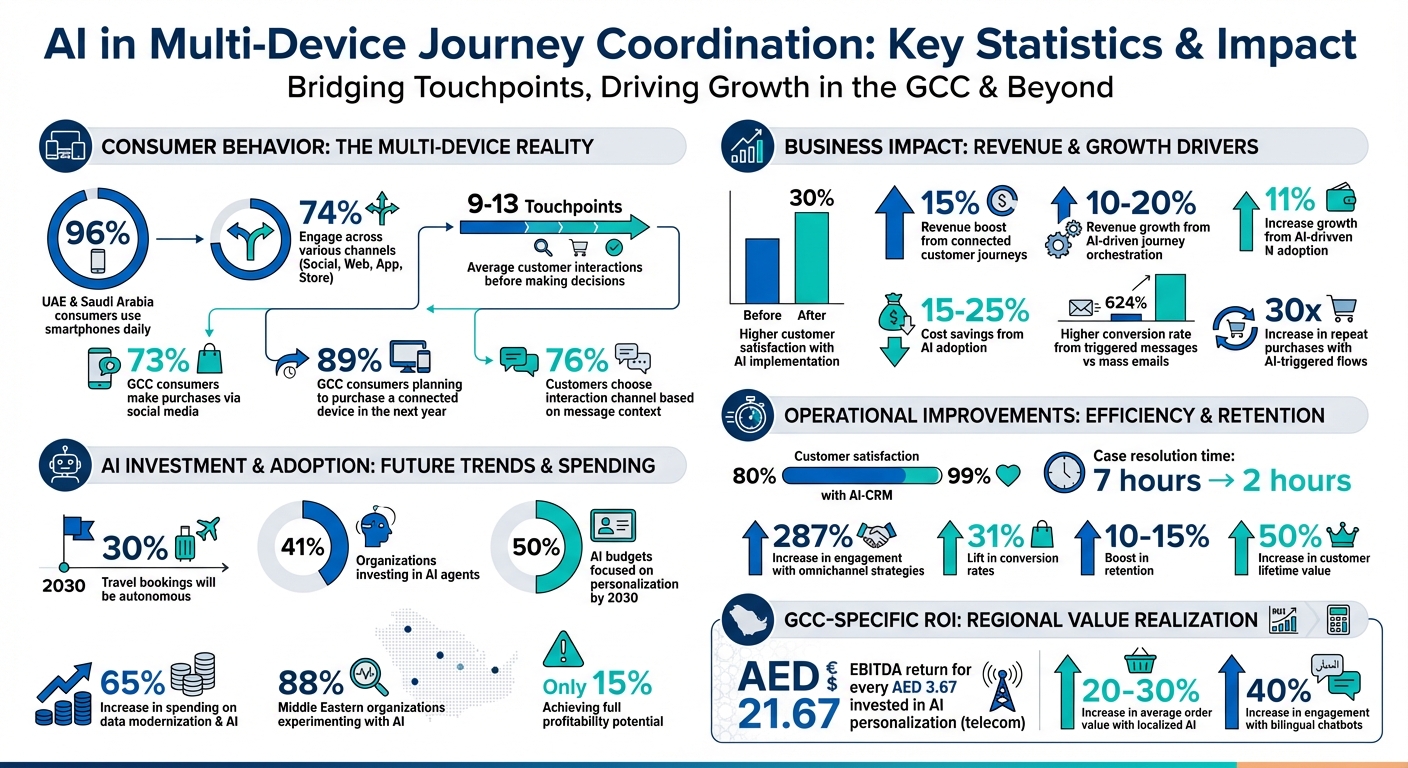
AI Multi-Device Journey Coordination: Key Statistics and Business Impact in GCC
Recent Research on AI and Multi-Device Synchronization
AI-Driven Personalisation and Real-Time Coordination
AI is transforming how people interact across devices, especially in areas like travel and hospitality. According to IDC, by 2030, 30% of travel bookings will be handled autonomously by AI agents. These agents take over tasks like evaluating options, applying user preferences, and completing transactions without human intervention.
Dorothy Creamer, Senior Research Manager at IDC, highlights this shift:
By 2026, hospitality, dining, and travel brands will function in a system where discovery, comparison, booking, and service are mediated by intelligent agents acting on behalf of guests.
Currently, 41% of organisations are already investing in these AI agents for handling complex service scenarios. Looking further ahead, 50% of AI budgets in the travel and hospitality sectors will focus on personalisation by 2030.
This shift isn’t just theoretical - it’s delivering results. AI-CRM strategies have improved customer satisfaction rates from 80% to 99% while slashing case resolution times from 7 hours to just 2 hours. Achieving this level of efficiency requires a unified data system that connects property management tools, loyalty programmes, and digital platforms. This interconnected framework paves the way for more advanced multi-device integration.
Multi-Agent AI Systems for Cross-Device Adaptation
AI agents are evolving, and their capabilities are expanding. Recent research categorises this evolution into three distinct waves: Knowledge Agents (focused on integrating information), Action Agents (designed to execute tasks), and Orchestration Agents (capable of coordinating workflows). Orchestration agents represent a major leap forward - they don’t just react to individual requests but manage entire workflows across devices, guided by user goals and past behaviours.
Tapan Patel, Research Director at IDC, describes this transformation:
Customer journeys now originate not only from users but are also initiated by AI agents well before direct brand engagement.
For these systems to function effectively, brand data must be machine-readable. Heather Hershey, another Research Director at IDC, stresses this point:
If machines can't read it, customers won't see it.
To meet these demands, brands are significantly increasing their investments in data modernisation, security, and AI. Spending in these areas is projected to grow by 65% as companies prioritise multi-device journey coordination to enhance customer experiences. This trend underscores the importance of building a robust digital infrastructure to support these advanced AI capabilities.
End-to-End Customer Experience with AI Powered Multi-Channel Bot and CRM Integration Demo
How AI Improves Multichannel Customer Journeys
AI is reshaping how businesses interact with customers across various devices and platforms. The results speak volumes: companies adopting AI-driven journey orchestration report 10–20% revenue growth and 15–25% cost savings. These efficiencies come from AI's ability to synchronise interactions in real time across email, SMS, mobile apps, websites, and even physical locations. This sets the foundation for understanding how AI enables seamless, real-time customer journeys across multiple channels.
AI in Multichannel Lead Nurturing
Gone are the days of one-size-fits-all campaigns. AI enables personalised, triggered messaging that delivers results. For instance, triggered messages achieve a 624% higher conversion rate compared to traditional mass emails. Even more impressive, AI-triggered flows can increase repeat purchases by up to 30 times.
Take the example of a major US airline in October 2025. Using machine learning, the airline tailored flight delay compensation based on customer value. The outcome? A 210% improvement in targeting at-risk customers, an 800% boost in customer satisfaction, and a 59% drop in churn intention among high-value travellers. The AI system analysed data from web bookings, mobile app interactions, and call centre records to recommend the best action for each customer segment.
Similarly, a global payments processor used machine learning to predict merchant attrition within seven days. By deploying automated interventions - such as waiving fees or resolving technical issues - targeted at specific merchant clusters, the company achieved an estimated 20% annual reduction in attrition. The outreach spanned email, phone, and in-app notifications, ensuring merchants received timely support on their preferred platform.
Non-Linear Customer Journeys Across Devices
AI's value extends beyond lead nurturing by enabling seamless experiences as customers move between devices. Modern customer journeys are rarely linear, and AI bridges these gaps by preserving context across smartphones, tablets, and desktops.
Through identity resolution, AI links fragmented data points - such as email addresses, device IDs, and IP fingerprints - into unified customer profiles. This approach drives a 287% increase in engagement and a 31% lift in conversion rates compared to single-channel strategies. Additionally, robust omnichannel strategies lead to a 10–15% boost in retention and a 50% increase in customer lifetime value.
The importance of context cannot be overstated. About 76% of customers choose their interaction channel based on the message's context. AI ensures continuity by transferring interaction histories between devices. For example, a query initiated on a web chatbot can seamlessly transition to a phone adviser who already has the full conversation history. Similarly, promotional codes from emails can automatically populate in mobile browsers when clicked, reducing friction and enhancing the customer experience.
sbb-itb-058f46d
Data Strategies for Real-Time Personalisation in the GCC
Using Unified Data for GCC Businesses
To deliver truly tailored experiences, businesses in the GCC need to move beyond historical personalisation methods. Instead, they must adopt real-time, predictive strategies that rely on unified data from diverse sources like mobile apps, social media platforms, CRM systems, and even in-store interactions. Breaking down data silos is key to building a complete, 360-degree view of the customer.
The potential benefits of this approach are impressive. For instance, GCC telecom operators can see returns of up to AED 21.67 in EBITDA for every AED 3.67 invested in AI-powered personalisation engines. Mahmoud Makki, Partner at Strategy& Middle East, highlights the transformative potential of such systems:
An AI-powered customer value management engine can transform telco data into a competitive advantage, delivering personalized experiences and real business impact.
This transformation is built on four critical layers:
- A unified data foundation
- An AI-driven cognitive core
- Targeted value pools
- An activation layer for seamless customer engagement
One essential element of this strategy is cross-device identity resolution. As customers switch between mobile devices, desktops, and physical stores, businesses need to track these transitions to maintain a cohesive experience. With 89% of GCC consumers planning to purchase a connected device in the next year, managing this multi-device environment is more important than ever. Unified data strategies are the backbone of real-time personalisation, ensuring consistency across all touchpoints.
Adapting AI Strategies to Local Preferences and Metrics
With unified data practices in place, the next step is adapting AI strategies to the unique needs of the GCC region. This means addressing local nuances like right-to-left (RTL) text orientation, regional dialects, and payment systems such as mada in Saudi Arabia, Benefit in Bahrain, and KNET in Kuwait. Fine-tuned recommendation engines can increase average order values by 20–30%.
AI systems also need to account for the region's distinctive shopping habits. For example, during Ramadan, consumer activity spikes in the evening rather than during the day. Similar shifts occur during Eid celebrations and National Days. Language preferences are another critical factor - 75% of GCC consumers prefer shopping on websites in their native language, and 60% abandon sites that lack proper Arabic localisation. Bilingual chatbots that detect and adapt to the user’s language from the first interaction can increase engagement by up to 40%.
Data sovereignty is another pressing concern. Under the UAE's Federal Data Protection Law, customer data must be stored within the country’s borders. This means businesses must use compliant regional data centres instead of relying solely on global cloud infrastructure. With 25% of AI users in the region citing data privacy as their top concern, handling data transparently can become a competitive advantage. Features like granular consent options and self-service privacy dashboards not only comply with regulations but also help build trust, which is crucial for personalisation efforts.
Wick's Four Pillar Framework combines these elements - strong data foundations and AI-driven actions - to deliver personalised experiences that align with local regulatory and cultural requirements.
Conclusion
AI-powered multi-device journey coordination has moved from being an experimental idea to a critical strategy for businesses in the GCC. With 96% of consumers in the UAE and KSA using smartphones daily and 89% planning to buy a connected device within the next year, the groundwork for seamless cross-device experiences is already set. The real challenge now is not whether to adopt AI, but how quickly organisations can move from testing to impactful implementation. This transition promises not just operational improvements but also significant financial returns.
The numbers speak for themselves: businesses employing journey orchestration report revenue increases of 10–20% and cost savings of 15–25%. For GCC telecom operators, investments in AI-driven personalisation - every AED 3.67 spent - can yield up to AED 21.67 in EBITDA. These figures highlight a transformative shift in how companies connect with customers.
However, challenges remain. While 88% of Middle Eastern organisations are experimenting with AI, only 15% feel it’s achieving its full potential for profitability. Barriers like organisational silos (42%), difficulties in measuring ROI (59%), and fragmented data systems continue to slow progress.
Wael Fakharany, Director of Middle East and Africa at Adobe, captures the opportunity ahead:
Middle Eastern businesses that take this connected approach have a real opportunity to build momentum and shape the next phase of the digital economy, both locally and globally.
For businesses to thrive, they must go beyond pilot projects. Success lies in creating unified data systems, breaking down departmental silos, and adopting agile models that seamlessly integrate marketing technologies. Encouragingly, 61% of organisations in the region describe their cloud infrastructure as "very mature", providing the technical backbone needed for this transformation. The focus now should be on high-impact, high-return initiatives - so-called "lighthouse" projects - that showcase AI's value and drive broader adoption.
The time is ripe for GCC businesses to act. Consumers are eager, the technology is proven, and the benefits for early adopters are clear. Moving from fragmented customer interactions to fully coordinated, AI-driven journeys isn’t just about staying competitive - it’s about leading the way in redefining customer engagement across the region.
FAQs
How does AI enhance customer experiences across multiple devices?
AI is reshaping how customers interact across devices like smartphones, tablets, and desktops by creating smooth, personalised, and interconnected experiences. It uses real-time data analysis to offer tailored content, recommendations, and deals - ensuring a consistent experience regardless of the device. This approach boosts user engagement, satisfaction, and loyalty.
By anticipating customer needs and automating customised interactions, AI eliminates unnecessary hurdles, making the journey easier and more intuitive. It helps brands deliver the right message or service at the perfect moment, building trust and deepening relationships. In the GCC region, AI is becoming an integral part of everyday digital interactions, allowing businesses to offer seamless and context-aware experiences to their customers.
What challenges do businesses face when using AI for coordinating journeys across multiple devices?
Using AI to coordinate journeys across multiple devices comes with its own set of hurdles. One major issue is ensuring smooth communication between devices like smartphones, wearables, and smart displays. Each of these devices has unique features and capabilities, which makes synchronising them a complex technical task. Advanced communication protocols are essential to make this work seamlessly.
Another layer of complexity is dealing with regulatory and ethical considerations, especially in the UAE, where AI-related laws are continuously evolving. Businesses operating here must stay compliant with both local and international regulations. This includes prioritising user data privacy, security, and consent - particularly when sensitive information is involved.
On top of that, integrating AI into an organisation’s existing systems often requires substantial investment. This includes not just the technology itself but also skilled professionals to manage it and resources for ongoing maintenance. Addressing these gaps is crucial to fully unlock the potential of AI for multi-device coordination.
How can GCC businesses protect data privacy while using AI technologies?
Protecting data privacy is a top priority for businesses in the GCC as they embrace AI technologies. Countries like the UAE and Saudi Arabia have introduced strict data privacy laws, inspired by frameworks like GDPR, which require organisations to focus on protecting personal data and ensuring transparency.
To stay compliant, businesses should:
- Develop clear policies for how data is handled, ensuring proper management and accountability.
- Use secure storage solutions to protect sensitive information.
- Communicate openly with users about how their data is collected, stored, and used.
On top of that, adopting advanced cybersecurity tools and privacy-preserving AI techniques is crucial. These measures help guard against cyber threats and ensure sensitive information remains protected. Aligning AI efforts with local regulations, such as the UAE’s federal laws and Dubai’s AI ethics guidelines, further supports responsible AI use.
By blending regulatory adherence, cutting-edge technology, and open communication, GCC businesses can confidently adopt AI while building trust and safeguarding user privacy.