

Blog / AI Models for Real-Time Journey Optimization
AI Models for Real-Time Journey Optimization
AI is transforming customer experiences by enabling real-time journey optimization. This approach uses live data, predictive intelligence, and decision engines to instantly personalize interactions. Unlike older methods that depend on static rules, AI dynamically adjusts to customer behavior, boosting satisfaction and driving conversions. For instance:
- Businesses report a 10%-20% increase in conversions and 15%-25% higher satisfaction.
- Global market growth: Expected to reach $12.5 billion by 2025, growing at 24% annually.
- UAE focus: Initiatives like the National Strategy for Artificial Intelligence 2031 and partnerships with global tech leaders are accelerating adoption in sectors like retail, real estate, and telecom.
AI-powered tools, such as predictive models and unified customer profiles, are reshaping industries by anticipating needs, optimizing communication, and enhancing customer loyalty. Companies in the UAE are using these advancements to meet high expectations and achieve measurable results.
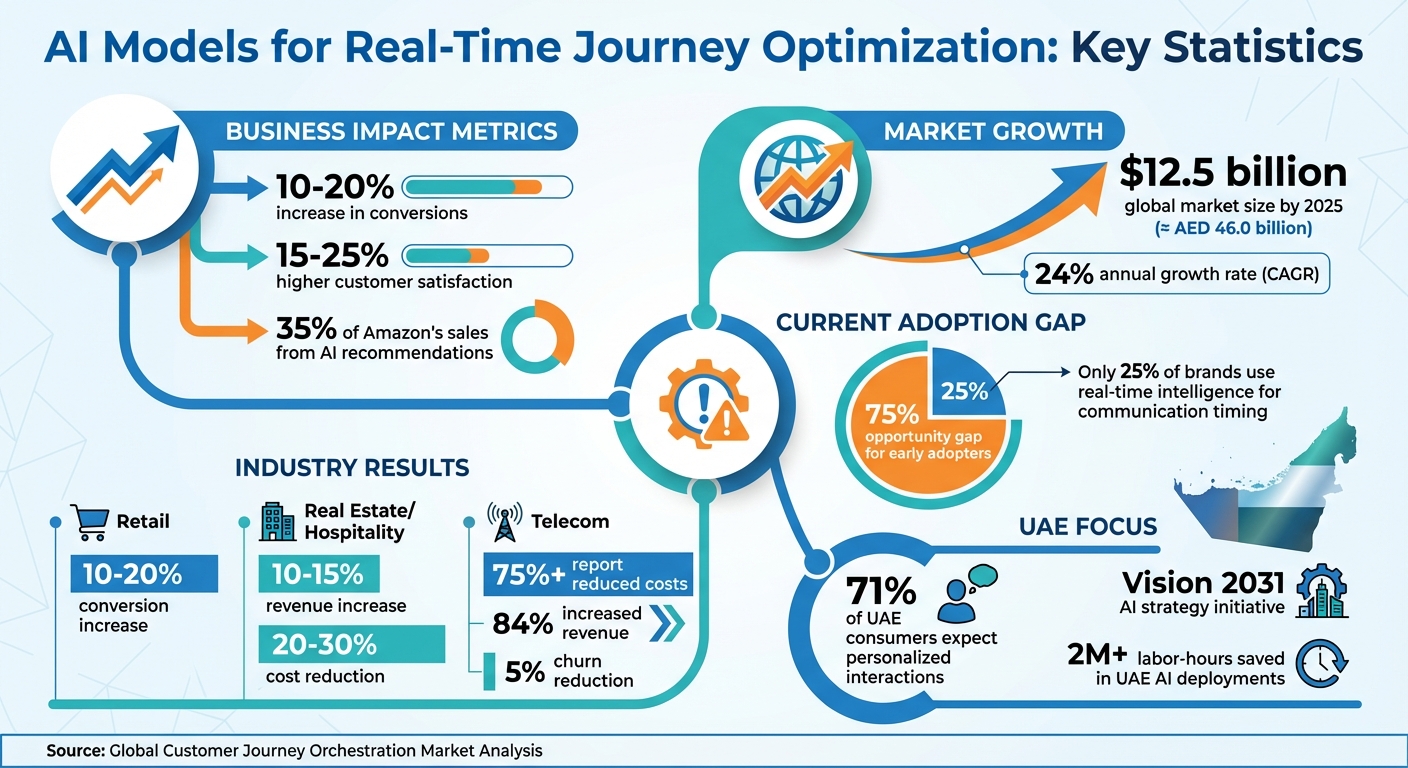
AI Journey Optimization Impact: Key Statistics and Market Growth
Optimizing the Customer Journey with (Causal) AI | #BAS23
Core AI Technologies for Real-Time Optimisation
Real-time optimisation hinges on three key components: predictive intelligence, decision engines, and unified customer profiles. Each contributes uniquely to reshaping how businesses interact with customers across various channels.
Predictive Intelligence and Behaviour Forecasting
Predictive intelligence shifts businesses from reacting to customer actions to anticipating their needs. By analysing patterns and generating real-time scores, AI enables proactive engagement. For example, Customer AI services calculate metrics like churn or conversion probabilities and embed these scores into customer profiles. If a customer begins to show signs of disengagement, the system can step in with a tailored offer or reminder to re-engage them.
AI also determines the best time and channel to connect with each customer, learning from their past behaviours. Instead of sending messages at random, it schedules communication when customers are most likely to respond, reducing fatigue and improving effectiveness.
The results are undeniable. Companies using AI-powered journey orchestration have seen improvements in both conversion rates and customer satisfaction. Yet, only 25% of brands currently use real-time intelligence to optimise communication timing, leaving a big opportunity for those ready to adopt this approach. Predictive insights like these enable businesses to make fast, data-backed decisions.
Real-Time Decision Engines
Decision engines are the backbone of real-time optimisation, working in milliseconds to identify the best action for each customer. Through AI-powered ranking, supervised machine learning and deep learning models assess real-time customer data and rank offers based on their likelihood to engage - whether that's through clicks, opens, or conversions.
In the "online phase", deep learning models evaluate and rank potential offers by analysing intricate, non-linear interactions. The system also enforces selection strategies like eligibility rules and frequency limits to prevent over-messaging and ensure compliance with consent requirements. For instance, if a customer has already received three promotional messages in a week, the engine might hold back an additional offer, even if it scores highly.
To address the "cold-start problem", these systems allocate 10% of traffic to exploratory recommendations while the remaining 90% benefits from model-driven insights. Weekly retraining ensures the system adapts to the latest customer behaviours. Once decisions are made, unified customer profiles tie everything together to complete the optimisation process.
Unified Customer Profiles and Multi-Channel Data Integration
A holistic view of the customer is essential for real-time optimisation, and unified profiles make this possible. These profiles consolidate behavioural, transactional, financial, and operational data into a single, comprehensive view. Whether a customer interacts via mobile, desktop, or in-store, the system treats all actions as part of one seamless journey.
"Data supply chains are the foundational building blocks of personalisation. In journey orchestration, bringing together customer- and brand-initiated touchpoints breaks down data siloes across channel-structured organisations." – Brent Kostak, Senior Product Marketing Manager, Adobe
This integration allows businesses to respond instantly to real-time signals. For instance, if a customer enters a physical store, the system can immediately adjust their journey based on the latest updates to their profile. These unified profiles provide critical inputs - or "features" - for AI models, enabling them to understand complex relationships between user data and contextual factors like device type, location, or environment. This capability ensures adjustments happen in real-time, something static profiles can't achieve.
In regions like the UAE, where customer journeys span digital and physical touchpoints, this approach is especially important. Standardising data formats ensures that information from diverse channels - web, mobile, or offline - feeds seamlessly into the unified profile. The outcome? Consistent, personalised experiences no matter how or where customers choose to engage.
How to Implement AI for Real-Time Journey Optimisation
To implement AI for real-time journey optimisation, you’ll need to focus on three key phases: assessing your data infrastructure, configuring AI models for specific goals, and ensuring ongoing performance improvements. These steps work together to create an effective and adaptable approach to optimisation.
Evaluating Data Infrastructure and Readiness
First, check if your systems can handle real-time decision-making. A good starting point is setting up a Customer Data Platform (CDP). This tool combines data from sources like CRMs, web analytics, and customer support interactions into unified profiles. With this consolidated view, you can avoid the problem of fragmented insights across different channels.
Your system should also capture real-time behavioural data - like clicks, page views, and cart additions - using an event ingestion system. To maintain high-quality data, standardise elements such as customer identifiers, timestamps, and consent permissions.
Another critical factor is ensuring your offers generate enough data for AI learning. For example, top-performing offers should have at least 250 impressions and 25 conversions within 30 days. If your traffic is on the lower side, consider launching a pilot programme that targets high-impact scenarios like recovering abandoned carts or onboarding new users.
Setting Up AI Models for Specific Use Cases
Once your data infrastructure is ready, define clear business goals. Are you aiming to boost conversions, reduce churn, or drive revenue growth? These objectives will help you choose the right AI model. For instance:
- Auto-optimisation models work well for improving overall performance.
- Personalised models use deep learning to make tailored recommendations based on factors like device type, location, and time.
You’ll also need to define key "Experience Events" like impressions and conversions to train your models. Including up to 50 audience segments and contextual data can help the AI identify complex patterns.
For new models without historical data, you can apply a cold-start strategy. Allocate around 10% of your traffic to randomised offer serving to collect initial training data. The rest of the traffic can benefit from AI-driven recommendations, with weekly retraining sessions to keep up with changing customer behaviours.
Tracking Performance and Continuous Improvement
Keeping an eye on your AI’s performance is essential to distinguish what’s working from what’s experimental. Start by using dry-run modes to simulate customer journeys and uncover potential errors or data gaps. Then, apply A/B testing by setting aside around 10% of your audience as a control group. This allows you to compare AI-driven results against traditional rule-based methods.
Monitor key metrics like conversion rates, customer lifetime value, and churn likelihood. Automated feedback loops can be used to refine the AI’s predictions by learning from both successes and failures. Additionally, track technical performance indicators like decision latency and model accuracy. In the UAE, where customer journeys often span both online and offline interactions, ensuring low latency (processing events in milliseconds) is especially important for real-time results.
Lastly, while AI can assist with data analysis and insights, human oversight should always play a role. Marketers need to set strategic goals and maintain control over the brand’s tone and messaging. AI is a powerful tool, but it works best when guided by human expertise.
sbb-itb-058f46d
Industry Applications of Real-Time Journey Optimisation
Real-time optimisation, powered by advanced AI technologies, is reshaping industries across the UAE, meeting the growing demand for precision and speed in customer interactions.
Retail and E-Commerce
Retailers in the UAE are leveraging AI to craft unified customer profiles by combining behavioural, transactional, and financial data. Imagine this: a loyalty app user walks near a store, and their phone buzzes with a notification about an item they previously browsed online that's now back in stock. This behaviour-based trigger bridges the gap between online browsing and in-store purchases - a game-changer in UAE retail.
AI systems also excel at determining the next-best-action, delivering personalised offers through preferred channels like SMS, email, or push notifications in mere milliseconds. Retailers using AI-powered journey orchestration have reported conversion rate increases of 10% to 20%, alongside a 15% to 25% boost in customer satisfaction. Amazon's recommendation engine, responsible for 35% of its total sales, highlights the massive revenue potential of these technologies.
Dynamic content takes personalisation further by adapting webpages and emails based on factors like location, weather, or device type. In a market where 71% of UAE consumers expect tailored interactions, these capabilities are no longer optional - they're essential.
While retail focuses on immediate customer actions, the UAE's real estate and hospitality sectors use AI to meet high-touch service expectations.
Real Estate and Hospitality
In the UAE, where international clientele demand premium services, AI helps real estate and hospitality providers deliver concierge-level experiences. Next Best Experience (NBE) engines analyse customer profiles to anticipate needs - like scheduling a property viewing or suggesting a luxury upgrade - before the customer even asks. Unlike retail’s quick purchase triggers, this approach nurtures relationships over longer decision cycles.
Real-time optimisation also adjusts to contextual factors, such as local events or weather, to refine property viewing schedules or travel packages. For instance, hospitality providers can notify guests about flight delays or facility closures, ensuring seamless communication during operational disruptions. Companies in these industries report revenue increases of 10% to 15% and a 20% to 30% reduction in service costs thanks to AI.
Consistency across digital and physical touchpoints is critical here. Whether customers interact via mobile apps, websites, or in person, AI ensures a unified experience. Predictive churn modelling further empowers real estate firms by scoring leads' likelihood to buy or rent, enabling agents to focus on high-priority prospects.
While real estate focuses on relationship management, telecommunications deal with technical challenges that require their own AI solutions.
Telecommunication and Media
Telecommunication and media companies in the UAE use AI to manage large-scale customer relationships while addressing linguistic and cultural nuances. Predictive churn management tools analyse real-time network data - like latency and signal strength - to identify customers at risk of leaving. With 38% of telecom churn linked to network issues, this capability is vital for retaining customers.
In May 2025, the UAE National Media Office (NMO) partnered with Presight to implement a sovereign AI platform for real-time sentiment analysis. Spearheaded by Dr. Jamal Mohammed Obaid Al Kaabi, this initiative processes billions of media data points daily to align messaging with national priorities. This project has already saved over two million labour-hours in similar UAE deployments and plays a key role in achieving Vision 2031 goals.
"Together, we're building an intelligence-driven media ecosystem that not only enhances media situational awareness and strategic coordination, but also ensures that the UAE's national narrative is secured, coherent, credible, and globally resonant." - Thomas Pramotedham, CEO of Presight
AI-powered Next Best Experience engines also improve customer satisfaction by coordinating touchpoints. For example, these systems pause marketing campaigns for customers with unresolved complaints, significantly boosting Net Promoter Scores. In October 2025, a telecom provider in Asia-Pacific used AI to identify customers at risk of "bill-shock" and sent personalised messages explaining price changes. This reduced churn by 5% and delivered an ROI four times higher than previous campaigns.
For the UAE market, AI must accommodate Gulf, Levantine, and Egyptian dialects to provide accurate conversational support. Over 75% of telecom operators report reduced operational costs through AI, while 84% credit it with increasing annual revenue.
Conclusion: Improving Customer Journeys with AI
AI has transformed customer journey management from reactive efforts into real-time, proactive orchestration. By leveraging unified customer profiles, businesses can predict needs and deliver personalised experiences almost instantly. The market for Global Customer Journey Orchestration is expected to hit US$12.5 billion (approximately AED46.0 billion) by 2025, with a compound annual growth rate of 24%. This highlights how essential real-time optimisation has become in today's competitive landscape.
The results of AI-powered journey optimisation are undeniable - companies across industries like airlines, telecommunications, and retail have seen measurable improvements in both conversion rates and customer satisfaction when adopting AI at scale. In the UAE, where customer expectations are particularly high and markets are diverse, achieving success requires a mix of strategic planning and technical expertise. Breaking down data silos, implementing strong data governance, and balancing quick pilot successes with long-term infrastructure investments are all critical steps in this transformation. Businesses that excel in these areas are poised to lead in customer loyalty, operational efficiency, and sustainable growth.
For organisations looking to capitalise on these benefits, partnering with the right consultancy can make all the difference. Wick specialises in helping businesses navigate this transformation by building integrated digital ecosystems. Through their Four Pillar Framework - covering website development, content creation, data capture, and intelligent automation - Wick equips organisations with the tools they need to scale real-time optimisation. Whether you're just starting with predictive models or aiming to implement AI across your entire enterprise, the right partner can accelerate your progress and drive tangible results.
The real challenge isn't deciding whether to adopt AI for journey optimisation - it's implementing it quickly enough to stay ahead of the competition.
FAQs
How can AI models enhance customer satisfaction through real-time journey optimization?
AI models help businesses elevate customer satisfaction by offering personalised and timely experiences driven by real-time data. By examining customer behaviour, preferences, and even sentiment, AI enables companies to predict what their customers need and address those needs proactively. This approach strengthens engagement and builds loyalty.
For example, AI-powered tools can recommend the next best action for each customer, ensuring interactions are relevant and consistent across different channels. This not only enhances satisfaction but also supports better retention and increased revenue. Machine learning further refines this process by adjusting communications dynamically, aligning them with individual preferences to create a more tailored experience.
With AI, businesses can craft a customer journey that feels intuitive and responsive. Every interaction becomes more meaningful and personalised, laying the groundwork for stronger relationships and sustained success.
What technologies power AI-driven real-time customer journey optimization?
AI-powered real-time customer journey optimisation depends on a blend of advanced technologies working in harmony. At the core are artificial intelligence (AI) and machine learning (ML) models, which process massive datasets to predict customer behaviour and make instant, data-driven decisions. Natural language processing (NLP) adds a personal touch by tailoring interactions, ensuring smoother and more engaging customer experiences. Meanwhile, telemetry data integration facilitates real-time tracking, allowing businesses to adjust and fine-tune the customer journey on the fly.
Together, these technologies create personalised, timely, and relevant interactions, helping businesses address customer needs efficiently while building stronger, lasting relationships.
What are the advantages of using AI for real-time journey optimization in the UAE?
AI-driven journey optimisation allows businesses in the UAE to create personalised customer experiences by analysing data instantly. This technology helps predict what customers need, customise interactions, and improve satisfaction levels.
Using AI, companies can also boost customer loyalty, simplify processes, and make decisions based on data - crucial for thriving in the UAE's dynamic and competitive environment. These tools help organisations stay ahead by delivering smooth, engaging, and locally relevant experiences.