

Blog / AI in Mobile Usability Testing Tools
AI in Mobile Usability Testing Tools
AI is transforming mobile usability testing by automating tasks, improving accuracy, and offering predictive insights. In the UAE, where mobile usage exceeds 98% and smartphone adoption is among the highest globally, AI-driven tools are critical for optimising apps to meet local user expectations. These tools address unique regional needs such as bilingual interfaces, right-to-left layouts, and AED-based payment systems.
Key highlights:
- AI Benefits: Faster testing, reduced costs, and improved precision.
- Advanced Features: Automated heatmaps, predictive analytics, and voice/gesture testing.
- Local Relevance: Tailored solutions for UAE-specific challenges like Arabic text alignment, cultural preferences, and mobile-first user behaviour.
AI-powered usability testing not only streamlines workflows but also aligns with the UAE’s Vision 2031 goals for digital transformation, ensuring apps deliver seamless, efficient, and user-friendly experiences.
How AI is Transforming Mobile Testing: Faster, Smarter, Better
Recent AI Developments in Mobile Usability Testing
The world of mobile app testing has undergone a major shift, thanks to advancements in AI. What once required hours of manual analysis is now handled by sophisticated tools. From spotting confusing navigation patterns to predicting where users might drop off, these tools are reshaping how developers optimise mobile experiences. They’re also enhancing features like heatmaps, predictive analytics, and voice or gesture testing.
AI-Powered Heatmaps and User Flows
AI-driven heatmaps have taken user flow analysis to a whole new level. Using computer vision and pattern recognition, these tools track how users interact with mobile screens - whether they’re tapping, swiping, or scrolling. But they don’t just stop at mapping clicks. They can highlight issues like "rage taps" on unresponsive elements, areas where interactions fail (dead zones), or loops that confuse users. Even better, they can segment sessions by user behaviour, such as distinguishing new users from returning ones or grouping users by language preferences like Arabic and English. This makes it easier to identify problem areas without needing manual tagging.
For teams in the UAE, these tools are a game-changer. They help detect localisation challenges, such as users struggling with right-to-left layouts, hesitating over payment methods in AED, or frequently switching between Arabic and English interfaces. These insights feed directly into targeted A/B tests, streamlining the optimisation process.
Predictive Analytics for User Behaviour
Predictive analytics uses historical data - like event logs, error rates, and task completion times - to forecast where users might face friction. For example, these models can identify patterns such as repeated corrections in forms, slower completion times in specific app steps, or frequent changes in screen orientation that often lead to drop-offs. In UAE-specific pilot studies, predictive models have flagged problematic checkout steps, leading to simplifications that significantly improved conversions.
Voice and Gesture Recognition Testing
AI platforms have also made strides in testing voice and gesture recognition. These tools simulate and evaluate voice commands using synthetic speech across various accents, languages, and noise levels, all while measuring accuracy and response times. For UAE apps, this is especially useful for scenarios like Arabic and English voice searches in e-commerce or government apps, voice-based navigation in mapping tools, and hands-free banking transactions.
On the gesture side, computer vision analyses touch patterns - such as swipe paths, multi-finger gestures, pressure, and speed - to ensure smooth functionality across devices. This is particularly important for interactive elements like carousels, pull-to-refresh actions, and edge-swipe navigation. Given the variety of Android and iOS devices popular in the UAE, this ensures a consistent user experience across the board.
Benefits of AI-Powered Mobile Usability Testing
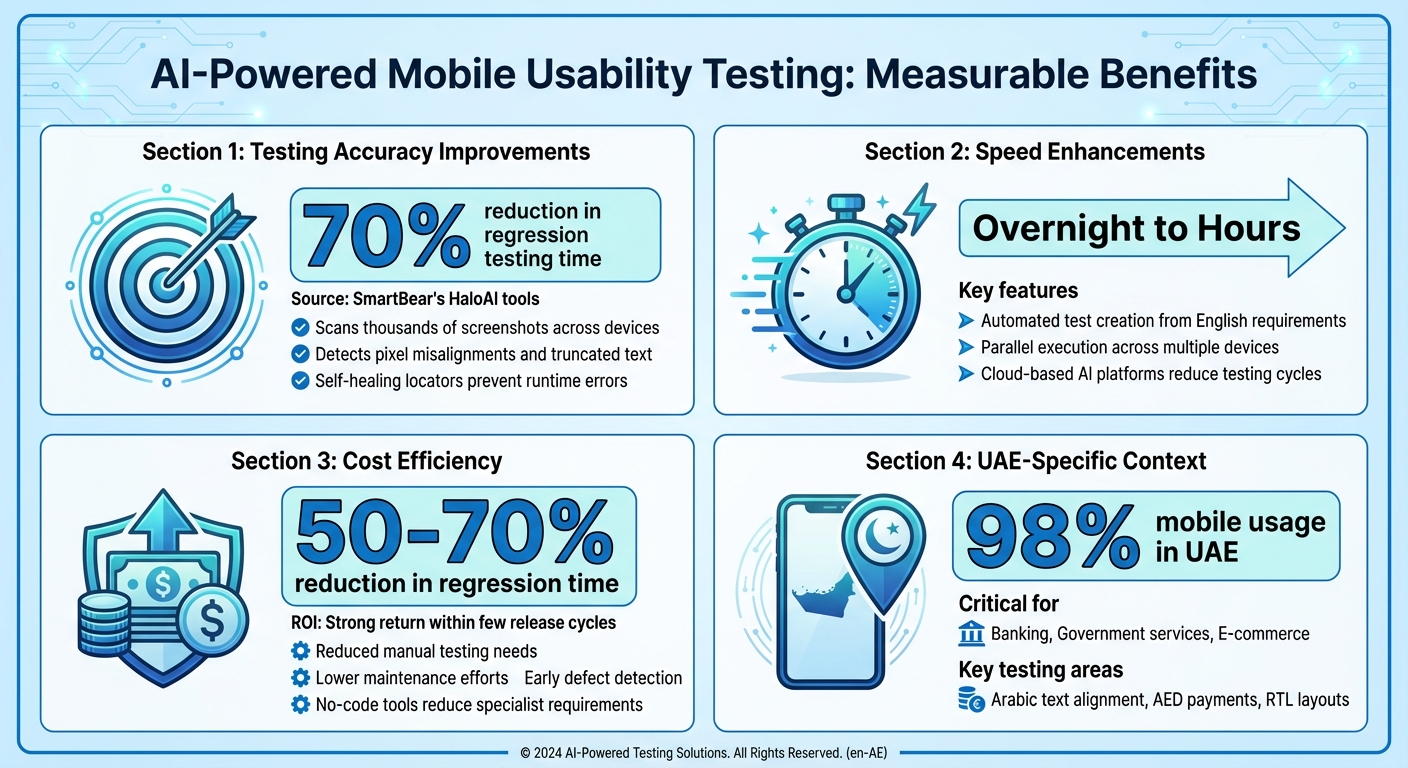
AI Mobile Usability Testing Benefits: Key Statistics and Impact Metrics for UAE Businesses
AI-powered mobile usability testing offers a range of advantages, including improving product quality, speeding up release cycles, and cutting testing costs. These benefits are particularly relevant in the UAE, where consumers demand smooth and reliable experiences from apps used for banking, government services, and online shopping.
Improved Testing Accuracy
AI brings precision to testing by minimising human bias, expanding test coverage, and identifying subtle issues that manual testers might overlook. For instance, computer vision models can scan thousands of screenshots across devices to detect pixel misalignments, truncated Arabic text, or poor colour contrast that could hinder accessibility. Self-healing locators ensure that tests remain reliable even when user interfaces change, preventing unnoticed errors or breaks during runtime. Additionally, machine learning analyses user session data - such as taps, scrolls, and dwell times - to pinpoint usability problems at critical points in the user journey, like payment screens or Emirates ID verification processes. A notable example is SmartBear's HaloAI tools, which achieved a 70% reduction in regression testing time for mobile apps by leveraging self-healing locators and visual AI.
Faster Test Cycles
AI significantly speeds up testing by automating test creation, running tests in parallel, and efficiently organising results. Tools powered by AI can generate or update regression test suites from simple English requirements or design prototypes, saving developers a considerable amount of scripting time. Cloud-based AI platforms further enhance efficiency by executing tests simultaneously across multiple devices and operating system versions, reducing what used to take overnight to just a few hours - or less. For UAE businesses, this speed is crucial, especially when aligning app launches with key shopping events like Ramadan promotions or end-of-year sales, or meeting government deadlines.
Cost Efficiency for Enterprises
AI-driven testing tools help businesses save money by reducing the need for manual testing, lowering maintenance efforts, and catching defects early to avoid costly fixes later. No-code AI tools enable non-technical team members to create tests, cutting down on the need for expensive specialists. Self-healing features also minimise the time engineers spend fixing scripts. Early and accurate detection of issues prevents costly emergency fixes, reputational harm, and lost revenue from abandoned carts or poor app reviews - critical concerns in competitive sectors like fintech and travel in the UAE. While AI tools often come with licensing or subscription fees, many case studies show regression time reductions of 50–70%, delivering a strong return on investment for medium to large organisations within just a few release cycles. These savings make it easier to incorporate AI tools into existing workflows seamlessly.
sbb-itb-058f46d
Integrating AI Tools into Mobile Testing Workflows
Integrating AI testing tools into your mobile workflow can enhance efficiency without disrupting your release timelines. For businesses in the UAE - particularly in banking, government, and e-commerce - it’s essential to align these tools with your existing processes to maintain seamless operations.
Selecting the Right AI Tool
When choosing an AI tool, prioritise those that integrate smoothly with your CI/CD pipelines and issue trackers like Jira, GitLab, or Azure DevOps. This allows automated testing on every build. Tools that support cross-platform testing across Android, iOS, and hybrid frameworks like Flutter or React Native are ideal. Access to real-device clouds for testing on popular devices used in the GCC region is another must-have feature.
Key functionalities to look for include self-healing locators to minimise maintenance, visual AI for enhanced accuracy, and no-code or low-code authoring so non-technical team members can contribute to test creation. For businesses handling sensitive data, ensure the tool supports data residency, on-premises or private cloud deployment, Arabic/RTL support, and SSO with role-based access. When it comes to pricing, evaluate subscription models in AED that scale with your team size rather than being based on test volume.
Before committing, run a 2–4 week proof of concept with 2–3 shortlisted tools. Test core app scenarios like onboarding or purchase flows, and use success criteria such as ease of creating tests in plain English, stability during UI changes, compatibility with your build pipelines, and overall time savings. Test on a representative device matrix, including recent iPhone and Android flagships commonly used in the UAE, using device clouds like BrowserStack or AWS Device Farm. Don’t forget to assess the vendor’s training resources, Arabic-friendly customer support, and service-level agreements.
Once the right tool is selected, the next step is preparing your teams to make the most of these integrations.
Training Teams for AI Integration
To fully harness AI tools, upskill your QA, UX, product, and DevOps teams. QA staff should focus on AI-assisted test design, natural-language test authoring, interpreting visual AI dashboards, and maintaining self-healing rules. UX and product teams can learn to translate usability hypotheses into measurable AI test scenarios, such as testing navigation clarity or identifying friction points in forms. Meanwhile, DevOps engineers need to understand test orchestration, executing tests in parallel on device clouds, and securely managing credentials and test data.
A well-structured 4–8 week training programme can set your teams up for success. Start with vendor-led workshops that demonstrate the tools’ core features using your own mobile app. Pair senior automation engineers with UX or business testers during short sprints to encourage knowledge sharing. Establishing a centre of excellence or an "AI testing guild" can help maintain best practices, coding standards, and playbooks for consistent adoption. For UAE-based teams, schedule sessions that consider the local working week and cultural norms, such as adjusted hours during Ramadan or public holidays.
With proper training, teams can use AI tools effectively, improving both reliability and speed in the testing process.
Monitoring and Improving AI Performance
Once the tools are integrated and the teams are trained, it’s crucial to monitor AI performance consistently. Track key performance indicators (KPIs) such as test creation time, maintenance effort, and flaky test percentages. Keep an eye on regression cycle durations - some AI platforms report savings of up to 70% - and ensure device and browser coverage includes high-usage segments in the Gulf region. From a usability standpoint, measure the number of defects caught pre-release, their correlation with app store ratings, and changes in conversion or task completion rates for key mobile journeys.
To ensure ongoing improvement, establish a feedback loop for testers to adjust and label AI suggestions. Conduct periodic reviews of visual AI baselines, especially after major app redesigns, to update locators and refine regression suites. Integrating production analytics or session replay tools with your AI testing platform can help identify high-impact scenarios for new test creation, ensuring the AI focuses on what matters most to your local users.
Wick's Four Pillar Framework for AI-Optimised Mobile SEO and Usability

After incorporating AI testing tools, the next step is connecting those insights to broader business outcomes. Wick’s Four Pillar Framework takes usability insights and turns them into actionable mobile SEO improvements. This is especially relevant in the UAE, where over 95% of the population uses mobile internet, and users expect fast, bilingual (Arabic–English) digital experiences.
Build & Fill: Laying the Groundwork for Mobile Optimisation
The Build & Fill pillar is all about creating mobile-first digital foundations that align seamlessly with AI testing tools. Wick focuses on responsive design, clear typography, and optimised media tailored for UAE's advanced 4G/5G networks. By using semantic naming conventions in the code, Wick ensures AI-driven automation remains reliable, reducing potential errors in visual AI tools. Core Web Vitals, like Time to Interactive, are optimised from the start, ensuring AI analytics provide meaningful data.
When it comes to content, Wick designs for mobile-first consumption. This includes short, scannable sections, collapsible FAQs, and video formats that display effectively on devices popular in the UAE. AI research tools help analyse trending search topics in both Arabic and English, identifying keywords and content formats that align with local search behaviours - like "near me" queries in cities such as Dubai or Abu Dhabi. Social media posts are also A/B tested with AI to find the creatives that attract high-quality mobile traffic. This comprehensive foundation sets the stage for boosting visibility, as explored in the next pillar.
Plan & Promote: Boosting Mobile Visibility
The Plan & Promote stage focuses on leveraging AI-powered tools to uncover mobile-specific SEO opportunities. These range from optimising for voice searches to targeting location-based queries across UAE emirates. AI models group search queries by intent and map them to mobile landing pages or app screens, ensuring each page is equipped with optimised metadata, fast load times, and a smooth user experience. Metrics like scroll depth, interaction rates, and micro-conversions (e.g., WhatsApp clicks, call taps, or "book now" actions) are fed back into AI systems to refine SEO strategies and creative content.
AI-driven usability insights, such as heatmaps and user journey maps, play a key role here. For example, if data reveals that Dubai-based users often abandon their journey during payment or delivery steps, Wick adjusts UI elements and metadata to reduce friction. In its collaboration with Forex UAE, Wick manages ongoing website optimisation and SEO strategies, using detailed performance tracking to drive better digital outcomes. The result? More personalised and effective mobile experiences, which are the focus of the next pillar.
Tailor & Automate: Creating Personalised Mobile Experiences
The Tailor & Automate pillar uses AI-powered personalisation engines to dynamically adjust mobile content, calls-to-action, and layouts based on user behaviour, device type, language preference, and intent. For UAE audiences, this means showcasing Arabic content, displaying prices in AED (د.إ), highlighting nearby store locations, and offering popular payment or delivery options - all tailored to the user’s emirate and past interactions. AI models segment users into micro-audiences, such as repeat luxury buyers, first-time visitors, or B2B decision-makers, and serve them tailored offers and navigation paths.
Wick also sets up automation workflows that integrate AI testing, analytics, and marketing platforms. These workflows ensure that insights lead to immediate actions without manual intervention. For example, if AI tools detect a drop in form completions on a key mobile page, an automated alert triggers a rollback or initiates an A/B test. Similarly, automated systems can send personalised follow-up messages based on a user’s mobile interactions. In its work with Olive Branch Properties, Wick implemented AI-powered customer service solutions paired with automated communication systems, improving overall service delivery.
To measure success, Wick uses a framework that ties AI-driven UX and SEO changes to business outcomes, such as revenue in AED, cost per acquisition, and customer lifetime value. Key metrics like task completion rates, time on task, organic traffic, and click-through rates are segmented by emirate, language, and device to assess the impact of these strategies.
Conclusion: The Future of AI in Mobile Usability Testing
Key Takeaways for UAE Businesses
With over 70% of companies adopting AI testing solutions, the shift from experimental tools to indispensable assets is clear. For businesses in the UAE, where a mobile-first economy and widespread smartphone usage dominate, this evolution is especially crucial. AI-powered tools now reduce regression testing times by as much as 70%. They also offer features like automated heatmaps, predictive analytics, and machine learning–driven UI testing, which reveal insights that manual testing often overlooks.
Looking forward, technologies like advanced voice and gesture recognition, natural-language test creation using GPT-based engines, and seamless integration with CI/CD pipelines are expected to become standard practices. These advancements align perfectly with the UAE’s smart city initiatives and the region’s projected 40% annual growth in AI adoption. For businesses, integrating AI testing into their workflows - ensuring seamless Arabic and English user experiences, AED-based transactions, and location-specific functionality on real devices - will be essential to staying competitive in an increasingly digital landscape.
Working with Partners Like Wick
To fully leverage these advancements, collaboration with experts like Wick can turn testing insights into actionable digital strategies. Effective AI-driven mobile testing requires a connected ecosystem that ties testing data to SEO performance, analytics, and personalised user experiences. Wick’s Four Pillar Framework combines mobile testing insights with robust SEO strategies and personalisation tools, ensuring that improvements directly impact key business metrics like AED revenue, cost per acquisition, and customer lifetime value.
Wick’s approach delivers seamless experiences tailored to local audiences across Dubai, Abu Dhabi, and other parts of the UAE. For businesses aiming to future-proof their mobile strategies, partnering with specialists who understand both AI’s potential and the nuances of the regional market offers a clear path to achieving long-term digital success.
FAQs
How does AI enhance the accuracy of mobile usability testing in the UAE?
AI is transforming mobile usability testing in the UAE by leveraging advanced algorithms to analyse user interactions, identify usability issues, and suggest real-time improvements. These tools use predictive analytics to offer clear insights, enabling developers to craft smoother experiences that cater to the UAE's rich cultural and linguistic diversity.
By automating repetitive tasks, AI not only minimises human error but also accelerates the testing process. This ensures mobile apps are better aligned with local user expectations, helping businesses deliver intuitive and user-friendly applications tailored to the specific needs of the UAE market.
How does AI improve mobile app usability testing?
AI is transforming mobile app usability testing by streamlining repetitive tasks and offering sharper insights. Some standout features include automated UI testing, which swiftly spots interface problems, predictive analytics to anticipate user behaviour, and AI-powered bug detection that speeds up issue identification and resolution.
On top of that, AI supports real-time performance tracking and designs customised testing scenarios to mimic a wide range of user interactions. This ensures apps are thoroughly tested for usability and functionality. These tools greatly improve the precision and speed of testing, enabling businesses to deliver smooth and reliable mobile experiences.
How can businesses in the UAE leverage AI tools to improve their workflows?
Businesses in the UAE can refine their operations by incorporating AI-powered tools that simplify tasks and support smarter decision-making. Using a structured strategy like Wick’s Four Pillar Framework, companies can align their digital initiatives with a focus on data-driven planning, smart automation, and customised customer experiences.
This approach is specifically designed to cater to the UAE market, addressing local factors such as the AED currency, metric measurements, and cultural preferences. By leveraging AI tools, organisations can unlock higher efficiency, gain valuable customer insights, and drive long-term growth within the region.