

Blog / AI vs. Manual Personalization in Gulf Retail

Wick
December 24, 2025AI vs. Manual Personalization in Gulf Retail
AI-driven personalization is transforming Gulf retail, delivering faster, more tailored shopping experiences compared to manual methods. Here’s the key takeaway: AI boosts conversions by 30–40% and average order values by 20–30%, while manual efforts struggle with scale and real-time responsiveness.
Key Insights:
- AI Personalization: Uses machine learning for real-time recommendations, Arabic NLP, and predictive analytics. It processes millions of signals instantly, offering highly targeted experiences.
- Manual Personalization: Relies on human-curated rules and broad customer segments. It’s resource-intensive, slower, and less precise.
- Consumer Expectations: 75% of GCC shoppers prefer websites in Arabic, but 60% abandon sites lacking proper localization. AI addresses these gaps effectively.
- Challenges: AI faces talent shortages and fragmented data systems, while manual methods lack efficiency and scalability.
Quick Comparison:
| Metric | AI Personalization | Manual Personalization |
|---|---|---|
| Processing Speed | Real-time (milliseconds) | Days to weeks (batch-based) |
| Scalability | High | Low |
| Revenue Impact | 10–15% increase | 8–10% (labor-intensive) |
| Localization | Dynamic Arabic NLP | Static translations |
AI's ability to learn, adapt, and deliver instant results makes it the preferred choice for Gulf retailers, especially during high-demand periods like Ramadan. However, combining AI with human oversight can bridge gaps in empathy and cultural nuances, ensuring a balanced approach.
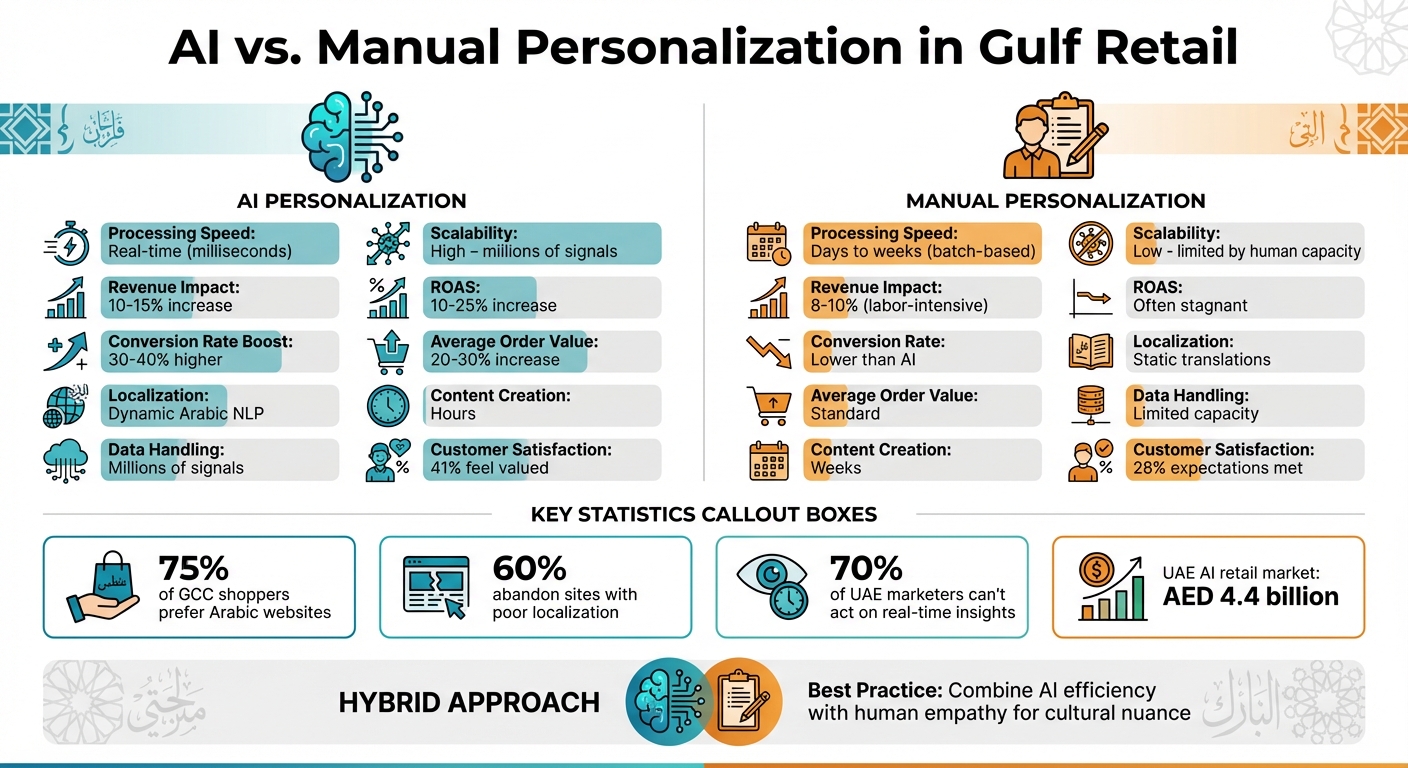
AI vs Manual Personalization in Gulf Retail: Performance Comparison
Episode 1 – Revolutionizing Retail with AI: Personalization, Engagement & Efficiency
How AI-Driven Personalisation Works
AI-driven personalisation leverages machine learning algorithms to analyse customer data and create tailored shopping experiences. Unlike traditional rule-based systems that follow fixed "if-then" rules, AI evolves continuously, learning from every interaction to fine-tune its recommendations in real time. In the UAE, the AI-powered retail personalisation market is valued at approximately AED 4.4 billion, highlighting the significant investments Gulf retailers are making in this technology. This evolving capability opens the door to understanding how AI-driven strategies function behind the scenes.
Predictive Analytics and Real-Time Recommendations
AI relies on predictive analytics to anticipate customer behaviour. By using reinforcement learning, these systems experiment with different offers, messages, and timings for individual shoppers, optimising results based on metrics like conversions or profit. A noteworthy example is L'Oréal's March 2025 initiative, where generative AI automated metadata tagging for 200,000 products across 36 brands and over 500 websites. This innovation saved an impressive 120,000 hours of manual effort and boosted SEO by tapping into unstructured customer data to reveal preferences. In Gulf markets, recommendation engines can increase average order values by 20–30%, while personalisation strategies tailored to local preferences deliver 30–40% higher conversion rates compared to generic global approaches.
Arabic Language and Cultural Integration
AI systems designed for Gulf retailers incorporate Arabic Natural Language Processing (NLP) to handle the unique aspects of the language, including right-to-left text orientation, Modern Standard Arabic, and regional dialects. Bilingual chatbots, for instance, can detect a user’s language preference from the very first message, removing the need for manual selection and boosting engagement rates by up to 40%. Beyond language, AI integrates regional and cultural nuances - ensuring messages, imagery, and interactions align with local values. This includes considerations for modesty, family-focused messaging, and accommodating religious observances like Ramadan, where evening shopping peaks are common.
"AI personalisation GCC strategies diverge from global playbooks. Success requires marrying cutting-edge technology with deep cultural localisation." – Aneesh Sreedharan, CEO of 2Hats Logic Solutions
Omnichannel Personalisation
AI excels at unifying customer interactions across multiple touchpoints, whether it’s websites, mobile apps, or WhatsApp. With WhatsApp usage in the region averaging over three hours daily, many retailers have embraced conversational commerce through the WhatsApp Business API, enabling seamless product discovery and transactions.
"AI connects all customer touchpoints by delivering a consistent experience across in-store, online, or app channels." – Jadd Elliot Dib, Founder and CEO of PangaeaX
This omnichannel strategy ensures that a customer browsing on their phone late at night will experience the same personalised journey when they visit a physical store the next morning, creating a seamless and unified shopping experience.
How Manual Personalisation Works
Manual personalisation operates on predefined, human-created rules instead of relying on dynamic algorithms. Marketers design broad customer segments based on factors like age, gender, life stages (e.g., mothers shopping for children), or interests such as fashion-savvy young women. These segments are then targeted using rule-based logic - essentially "if-then" statements that trigger specific actions when customers meet certain criteria.
Segmentation and Rule-Based Methods
At the heart of manual personalisation are customer segmentation and business rules. Marketers examine available data to group customers into categories and set up triggers that respond to specific behaviours. For example, if a shopper browses a product but doesn’t complete the purchase, a system might send a discount email based on a predefined rule. Similarly, calendar-based campaigns are common, where retailers schedule promotions around events like Ramadan, Eid, or National Days.
In Gulf markets, manual methods often require shoppers to manually select their language preference - Arabic or English - which can create unnecessary friction. Automated systems, by contrast, can detect language preferences and improve engagement rates by as much as 40% by removing this extra step. Manual segmentation relies on basic demographic and behavioural data, which misses the nuanced patterns and micro-segments that advanced machine learning can uncover.
"A recommendation engine trained on Western shopping behaviors will never understand why a Saudi shopper browses differently during Ramadan." – Aneesh Sreedharan, CEO, 2Hats Logic Solutions
While these manual techniques are straightforward, they lack the ability to adapt quickly to real-time customer insights, a gap that will be explored further.
Limitations of Manual Methods
Manual personalisation presents significant challenges when it comes to scalability and efficiency, particularly in Gulf retail markets. Nearly 70% of marketers in the UAE report being unable to act on real-time customer insights. Additionally, fragmented data across various retail channels and inconsistent Arabic data formatting create major obstacles for manual processing in the GCC. A survey of Gulf consumer companies revealed that 50% of respondents experienced significant inaccuracies in their data.
These technical issues are compounded by a lack of consumer trust. Only 31% of UAE shoppers feel that brands deliver content tailored to their needs, and just 18% believe they receive fair value in exchange for sharing their personal data. Manual localisation efforts often focus on mechanical translation rather than meaningful cultural adaptation, which is a critical issue given that 60% of GCC shoppers abandon websites with poor Arabic localisation. Static, rule-based systems require heavy human involvement, making them difficult to scale across varied customer journeys.
These limitations highlight the need to compare manual methods with AI-driven approaches, particularly in terms of efficiency and scalability.
Efficiency and Scalability: AI vs. Manual
Comparison Metrics
AI takes the lead over manual personalisation in several critical performance areas. For instance, AI systems can adjust pricing and offers in real-time - often in milliseconds - while manual methods rely on slower, batch-based processes. This difference is particularly evident in the table below.
AI also outshines manual systems when it comes to data handling. It processes millions of signals, both structured and unstructured, while manual approaches struggle with fragmented data and limited human resources. This inability to manage data efficiently hampers the real-time responsiveness that modern businesses require.
| Metric | AI-Driven Personalisation | Manual Personalisation |
|---|---|---|
| Processing Speed | Real-time (milliseconds) | Days to weeks (batch processing) |
| Data Volume Handling | Millions of signals | Limited by human capacity |
| Adaptation to Local Preferences | Dynamic; uses NLP for Arabic/English and adjusts for events | Static; based on broad demographic assumptions |
| Content Creation | Generated in hours | Takes weeks to create |
| Scalability | High; supports millions of individualised journeys | Low; requires proportional staff increases |
For example, in 2024, L'Oréal and Gibson Guitars showcased AI's potential by automating metadata tagging for 200,000 titles and generating over 40% of their total revenue through automated interactions.
AI's ability to meet localised and time-sensitive demands further underscores its superiority.
Meeting Gulf Retail Demands
During high-demand periods like Ramadan, Gulf retailers experience significant surges in customer activity. AI’s predictive demand forecasting and real-time adjustments make it indispensable during these times. In contrast, manual systems often take weeks to plan and roll out campaign variations, leaving businesses struggling to keep up.
The UAE’s retail environment, with 99% internet penetration and a tech-savvy population, demands instant responsiveness that manual methods simply cannot provide. As Jadd Elliot Dib, Founder and CEO of PangaeaX, puts it:
"In the next five years, retail will become more real-time, with AI able to adjust offers, messages, and inventory instantly based on customer behaviour"
Manual processes also face scalability challenges. To match AI’s capabilities, businesses would need to significantly increase their workforce, a strategy that is neither efficient nor sustainable. Additionally, projections suggest that by 2030, nearly 70% of routine in-store tasks will be automated, further highlighting the limitations of traditional methods.
Performance Results in Gulf Retail
When it comes to Gulf retail, the numbers tell a compelling story. AI-powered personalisation is proving to be a game-changer, delivering measurable benefits that manual methods simply can't match. Here's a closer look at how these two approaches stack up.
AI Performance Metrics
AI-driven personalisation has been shown to increase Return on Ad Spend (ROAS) by 10%–25% and boost revenue by 10%–15%. These gains highlight AI's ability to outperform manual strategies in the Gulf's fast-paced retail sector.
Manual Personalisation Results
Manual personalisation struggles to keep up in the UAE's competitive retail market. A staggering 70% of shoppers in the UAE report receiving irrelevant notifications that fail to align with their preferences or purchase history. Furthermore, only 28% of consumers feel that manual approaches meet their personalisation needs effectively.
One example of manual efforts comes from a Middle Eastern omnichannel retailer that managed an 8% to 10% revenue uplift in 2021 by creating a team dedicated to crafting millions of tailored messages weekly. They tested specific triggers, such as offering ready-to-eat meals to impulse buyers on Mondays. While this approach yielded some results, it required extensive human resources and lacked the speed and scalability of AI systems.
Adding to these challenges is a trust gap. Only 35% of UAE consumers trust how brands handle their data, and just 18% believe they receive fair value for sharing their personal information.
Performance Comparison Table
| Metric | AI-Driven Personalisation | Manual Personalisation |
|---|---|---|
| Return on Ad Spend (ROAS) | 10%–25% increase | Often stagnant or diluted by irrelevant targeting |
| Revenue Lift | 10%–15% average increase | Minimal; 70% of messages viewed as irrelevant |
| Customer Satisfaction | 41% feel understood/valued | 28% feel expectations are not met |
| Content Creation Speed | Hours (via Generative AI) | Weeks |
| Implementation Cost | High (~AED 500,000 per retailer) | Low to moderate (labour intensive) |
While AI personalisation requires a higher initial investment - around AED 500,000 per retailer in the UAE - the returns more than justify the expense. By 2025, the UAE's market for AI-powered retail personalisation is expected to hit USD 1.2 billion, driven by its unmatched ability to deliver results. These figures underline why Gulf retailers are increasingly turning to AI to shape their personalisation strategies.
Implementation Challenges in Gulf Retail
Both AI and manual personalisation offer tremendous potential for Gulf retailers, but their implementation isn't without challenges. Understanding these obstacles is key to navigating the region's unique retail landscape.
AI Implementation Obstacles
One of the biggest challenges facing AI adoption in the GCC is a severe shortage of skilled professionals. A striking 93% of participants in a GCC retail roundtable highlighted the lack of AI talent as the main barrier to progress. This talent gap makes it difficult for retailers to fully leverage AI's capabilities.
"The GCC retail sector is at a tipping point. AI is the key to delivering personalised, high-impact customer experiences - but it all begins with talent." - Moza Al Futtaim, Chief AI Officer, Al-Futtaim
Fragmented customer data across 20–25 outdated systems further complicates AI integration. Only 35% of GCC retailers have modern infrastructure in place to support AI adoption. On top of that, regulatory hurdles, such as data residency laws, prevent sensitive customer data from being stored on global public clouds, limiting access to advanced AI services. Cybersecurity concerns also loom large, with 66% of GCC executives citing it as their top worry when it comes to generative AI.
Cultural nuances add another layer of complexity. AI models often fall short when trained on Western shopping behaviours, as they struggle to adapt to Gulf-specific patterns like Ramadan shopping peaks or the need for sophisticated Arabic language processing. Manual methods, while potentially more culturally aware, also fail to fully capture the depth of these nuances. Additionally, trust issues persist, with only 35% of UAE shoppers confident in how brands handle their data.
Manual Personalisation Obstacles
Manual personalisation, while offering a human touch, is incredibly resource-intensive. For instance, in September 2025, L'Oréal automated metadata tagging for 200,000 product titles across 36 brands and 500 websites, saving an estimated 120,000 hours of manual labour. This example underscores how labour-heavy manual processes can be.
The region's talent shortage magnifies this issue, making it harder to find and retain skilled staff to manage segmentation and manual campaigns. Targeting smaller, diverse consumer segments manually is not only time-consuming but also cost-prohibitive. Another significant drawback is the lack of real-time responsiveness; 70% of UAE marketers admit they can't act on customer insights promptly due to outdated backend systems.
These limitations have driven many retailers to rethink their approach, often opting for a mix of AI and manual methods.
Combining AI and Manual Methods
To overcome the challenges of both approaches, Gulf retailers are increasingly adopting a hybrid strategy. This method combines AI's efficiency with the cultural sensitivity and strategic input of human teams. AI takes care of data-heavy tasks and scaling operations, while humans bring empathy and local understanding into the equation.
"AI handles efficiency, while humans handle empathy. Empathy must remain at the centre; AI should make human service better, not replace it." - Jadd Elliot Dib, Founder and CEO, PangaeaX
Best practices for implementing this hybrid model include appointing "analytics translators" to bridge the gap between technical teams and business leaders and involving local consultants to ensure AI-generated content aligns with regional expectations. For example, in September 2025, Gibson Guitars used AI-driven personalisation to double customer engagement and boost email-driven sales by 50%. Automated experiences now account for over 40% of their revenue.
To make hybrid strategies work, retailers need to move beyond isolated pilot projects. Centralised data platforms can help eliminate silos, while Customer Data Platforms (CDPs) can unify customer interactions across mobile, web, and in-store channels. Modular data products tailored to specific business needs can also make the transition smoother. Starting small with tools like recommendation engines before scaling to more advanced AI systems can help retailers build capabilities gradually and manage the shift effectively.
Conclusion: AI's Advantages Over Manual Personalisation
AI for Gulf Retail Growth
The benefits of AI in Gulf retail are hard to ignore. AI-driven personalisation consistently outshines manual methods, delivering impressive results. Retailers leveraging culturally aware AI tools have reported conversion rates climbing by 30%–40% and average order values increasing by 20%–30%, thanks to recommendation engines. Additionally, AI-powered campaigns have improved return on ad spend by 10%–25%.
One of the standout advantages is efficiency. Generative AI can compress content production timelines from weeks to mere hours. This speed is critical for catering to Gulf consumers, who are mobile-first and expect swift service. AI also adapts seamlessly to cultural nuances, such as Ramadan evenings and Eid shopping trends - areas where manual segmentation often falls short.
Gulf consumers, particularly Gen Z and Millennials, have high expectations for instant and personalised shopping experiences. With 82% of UAE marketers now prioritising AI for personalisation, the technology has evolved from being a novelty to a necessity. The UAE’s AI-powered retail personalisation market, currently valued at USD 1.2 billion, underscores this transformation. Beyond just processing data faster, AI uncovers micro-segments and patterns that human analysts might miss, enabling hyper-personalised shopping experiences. These capabilities align perfectly with Wick's vision for scaling personalisation.
Wick's AI Personalisation Implementation
To address challenges like fragmented data and scalability, Wick has developed a hybrid solution. Their Four Pillar Framework provides a structured approach to AI personalisation in Gulf retail. The Tailor & Automate pillar focuses on deploying AI-driven personalisation strategies paired with marketing automation, while the Capture & Store pillar ensures a solid foundation for data analytics and customer journey mapping.
FAQs
How does AI-driven personalization boost sales and customer engagement in Gulf retail?
AI-powered personalisation is revolutionising retail in the Gulf region, delivering highly relevant product suggestions and customised shopping experiences. The result? Higher conversion rates and larger average order values. In fact, research indicates that real-time AI tools can increase conversion rates by 30–40% and boost average order values by as much as 40%, outperforming traditional, rule-based methods by a significant margin.
What makes this possible is AI's ability to process millions of customer signals - like browsing patterns, preferences, and even cultural nuances - within milliseconds. By automating this analysis, AI not only removes the inefficiencies of manual processes but also scales effortlessly across extensive product catalogues, constantly adapting to evolving customer needs. For shoppers in the UAE, this means receiving personalised deals, dynamic pricing, and culturally aligned content that create a shopping experience that feels both relevant and seamless.
What are the key challenges of adopting AI-driven personalization in the GCC region?
Implementing AI-driven personalisation in the GCC region presents some unique hurdles that businesses must navigate:
- Scattered Data Sources: Customer data is often stored across various systems, making it tough to bring everything together for meaningful analysis. This fragmentation hinders the ability to create real-time, tailored experiences for users.
- Local Context and Language Barriers: Many AI models are built around Western consumer behaviours, which might not align with regional preferences. For instance, shopping patterns during Ramadan or the need for Arabic-language interfaces are often overlooked, limiting the relevance of these models.
- Privacy and Legal Requirements: The UAE and other GCC nations enforce strict data protection laws, requiring businesses to handle customer data with transparency and care. This adds an extra layer of complexity when integrating AI solutions.
Addressing these obstacles calls for investments in advanced infrastructure, AI solutions tailored to regional needs, and fostering a mindset of digital progression within organisations.
How does AI address Arabic language and cultural nuances in Gulf retail personalization?
AI is transforming Gulf retail by addressing the unique challenges of Arabic language and cultural nuances. Thanks to Natural Language Processing (NLP) models trained specifically for Arabic, AI can handle right-to-left text formatting, understand Gulf dialects, and even interpret sentiment and behaviour. It doesn’t stop there - AI incorporates cultural elements, like Ramadan, Eid Al-Fitr, and Eid Al-Adha, to adjust recommendations and promotions in line with evolving consumer habits during these significant periods.
On a deeper level, AI ensures content resonates with local preferences. For instance, it highlights family-focused products or modest clothing, reflecting the values of the region. Personalisation is another key strength, offering Arabic-language interfaces and culturally suitable messaging that boost user engagement and minimise cart abandonment. Ethical practices are also prioritised, with AI adhering to local data privacy regulations such as the UAE’s Federal Data Protection Law, ensuring transparency and responsible data use.
By combining precise language capabilities with a deep understanding of cultural context, AI delivers a level of scalability and adaptability that manual methods simply cannot match in the ever-changing Gulf retail landscape.