

Blog / How AI Improves Customer Pain Point Resolution
How AI Improves Customer Pain Point Resolution
AI is transforming how businesses in the UAE resolve customer frustrations. From reducing long wait times to providing tailored support in Arabic and English, AI tools like chatbots, predictive analytics, and personalisation engines are addressing common issues such as fragmented communication and lack of personalisation. Here's what you need to know:
- Faster Responses: AI chatbots offer 24/7 support across WhatsApp, websites, and apps, cutting wait times significantly.
- Predictive Analytics: Early detection of potential problems - like repeated payment failures - helps businesses intervene before customers leave.
- Personalised Experiences: AI uses customer data to deliver relevant recommendations, offers, and bilingual communication.
- Impact: Companies using AI have reported up to a 25% reduction in churn, shorter resolution times, and improved customer satisfaction.
In a competitive, fast-paced market like the UAE, these AI-driven tools are helping businesses meet rising customer expectations while improving performance metrics like CSAT, NPS, and AED revenue.
AI in Customer Service: Faster Resolutions, Happier Customers
How AI Identifies Customer Pain Points
AI tools are reshaping how businesses uncover customer pain points by analysing vast amounts of data. Rather than relying on manual reviews or small feedback samples, AI dives into all customer interactions - everything from call recordings and WhatsApp chats to app activity and social media comments. This level of analysis reveals patterns that traditional methods often miss, which is especially important in the UAE's diverse, multilingual environment.
Using natural language processing (NLP), AI can group thousands of customer messages into themes like "delivery delay" or "confusing checkout". Beyond text, predictive models track behavioural signals - such as fewer app logins, repeated failed payment attempts, or frequent password resets - to flag early signs of customer churn. For example, an e-commerce company reduced cart abandonment rates by 25% after AI identified and resolved specific issues in their checkout process.
Data Analytics for Customer Insights
AI-powered data analytics turns raw data into practical insights by analysing surveys, support tickets, website traffic, and app usage to pinpoint recurring issues. Tools like Zeda.io's Insights Hub make this process seamless, converting hours of manual work into instant feedback by automatically categorising customer complaints and highlighting top reasons for churn.
In the UAE, where businesses handle feedback in multiple languages like Arabic and English, AI's ability to process multicultural data is invaluable. It can account for local preferences, such as AED currency tracking and metric-based delivery systems, ensuring insights are tailored to the region’s unique needs.
While data analytics sheds light on recurring problems, sentiment analysis digs deeper to uncover the emotional weight behind these issues.
Sentiment Analysis for Customer Feedback
Sentiment analysis takes customer feedback a step further by assessing how customers feel. It categorises feedback as positive, neutral, or negative and identifies specific emotions like frustration, confusion, or disappointment. This emotional insight allows businesses to address the most critical pain points first.
AI processes massive amounts of feedback - whether it’s app store reviews, social media comments, or support messages. Instead of manually sifting through thousands of reviews, AI highlights spikes in negative sentiment tied to particular issues, such as slower response times during Ramadan. Advanced speech analytics can even analyse contact centre calls in Arabic and English, detecting emotions, key phrases, and moments when customers express dissatisfaction. Businesses leveraging AI-driven sentiment analysis have reported up to a 25% drop in customer churn by proactively addressing these flagged issues.
AI Solutions for Resolving Customer Pain Points
Thanks to advancements in AI-powered data analytics and sentiment analysis, businesses can now address customer pain points with real-time, tailored solutions. Once AI identifies areas of concern, companies can deploy immediate interventions. In the UAE's fast-moving, multilingual environment, three key technologies - AI chatbots, predictive analytics, and personalisation engines - serve as the foundation for resolving customer issues effectively.
AI Chatbots for Immediate Support
AI chatbots are transforming customer service by addressing common queries instantly, reducing wait times, and allowing human agents to focus on more complex problems. In the UAE, these chatbots are designed to handle both Arabic and English, including local dialects, ensuring they resonate with the region's diverse population. Operating across popular platforms like WhatsApp, websites, mobile apps, and social media, they provide round-the-clock support.
What makes these chatbots particularly effective is their integration with CRM systems. This allows them to fetch real-time customer data to answer questions like "Where is my order?" or "How do I change my reservation?" instantly. If the chatbot detects frustration or lacks confidence in its response, it seamlessly escalates the conversation to a human agent, complete with the chat history. Businesses using such tools report shorter wait times and higher customer satisfaction, meeting the UAE's demand for 24/7, multilingual service.
Predictive Analytics for Early Issue Resolution
Predictive analytics takes customer support to the next level by identifying potential problems before they escalate into formal complaints. By analysing behavioural patterns, transaction histories, support logs, and customer sentiment, these systems flag early warning signs. For example, repeated failed payment attempts or a decline in app usage might indicate a customer is at risk of leaving. When these risks are detected, automated workflows can trigger proactive outreach through WhatsApp, bilingual content, or personalised incentives.
In e-commerce, this approach has reduced cart abandonment by 25% by resolving checkout issues. Similarly, in financial services, predictive models have streamlined processes like KYC and documentation, cutting onboarding times by 40%. By factoring in local events such as Ramadan, Eid, and UAE National Day, businesses can further refine their models to match customer expectations. Companies employing these AI-driven strategies have seen a 25% drop in customer churn, delivering the seamless, proactive service UAE customers value.
Personalisation Engines for Customised Experiences
Personalisation engines use data like browsing history, purchase behaviour, and context to create dynamic customer profiles. These profiles power recommendation algorithms that deliver highly relevant content, offers, and next steps. In the UAE, this means personalised product suggestions, such as modest fashion during Ramadan or home improvement items for summer, paired with culturally sensitive Arabic or English content.
Timing and delivery channels are also optimised to match customer preferences, whether through email, SMS, WhatsApp, or in-app notifications. For instance, banking customers might receive recommendations for Sharia-compliant savings plans based on their spending habits. Similarly, hospitality providers can send pre-arrival messages in the guest's preferred language, including personalised service details.
A great example of this in action is Wick's work with Hanro Gulf. They developed region-specific websites, SEO strategies, and dynamic social media campaigns tailored to UAE audiences. However, implementing personalisation responsibly is key. This includes gaining explicit consent, providing clear privacy notices, securely storing data, and offering transparent preference settings. These tailored experiences not only improve satisfaction but also build loyalty in the UAE's diverse market.
sbb-itb-058f46d
Wick's Four Pillar Framework: AI-Enhanced Pain Point Resolution
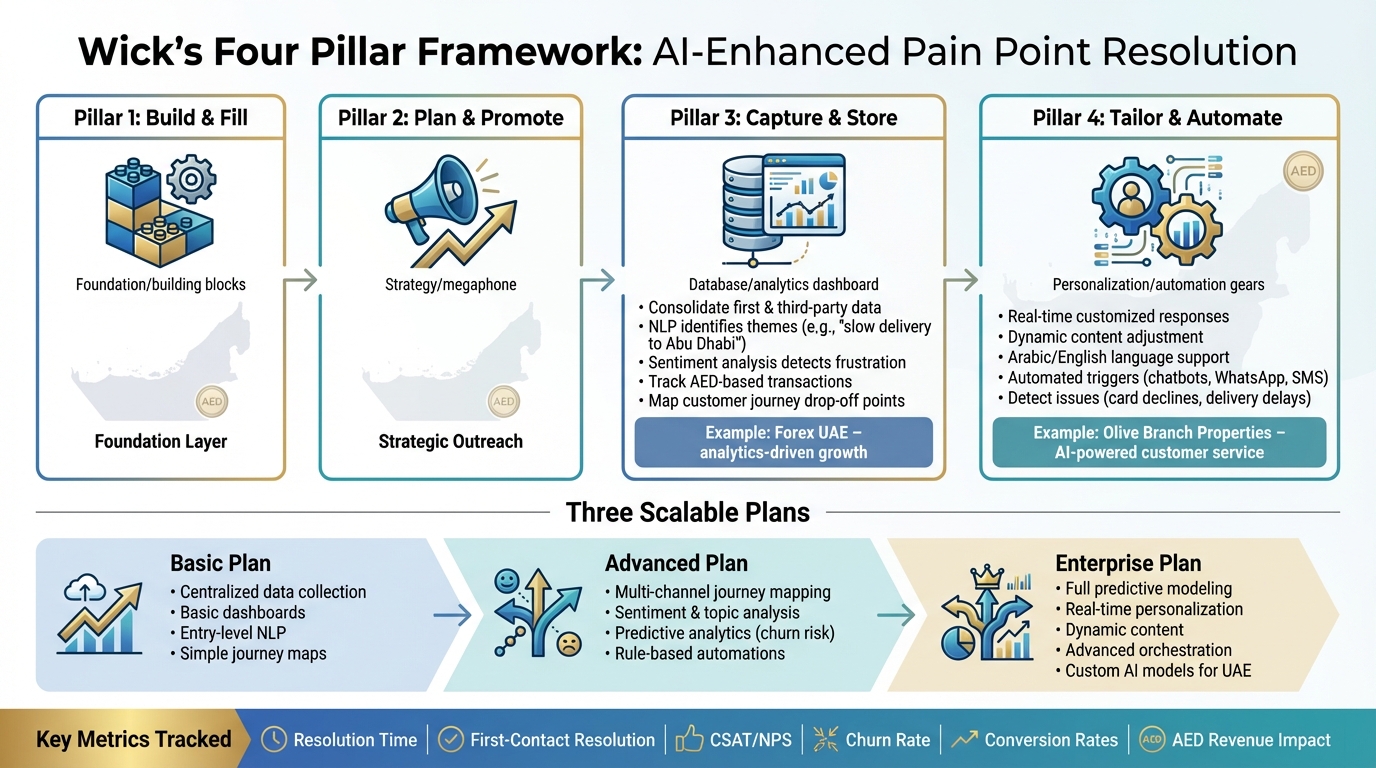
Wick's Four Pillar Framework for AI-Enhanced Customer Pain Point Resolution
Wick's Four Pillar Framework offers a streamlined, AI-powered approach tailored for UAE businesses. By integrating data, content, channels, and automation, this framework addresses customer pain points holistically. Instead of viewing challenges as isolated instances, Wick applies AI across four key pillars - Build & Fill, Plan & Promote, Capture & Store, and Tailor & Automate - to uncover friction points from real-world data and resolve them with targeted, automated solutions. Here's how each pillar transforms raw data into actionable strategies.
Capture & Store: Leveraging Data Analytics
The Capture & Store pillar focuses on gathering and analysing data to pinpoint customer pain points. By consolidating first-party and third-party data into a unified analytics layer, Wick uses AI to automatically identify recurring issues. Data sources include online behaviours, CRM records, support transcripts, social media feedback, and survey responses specific to AED-based transactions. For instance, AI tools like natural language processing (NLP) can highlight themes such as "slow delivery to Abu Dhabi" or "confusing VAT display in AED", while sentiment analysis detects frustration or confusion.
For UAE businesses, this process involves tagging critical touchpoints - like ad clicks, product views, add-to-cart actions, payment steps, and post-purchase support - and streaming this data into Wick's analytics platform. AI then maps out customer journeys, identifying common drop-off points, such as failures during 3-D Secure payment steps or address entry issues for specific emirates. Regular AI-generated reports prioritise fixes based on their impact on AED revenue and customer segments, whether in retail, hospitality, or financial services. A case in point is Wick's collaboration with Forex UAE, where analytics-driven insights guided strategic decisions, enabling consistent growth planning and enhanced digital performance.
Tailor & Automate: Providing Personalised Solutions
Once insights are gathered, the next step is turning them into actionable, personalised solutions. The Tailor & Automate pillar focuses on delivering real-time, customised responses at scale. AI engines dynamically adjust content, offers, and experiences based on customer data. For instance, UAE customers might see preferred payment options based on their past choices or receive Arabic-language support if their browser is set to Arabic. AI also detects issues like repeated card declines, predicted delivery delays, or language-specific misunderstandings, triggering tailored responses through chatbots, automated emails, SMS, or WhatsApp.
A practical example is Wick's work with Olive Branch Properties, where AI-powered customer service tools and automated communication systems ensured consistent and personalised client engagement. This approach highlights how the Tailor & Automate pillar delivers scalable, real-time resolutions that enhance customer experiences.
Wick's Plans for Scalable Solutions
Wick provides three scalable plans - Basic, Advanced, and Enterprise - designed to meet varying business needs while improving AI capabilities. These plans focus on resolving customer friction points in real time, with each tier offering progressively advanced features:
- Basic Plan: Centralises data collection, offers basic dashboards, applies entry-level NLP to feedback, and generates simple journey maps.
- Advanced Plan: Adds multi-channel journey mapping, sentiment and topic analysis, initial predictive analytics (like churn risk scores and purchase likelihood), and rule-based automations.
- Enterprise Plan: Includes full predictive modelling, real-time personalisation engines, dynamic website and app content, advanced orchestration across brands and regions, and custom AI models tailored to UAE-specific challenges - such as KYC onboarding for financial services or seasonal travel demands for airlines.
Across all plans, Wick tracks key customer experience (CX) and revenue metrics, including resolution time, first-contact resolution, CSAT/NPS, churn rate, and conversion rates at critical journey steps. Results are reported in AED revenue terms where applicable. The Advanced and Enterprise plans also deliver detailed insights by segment (such as emirate, language, device, or campaign) and provide metrics like predicted churn risk and the revenue impact of specific AI interventions.
Measuring the Impact of AI on Pain Point Resolution
Key Performance Metrics
AI's ability to identify and resolve issues has transformed customer service, but how do businesses measure its success? One clear indicator is reduced resolution time. AI chatbots and automated systems have significantly shortened waiting periods. For example, onboarding processes have seen a 40% decrease in resolution time, while cart abandonment rates have dropped by 25%, directly boosting customer satisfaction. These figures highlight the measurable benefits of investing in AI solutions.
Customer satisfaction (CSAT) and Net Promoter Scores (NPS) also provide valuable insights. Tools like Yellow.ai's agents, which operate across 35+ channels, use real-time sentiment analysis to validate AI's effectiveness. Proactive AI-driven strategies have even reduced churn rates by 25%. In the retail sector, automated engagement has led to noticeable improvements in conversion rates.
Other important metrics include deflection rates and first-contact resolution. For instance, Pelago achieved a 50% deflection rate while onboarding 5,000 users with the help of generative AI agents. In the UAE, tracking these operational metrics alongside revenue figures - reported in AED - provides a clear picture of AI's return on investment (ROI) and its broader impact on business performance.
UAE Business Applications
In the UAE, businesses are leveraging these metrics to address sector-specific challenges with AI-driven solutions. Forex UAE, in collaboration with Wick, demonstrates how detailed performance tracking and analytics can guide strategic decisions and drive consistent growth. This approach has supported their efforts to achieve sustainable digital performance improvements.
The retail sector has also seen success. Hanro Gulf utilised comprehensive analytics and performance optimisation as part of its digital transformation journey in the UAE market. Meanwhile, in property services, Olive Branch Properties implemented AI-powered customer service tools and automated communication systems. These enhancements ensured consistent, personalised client engagement, catering to the specific needs of their UAE-based clientele.
These examples underline how UAE businesses across industries can harness AI-driven metrics to elevate customer experiences while aligning with local market demands. By focusing on measurable outcomes, companies can refine their strategies and achieve tangible growth.
Conclusion: Improving Customer Experience with AI
AI has become a cornerstone for UAE businesses striving to meet ever-growing customer expectations. By combining tools like data analytics, sentiment analysis, chatbots, and predictive models, companies can pinpoint and address pain points swiftly. This shift turns moments of frustration into opportunities to strengthen loyalty, encouraging repeat business and fostering long-term growth.
Proactive AI solutions have shown clear results in reducing churn and abandonment rates. In a highly digital, mobile-first market like the UAE, these gains lead to higher customer satisfaction, increased AED revenue, and deeper brand loyalty.
To achieve this, businesses need an integrated system that seamlessly combines analytics, automation, and personalisation across all customer touchpoints. Wick's framework offers a practical approach: Capture & Store consolidates customer data to highlight issues, while Tailor & Automate provides scalable, personalised resolutions. This ensures AI initiatives enhance the overall customer experience rather than creating additional silos.
A smart starting point is to focus on a single, high-impact customer journey - like onboarding or checkout. Equip it with analytics, introduce a simple chatbot capable of handling common queries in both Arabic and English, and track the results using metrics like CSAT, NPS, and abandonment rates. Gradually expand these efforts based on measured outcomes. Collaborating with seasoned providers can help avoid pitfalls related to data quality and integration, ensuring a smoother implementation process.
As customer expectations in the UAE continue to rise, the importance of AI in resolving pain points will only grow. Companies that prioritise building intelligent and empathetic systems will be better positioned to deliver seamless, personalised experiences. These efforts not only meet customer demands but also lay the foundation for sustained growth and success in a competitive market.
FAQs
How does AI enhance customer service in a multilingual region like the UAE?
AI is transforming customer service in multilingual regions like the UAE by using natural language processing (NLP) and AI-driven translation tools. These technologies allow businesses to communicate effortlessly in multiple languages, ensuring customers feel heard and appreciated.
By offering real-time language detection and tailored interactions, AI enables companies to effectively serve the UAE's linguistically diverse population. Additionally, automated support systems simplify processes, boosting both efficiency and customer satisfaction across various language and cultural groups.
How does predictive analytics help prevent customer churn?
Predictive analytics plays a crucial role in reducing customer churn by examining data patterns to pinpoint customers who might be on the verge of leaving. With this knowledge, businesses can step in early, offering tailored solutions or targeted interactions to address potential issues.
Using these actionable insights, companies can strengthen connections with their customers, enhance satisfaction, and encourage lasting loyalty - key elements for steady and reliable growth.
How can businesses use AI for personalisation while safeguarding customer privacy?
To use AI for personalisation in a responsible way, businesses need to put customer privacy at the forefront. This means taking steps like securing clear and informed consent from customers, anonymising personal data to protect identities, and complying with regulations such as the UAE's Personal Data Protection Law (PDPL).
Conducting regular audits of AI systems is another crucial step. These checks help ensure that the systems stay transparent, fair, and reliable. By enforcing strict data governance policies and adopting ethical AI practices, businesses can not only meet privacy standards but also earn customer trust while providing personalised experiences.