

Blog / How AI Corrects Workflow Errors in Real Time

Wick
December 23, 2025How AI Corrects Workflow Errors in Real Time
AI is transforming how businesses in the UAE handle workflow errors, making processes faster, more accurate, and cost-effective. By using machine learning and rule-based systems, AI can identify mistakes like invalid emails, formatting inconsistencies, or duplicate entries in real time - fixing them automatically or flagging them for review. This saves both time and money, with companies reporting up to 70% cost savings and 544% ROI within six months of implementation.
Key Takeaways:
- Error Detection: AI spots anomalies in workflows, such as invalid data or bottlenecks, and corrects them instantly.
- Cost Savings: Businesses like Popl save up to AED 73,000 annually by automating tasks like email triage and lead enrichment.
- Improved Accuracy: AI ensures multilingual compliance, consistent formatting, and precise campaign timing.
- Real-Life Impact: Companies like Remote and foodora have reduced manual workload by 600+ hours monthly and improved customer engagement by over 40%.
AI-driven tools are no longer optional in UAE marketing - they’re essential for staying competitive in a fast-paced, data-heavy environment.
Self-Correcting AI Workflow Builder (How We Did It)
How AI Detects and Corrects Workflow Errors in Real Time
AI identifies and addresses workflow errors by learning typical patterns and flagging irregularities through two main methods: machine learning models for real-time anomaly detection and rule-based systems enhanced with predictive insights to prevent issues before they escalate. Together, these methods form a robust framework for detecting and correcting errors efficiently.
Machine Learning for Anomaly Detection
Machine learning leverages historical data to identify what "normal" looks like in a workflow. Once these patterns are set, the system continuously monitors live data - whether it's lead submissions, email addresses, or customer records - and flags anything out of the ordinary. Unlike traditional automation, which processes inputs without much context, AI goes a step further. It interprets tone, intent, and context, making it capable of real-time corrections that adapt seamlessly to multilingual campaigns and strict compliance standards, both of which are essential in UAE marketing operations.
These systems don't just stop at initial programming. Machine learning algorithms evolve with new data, reducing false positives and recognising errors that might not have been accounted for initially. Take, for instance, Remote, a global HR platform, which in 2024 integrated ChatGPT and Zapier to manage 1,100 monthly support tickets with only three staff members. The AI system classified and prioritised tickets, searched for past solutions, and even generated responses. It now handles 28% of tickets automatically, saving over 600 hours of work each month. This kind of efficiency aligns with the UAE's push for digitised and AI-enabled workflows, with 92% of executives aiming for full implementation by 2025.
Rule-Based Validation and Predictive Analysis
While machine learning adapts and evolves, rule-based systems rely on fixed criteria to ensure immediate checks. Using IF/THEN logic, these systems validate data consistency - such as checking email formats, verifying regional phone numbers, and ensuring customer records follow predefined structures. When paired with predictive analysis, these rules go a step further by analysing historical data and external factors to anticipate and avert potential bottlenecks.
A practical example is the University of Aberdeen, which implemented Freshservice's Freddy AI in 2024 to handle IT service requests. The system used AI-powered ticket triage and automated workflows to manage over 10,000 additional requests, accommodating a 208% increase in ticket volume while cutting resolution times by 81%. It could identify missing details in real time, reroute tasks, or request corrections without disrupting the entire process. For UAE marketers, this is particularly useful when managing multilingual campaigns and adhering to strict compliance rules, as even minor errors - like incorrect formatting - can derail entire workflows.
4 Common Workflow Errors AI Fixes in Marketing Campaigns
Marketing workflows in the UAE come with their own set of challenges, from catering to a multilingual audience to adhering to strict local regulations. AI has become a game-changer, tackling these issues by identifying and correcting mistakes in real time. This ensures campaigns run smoothly and deliver results. Let’s dive into the most common workflow errors that AI can address, errors that - if left unchecked - could derail marketing efforts in the UAE.
Data Entry Errors like Invalid Emails and Duplicates
AI-powered CRM tools are excellent at spotting and fixing duplicate records while enriching incomplete data sets. For example, natural language processing (NLP) can interpret unstructured data, recognising that terms like "copier" and "printer" belong to the same category. This ensures accurate data routing. Additionally, AI systems can clean up datasets by identifying invalid email formats or outdated contact details, either correcting them automatically or flagging them for human review. Tools like Intelligent Document Processing (IDP) and Optical Character Recognition (OCR) further enhance this process by extracting data from invoices and forms, flagging missing details or incorrect formatting. With 92% of executives expecting their companies to embrace AI-driven automation by 2025, these capabilities are becoming essential for UAE marketers handling high volumes of leads.
Formatting Inconsistencies in Customer Records
AI ensures consistency in customer records by transforming varied inputs into standardised formats. Using IDP, which combines OCR with machine learning, AI can extract and organise data from complex documents like forms or invoices. For businesses in the UAE, where multilingual records and diverse formatting conventions are common, AI can accurately process incoming requests, ensuring critical fields like names and dates are correctly aligned. Fixing these inconsistencies minimises delays during campaign launches, keeping operations on track.
Bottlenecks in Campaign Launch Processes
AI excels at identifying and resolving bottlenecks by analysing both historical data and real-time factors. Autonomous agents can adjust workflows based on live customer interactions or events, ensuring campaigns are launched at the best possible times. This not only streamlines the launch process but also eliminates delays that often consume valuable time. Effective timing is crucial, not just for launching campaigns but also for delivering individual messages.
Timing Missteps in Email Outreach Sequences
In 2025, foodora, a delivery service operating in over 700 cities, showcased the power of AI timing with BrazeAI Intelligent Timing. By moving away from fixed schedules and optimising message delivery to align with customer behaviour, they achieved impressive results: a 26% drop in unsubscribe rates, a 6% rise in push direct opens, and a 41% conversion rate for AI-timed messages.
"By shifting from fixed schedules to AI-powered send-time optimisation, they showed that when a message is delivered can be just as important as what it says." – Team Braze
AI takes timing to the next level by analysing individual engagement patterns, replacing rigid schedules with smarter, behaviour-driven delivery. This approach reduces the intrusiveness of marketing efforts, which is especially important for building trust in the competitive UAE market. Additionally, AI ensures seamless coordination of message delivery across multiple channels - email, SMS, and push notifications - avoiding the chaos of over-automation. These improvements lay the groundwork for smoother AI integration using Wick's Four Pillar Framework.
Implementing AI Error Correction Using Wick's Four Pillar Framework
Wick's Four Pillar Framework provides a structured approach to integrating AI error correction into marketing workflows, helping organisations avoid costly mistakes - bad data alone is estimated to cost AED 47.4 million annually. Here's how each pillar supports seamless AI error correction.
Integrate AI into the Tailor & Automate Pillar
This pillar focuses on real-time monitoring and immediate action. AI agents oversee workflows continuously, employing "circuit breaker" patterns to redirect tasks for backup validation whenever suspicious outputs arise. This mechanism is especially crucial for preventing widespread failures in automated, large-scale personalised campaigns.
Dynamic thresholds, based on rolling averages, can be set to flag outputs that deviate more than two standard deviations from historical accuracy rates. For high-stakes processes, such as evaluating proposals worth millions of AED, workflows should automatically escalate to human review when AI confidence levels are low. These safeguards ensure reliability and precision in critical tasks.
Set Up Alerts and Auto-Corrections in the Capture & Store Pillar
The Capture & Store pillar addresses common data entry and formatting errors. Real-time validation rules, such as text format checks, email domain verification, and character limits, can immediately flag and reject incorrect records. A centralised alerting system can monitor errors across production workflows, sending instant notifications (via platforms like Slack or Microsoft Teams) with detailed error information.
To tackle email deliverability issues - responsible for 16.9% of marketing emails failing to reach inboxes - AI tools can automatically configure and monitor SPF, DKIM, and DMARC records. For large-scale document processing, implementing checkpoints ensures that workflows can resume without starting over if an error occurs. These measures enhance data accuracy and operational efficiency.
Test and Optimise with Plan & Promote Pillar Data Insights
The Plan & Promote pillar leverages AI observability to improve workflow performance over time. By logging decision contexts and confidence scores, AI systems provide actionable insights. For instance, HubSpot's AI platform increased sales-qualified leads by 40% and cut training time by 25%.
Formal feedback loops, where sales teams flag incorrect lead qualifications, help refine scoring models continuously. Monthly audits can uncover persistent issues, like duplicate entries or outdated data, that real-time alerts might overlook. Multi-touch attribution models further identify where leads drop off due to workflow errors, providing a clearer picture of marketing channel performance. This data-driven refinement can lower operational costs by up to 30% while enhancing productivity by 40%.
Benefits and ROI of AI-Driven Error Corrections in UAE Marketing Operations
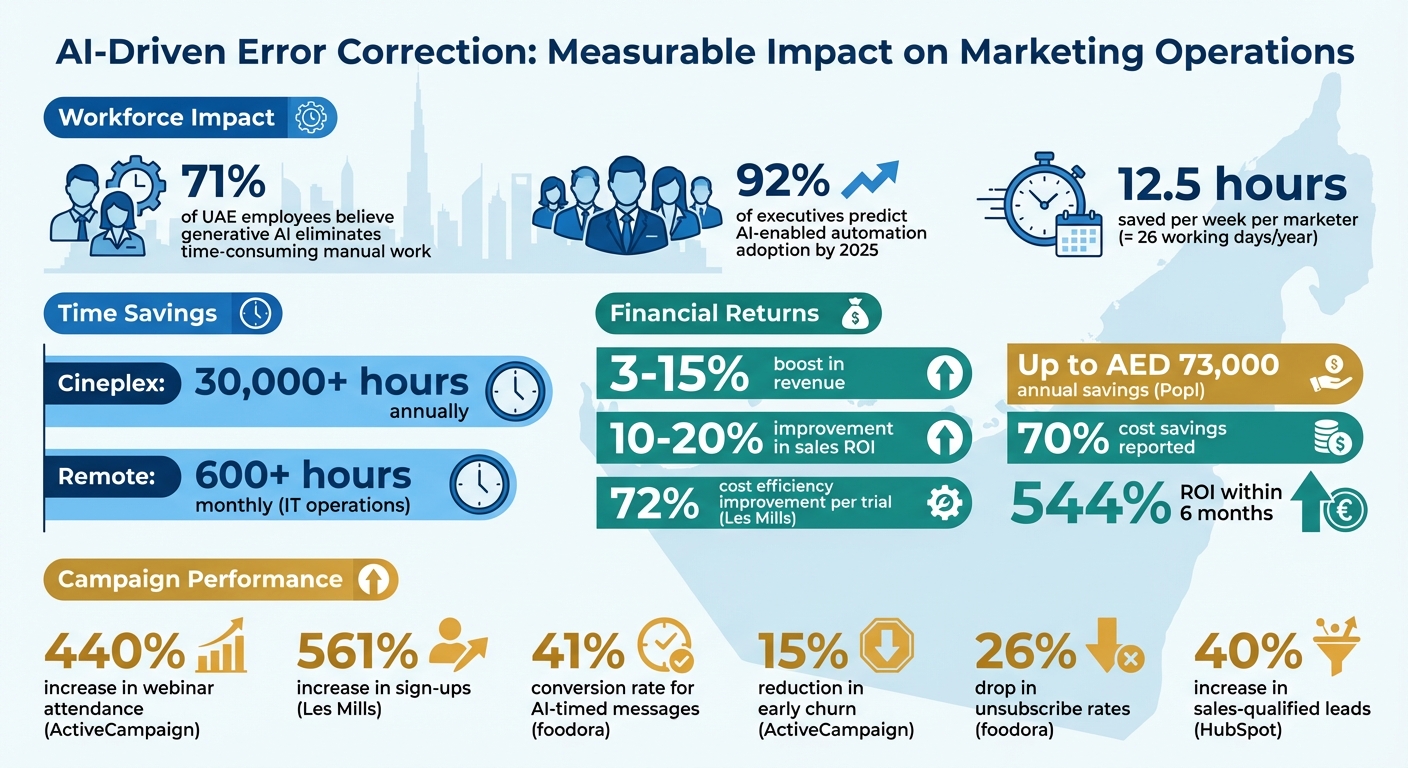
AI Workflow Error Correction: ROI and Impact Metrics for UAE Marketing
AI-driven error correction systems are transforming marketing operations in the UAE by streamlining processes, reducing costs, and enhancing campaign outcomes.
Efficiency and Cost Savings
AI takes over repetitive tasks like data entry, record cleaning, and fixing incomplete data, freeing up marketing teams to focus on more impactful strategies. In fact, 71% of employees in the UAE believe generative AI will eliminate time-consuming manual work. This shift not only saves time but also enhances productivity.
The financial impact is equally impressive. For instance, Cineplex saved over 30,000 hours annually by utilising Microsoft Power Automate with generative AI under the guidance of Bo Wang.
"Microsoft Power Automate continues to enhance our automation efforts. Its generative AI capabilities... really set Power Automate apart from competing solutions."
– Bo Wang, Vice President of Taxation & Treasury, Cineplex
AI's efficiency extends to IT operations as well. Remote, for example, uses AI workflows to automate 28% of its 1,100 monthly tickets, which translates to over 600 hours saved every month.
These operational savings go beyond just cutting costs - they also improve campaign precision, ultimately boosting ROI.
Improved Campaign Accuracy and ROI
AI's ability to catch and correct errors in real time ensures customer messages are accurate and timely. This precision reduces human error during data preparation in marketing CRM systems, leading to more personalised and effective customer engagement. The impact on revenue is clear: 80% of senior marketing analysts report that AI-driven insights significantly influence revenue growth.
Examples of success abound. ActiveCampaign saw a 440% increase in webinar attendance and reduced early churn by 15% by implementing an AI-supported onboarding system that corrected tagging errors and personalised outreach. Similarly, fitness brand Les Mills used AI-powered Demand Gen campaigns to drive a 561% increase in sign-ups and achieved a 72% cost efficiency improvement per trial during a four-week test.
Closer to home, UAE-based organisations are also reaping the benefits. United Foods leveraged IBM Cloud Pak for Business Automation to streamline workflows, significantly reducing manual intervention and boosting overall productivity.
Key Metrics of Improvement
| Metric Category | Impact of AI Integration | Company Example |
|---|---|---|
| Annual Time Savings | 30,000+ hours | Cineplex |
| Monthly IT Labour Savings | 600+ hours | Remote |
| Cost Efficiency | 72% improvement in cost per trial | Les Mills |
| Customer Retention | 15% reduction in early churn | ActiveCampaign |
| Lead Conversion | 561% increase in sign-ups | Les Mills |
The numbers speak for themselves: 92% of executives believe their organisations will adopt AI-enabled automation for workflows by 2025. For marketers in the UAE, this signals a transformative shift - not just in efficiency but in scaling operations without the need for additional resources or manual oversight.
Conclusion
AI-powered error correction is changing the game for marketing teams in the UAE. By identifying data entry mistakes, resolving formatting issues, and fine-tuning campaign timing in real-time, AI workflows cut through the inefficiencies that slow progress and drain resources. The result? Tangible improvements in how teams operate and achieve their goals.
This shift from rigid, rule-based systems to intelligent tools that can understand context and handle imperfect inputs allows businesses to scale without needing to significantly increase headcount or rely heavily on manual oversight. As Nicole Replogle from Zapier aptly explains:
"Real value shows up when AI starts taking the thinking parts of busywork and making them repeatable and fast".
AI isn’t here to replace human creativity - it’s here to support it. By automating repetitive tasks, teams can focus on strategic planning, building relationships, and making impactful decisions.
The benefits speak for themselves. Marketers using AI report saving 12.5 hours per week - equivalent to 26 working days per year. Additionally, businesses see a 3%–15% boost in revenue and a 10%–20% improvement in sales ROI. With 92% of executives predicting that their organisations will embrace AI-enabled automation by 2025, the real question isn’t whether to adopt these tools, but how quickly you can start.
For those looking to maximise these benefits, Wick's Four Pillar Framework offers a structured approach. By incorporating validation rules in the Capture & Store phase, leveraging automation intelligence in the Tailor & Automate phase, and driving continuous improvement through the Plan & Promote phase, businesses can create workflows that catch and fix errors before they become costly.
The roadmap is clear: start with a pilot programme, prioritise data accuracy, maintain human oversight, and let AI handle the repetitive tasks. The tools are ready, the results are proven, and the competitive edge belongs to those who take action now.
FAQs
How does AI identify and address unusual data in workflows?
AI works to spot unusual data in workflows by first understanding what "normal" looks like. It does this using advanced methods like deep-learning autoencoders, time-series models, or statistical analysis. These techniques help the system identify patterns or set thresholds that represent typical operations.
Once these benchmarks are established, the AI continuously monitors data in real time. When something deviates significantly from the norm, it flags it as an anomaly.
This ability to detect anomalies instantly allows AI to help prevent mistakes, streamline processes, and keep workflows running smoothly. It's a powerful resource for industries such as marketing automation and many others.
What are the cost-saving advantages of using AI for real-time error correction in UAE businesses?
In the UAE, businesses tapping into AI for real-time error correction are seeing impressive cost savings and smoother operations. With AI, processing times can shrink by 60–70%, human error rates can drop by as much as 90%, and first-year returns on investment (ROI) often reach 200–300%.
By automating repetitive tasks and fine-tuning resource allocation, companies can redirect their time and money to more strategic goals. This approach is especially valuable in the UAE, where the business landscape is both fast-moving and highly competitive.
How does AI help ensure multilingual marketing campaigns comply with UAE regulations?
AI-powered tools simplify the process of creating regionally appropriate marketing content. They can automatically translate materials, identify audience language preferences, and ensure compliance with local legal standards. For businesses in the UAE, this means following advertising and data privacy regulations, using د.إ for currency accurately, and steering clear of restricted language. These tools flag potential issues - like missing disclosures or incorrect formatting - and offer real-time corrections, cutting down on the need for manual reviews.
Beyond compliance, AI adjusts campaigns to match local preferences, such as the dd/MM/yyyy date format, comma-separated numbers, metric measurements, and British English spelling (e.g., "organisation"). It can even customise messages for important cultural occasions, such as Ramadan, while keeping the brand's tone consistent. The outcome? Faster campaign launches, fewer compliance headaches, and a better experience for diverse, multilingual audiences.