
Blog / 5G and IoT in GCC: Customer Support Insights
5G and IoT in GCC: Customer Support Insights
The Gulf Cooperation Council (GCC) is leading the way in using 5G and IoT to transform customer support. With ultra-fast 5G networks and interconnected IoT devices, businesses in the UAE, Saudi Arabia, and other GCC nations are moving from reactive to predictive support, improving speed, personalisation, and efficiency.
Key Highlights:
- 5G in the GCC: Nearly 97% of Dubai has 5G coverage, with speeds reaching 4.2Gbps in Abu Dhabi.
- IoT Adoption: IoT sensors and wearables are being used for real-time diagnostics, predictive maintenance, and tailored customer experiences.
- Government Support: Initiatives like the UAE Digital Government Strategy 2025 and Dubai IoT Strategy aim to digitise services and improve satisfaction.
- Business Impact: Companies using 5G and IoT report faster ROI (e.g., 3.3 years in Saudi Arabia) and enhanced profitability through AI and automation.
These technologies are reshaping industries like retail, healthcare, logistics, and manufacturing by enabling real-time responses, personalisation, and problem prevention. However, challenges like data security, cost, and system compatibility require careful planning and adherence to regulations.
For GCC businesses, investing in 5G and IoT is no longer optional - it’s the key to staying competitive in a fast-evolving digital landscape.
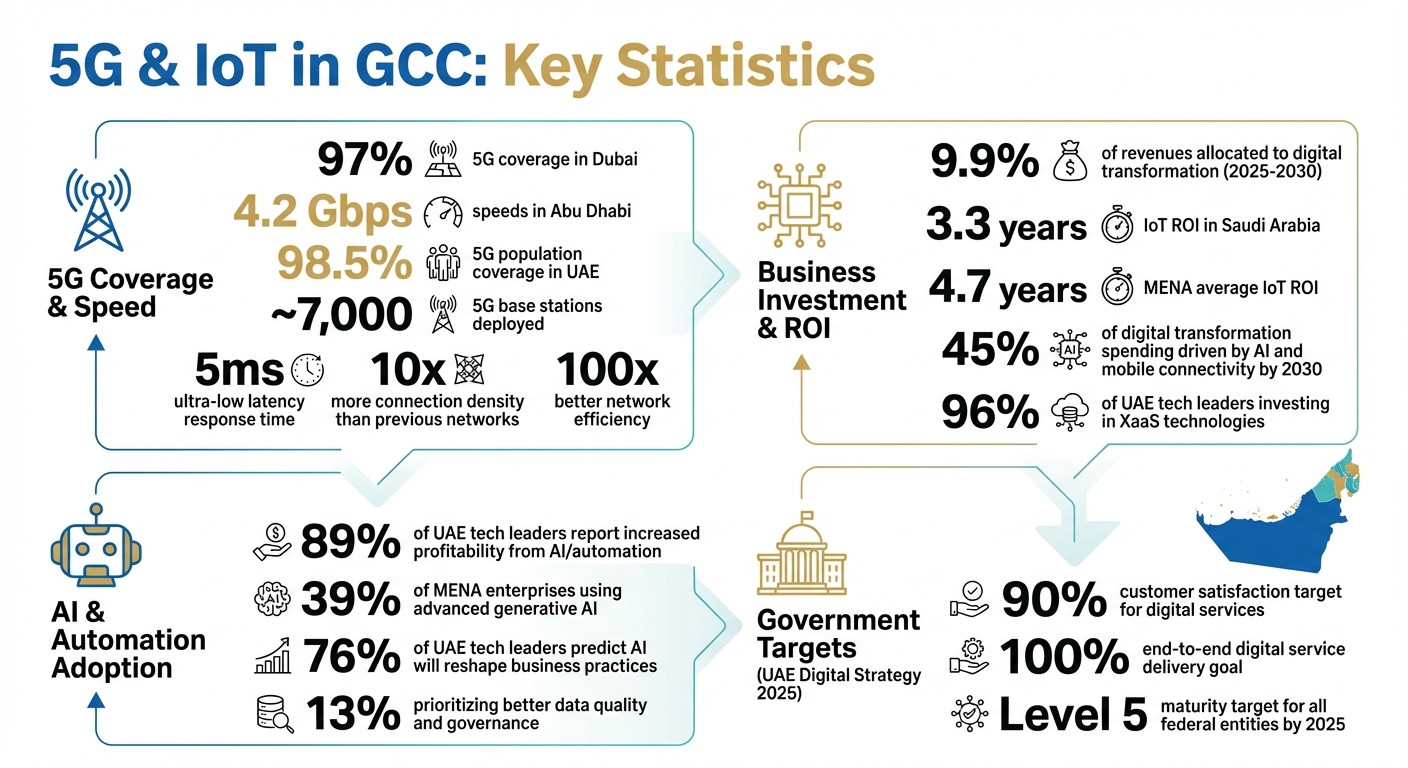
5G and IoT Adoption Statistics in GCC Countries 2024-2030
5G and IoT: Next-Generation Connectivity - How 5G Enables Massive IoT Deployments
Why GCC Businesses Are Adopting 5G and IoT for Customer Support
Three key factors are driving the adoption of 5G and IoT in customer support across the GCC.
Government Digital Programmes
The UAE government has laid out a solid framework to make digital transformation a priority. For instance, the UAE Digital Government Strategy 2025 sets bold goals, including achieving 90% customer satisfaction with digital services and ensuring 100% end-to-end digital service delivery.
The Dubai IoT Strategy pushes these efforts further by aiming to create a paperless government and develop an advanced IoT ecosystem. Platforms like Dubai Pulse provide a centralised digital infrastructure, enabling businesses to access integrated data sources. Additionally, the "Once Only" policy simplifies processes by ensuring customers only need to submit their data once for all services.
To ensure progress, the government uses a five-level maturity model to measure digital readiness. By 2025, all federal and local entities are expected to reach "Level 5" (Very High Maturity). This framework has fostered a competitive digital landscape, accelerating transformation efforts, especially after the pandemic.
Digital Acceleration After COVID-19
The pandemic reshaped customer expectations, with a growing demand for instant and remote support. In response, the Digital Customer and Digital Government Service Policy focuses on proactive services that anticipate user needs rather than waiting for complaints.
The numbers highlight this shift. AI, mobile connectivity, and related devices are expected to drive nearly 45% of digital transformation spending in the MENA region by 2030. Additionally, 89% of UAE tech leaders say investments in AI and automation have boosted profitability in the last two years.
To stay competitive, businesses are moving from reactive to proactive support. IoT sensors and 5G connectivity are being used to detect and resolve issues before customers even realise there's a problem. As customer expectations evolve, companies are focusing on advanced solutions to maintain a competitive edge.
Gaining an Edge Through Better Customer Support
Speed and personalisation are now critical for customer loyalty. Businesses that excel in these areas see higher satisfaction and retention rates. With 39% of MENA enterprises already using advanced generative AI to improve operations, companies that fail to keep up risk losing customers to more responsive competitors.
Between 2025 and 2030, GCC nations are projected to spend an average of 9.9% of their revenues on digital transformation. Saudi Arabian enterprises report an impressive IoT return on investment of just 3.3 years, significantly faster than the MENA average of 4.7 years.
"By prioritising data-driven strategies and leveraging cloud platforms, UAE tech leaders are transforming challenges into opportunities for sustained growth and efficiency."
– Mohamad Majid, Partner - Advisory, KPMG Lower Gulf
Sectors like logistics, utilities, and automotive are already using 5G-enabled IoT to streamline customer-facing operations. Real-time data analytics enables proactive notifications, predictive maintenance, and personalised service recommendations - capabilities that traditional support methods simply can't match. With 76% of UAE tech leaders predicting AI will reshape knowledge creation and business practices, the message is clear: adopting these technologies is no longer optional for businesses aiming to stay ahead.
How 5G and IoT Are Used in GCC Customer Support
The fusion of 5G and IoT is revolutionising customer support across the GCC. These technologies are shifting the focus from merely fixing problems to actively preventing them. Here’s how industries in the UAE and beyond are using these advancements to enhance their services.
Real-Time Customer Support with IoT
With ultra-low latency, 5G delivers response times as quick as 5 milliseconds, enabling instantaneous communication between devices and systems. This capability is crucial for remote diagnostics and emergency responses.
In sectors like maritime and manufacturing, 5G-enabled sensors and machine-to-machine (M2M) communication allow for remote diagnostics. For example, support teams can identify issues with a vessel's engine or troubleshoot manufacturing equipment without needing to be on-site, significantly reducing downtime.
The technology also supports high-capacity environments. With 10 times more connection density than previous networks, 5G ensures that thousands of devices in busy locations - like malls or stadiums - can stay connected to customer support systems simultaneously. This connectivity not only facilitates instant responses but also enables businesses to tailor customer experiences in real time.
Personalised Support Using IoT Devices
IoT devices continuously collect data, offering businesses valuable insights into customer behaviour and preferences. In retail, for instance, cloud Wi-Fi systems and sensors track customer movements and preferences. This allows staff to provide personalised assistance as soon as a customer enters the store. Some retailers are even experimenting with augmented reality (AR) dressing rooms powered by 5G, where customers can virtually try on outfits.
In industries like banking, logistics, and automotive, IoT wearables and telematics provide instant, tailored insights. These range from secure financial recommendations based on a customer’s spending habits to hands-free guidance for order fulfilment or alerts for vehicle maintenance before a driver even notices an issue.
Healthcare is another area seeing benefits. Remote sensors enable customised treatment plans and seamless virtual consultations, giving doctors real-time access to patient data during video calls.
"Retail which is already seeing a disruption will see the addition of new trends and personalisation when entering a store or building, and retail companies need a network that can handle the amount of data that will be required to manage this."
– Etisalat UAE
This level of personalisation isn’t just about enhancing the customer experience - it’s also about preventing problems before they arise.
Predictive Maintenance and Problem Prevention
IoT sensors are transforming maintenance by continuously monitoring equipment and predicting potential failures. In manufacturing, these sensors transmit diagnostics over 5G networks, allowing teams to address issues before they disrupt production lines.
In the Oil and Gas sector, the UAE employs 5G-powered robots and drones to inspect hazardous or hard-to-reach areas. This approach speeds up issue detection and minimises downtime for critical infrastructure. Similarly, in construction, wearables and environmental sensors provide real-time data on equipment performance and worker safety, helping support teams prevent accidents before they occur.
Railway operators are also leveraging predictive maintenance to optimise train schedules and reduce energy use. Sensors monitor engines and environmental conditions, enabling teams to fix potential mechanical problems before they affect passengers or cargo. This same strategy is applied in maritime operations, where nearshore 5G connectivity supports real-time monitoring of offshore drilling rigs and fishing vessels.
The financial benefits are clear. Saudi Arabian businesses report seeing returns on IoT investments in just 3.3 years, compared to the MENA region’s average of 4.7 years. With 5G offering 100 times better network efficiency, enterprises can deploy thousands of sensors without worrying about bandwidth or power limitations.
sbb-itb-058f46d
Challenges and Solutions for 5G and IoT Implementation in the GCC
Deploying 5G and IoT technologies for customer support in the GCC comes with unique challenges. Tackling these issues effectively is key to ensuring smooth implementation.
Infrastructure and System Compatibility
One of the biggest challenges is ensuring that different systems work together seamlessly. For instance, the UAE National Cloud Security Policy mandates interoperability between Cloud Service Providers to avoid vendor lock-in. This means businesses must choose partners that prioritise platform compatibility and portability.
Another complexity arises from data localisation laws. UAE regulations require that "Sensitive", "Secret", and government-related data be stored within the country. For customer support systems handling personal information (classified as "Secret Data"), this means businesses need local data centres or Sovereign Cloud solutions. Additionally, all IoT devices must receive Type Approval from the Telecommunications and Digital Government Regulatory Authority (TDRA) before deployment.
In 2023, Etisalat by e& showcased progress by launching its 5G Standalone (SA) network for mobile users, following its earlier rollout for Fixed Wireless Access users. The network’s Service Based Architecture enables features like network slicing and edge computing, which are critical for enterprise use cases. This demonstrates how operators are addressing compatibility issues at the infrastructure level.
Businesses must also register with the TDRA and secure an IoT Service Registration Certificate. Furthermore, integrating new 5G-IoT technologies with existing systems is essential to maintain uninterrupted customer support. This requires "Security by Design" features such as hardware-level authentication and device reset capabilities.
Once interoperability is managed, the next challenge is securing the vast data flows generated by IoT.
Data Security and Privacy
Handling customer data across thousands of IoT devices introduces significant security risks. The UAE takes this very seriously - violations of the IoT Framework can lead to fines ranging from AED 50,000 to AED 200,000 and imprisonment for at least one year.
The first step is proper data classification. UAE regulations divide data into four categories: Open, Confidential, Sensitive, and Secret. Personal customer information, categorised as "Secret Data", must remain within UAE borders. Regular audits ensure data is correctly classified and securely stored.
| Data Category | Storage Requirement | Examples in Customer Support |
|---|---|---|
| Open Data | UAE or Abroad | Public FAQs, store locations |
| Confidential/Sensitive | Primarily UAE* | Customer interaction history, account preferences |
| Secret Data | UAE Only | Personally identifiable information (PII), biometric data |
| Government Data | UAE Only | Interactions with public entities |
*Storage abroad is allowed only if the destination country meets UAE security standards.
Using edge computing to process data closer to its source reduces the risks of transmitting sensitive information. Multi-layered security measures - combining 5G network encryption, application-layer security, and identity management - are also essential. IoT providers must adhere to UAE encryption standards to safeguard data.
For critical customer support applications, such as those impacting public safety or health, businesses must maintain detailed subscriber records, including IDs, addresses, and device registration numbers.
While security is essential, managing costs and ensuring scalability is just as important.
Cost and Scalability
GCC enterprises are projected to allocate an average of 9.9% of revenues to digital transformation between 2025 and 2030. Despite the substantial investment, businesses in Saudi Arabia report achieving ROI on IoT projects in just 3.3 years, faster than the MENA average of 4.7 years.
Strategic partnerships play a key role in scaling effectively. For example, Du’s commercial launch of 5G-Advanced technology in January 2024, following successful trials in October 2023, involved collaborations with Huawei and Nokia. This initiative aimed to deploy hundreds of 5G-A base stations to support features like enhanced private networks and massive IoT connectivity.
Modular testing is another cost-effective strategy. Trial kits, such as those offered by Etisalat by e&, allow businesses to test IoT deployments, optimise performance, and accelerate implementation. Additionally, the UAE’s 98.5% 5G population coverage and approximately 7,000 5G base stations provide a strong foundation for nationwide connectivity. Network sharing agreements further enhance interconnection and interoperability.
Smart data classification also helps control costs. For example, "Open" data can be stored globally, while "Secret" data must remain within the UAE. Proper categorisation allows businesses to optimise storage expenses. Transitioning to 5G Standalone networks enables advanced features like network slicing, which is crucial for scaling customer support applications like AR/VR and low-latency real-time interactions.
How Wick Helps UAE Businesses Use 5G and IoT for Customer Support

Using 5G and IoT to improve customer support requires a seamless, data-focused strategy that connects every customer interaction. Wick's Four Pillar Framework equips UAE businesses to adopt these technologies effectively while adhering to local regulations and boosting growth. Here’s how each pillar turns these advanced tools into practical benefits for customer support.
Building Data-Driven Systems
5G-Advanced networks, with their ultra-low latency of just 1ms, allow businesses to gather and analyse customer data in real time. Wick's strategy focuses on creating systems that capture IoT insights instantly - monitoring device performance, customer behaviour, and identifying issues as they arise. The Capture & Store pillar emphasises data analytics and customer journey mapping, turning raw IoT data into actionable insights. This enables businesses to respond to customer needs immediately rather than waiting hours or days. Wick ensures these systems comply with the UAE’s strict local data regulations. With 13% of UAE tech leaders prioritising better data quality and governance, Wick’s frameworks align with operational needs and local data residency requirements.
AI-Driven Personalisation and Automation
High-speed 5G connectivity opens the door to generative AI and interactive tools that speed up response times and customise customer support. Wick's Tailor & Automate pillar leverages 5G-powered generative AI and M2M (Machine-to-Machine) control centres to deliver faster, more tailored resolutions. These systems also enable businesses to manage thousands of IoT devices simultaneously, providing real-time performance insights without disrupting operations. As companies in the MENA region increasingly adopt AI as a core business tool, Wick ensures these technologies can be scaled efficiently and effectively.
Scalable and Secure Solutions
With 96% of UAE tech leaders planning investments in XaaS (Anything as a Service) technologies, scalability and security are essential for any 5G-IoT system. Wick’s modular approach uses local cloud platforms to handle large volumes of IoT data flexibly, avoiding heavy upfront costs. The Plan & Promote and Build & Fill pillars work together to create secure, scalable ecosystems that meet UAE data localisation mandates. By utilising licensed spectrums and Sovereign AI strategies, Wick ensures robust data sovereignty and security, especially critical for industries like finance and healthcare. This framework also supports businesses in aligning with the GCC’s projected digital transformation spending of 9.9% of revenues between 2025 and 2030, ensuring long-term value from these investments.
Conclusion
The GCC region has become a global leader in digital transformation, outpacing many developed markets in the rollout of 5G and IoT technologies. For UAE businesses, these advancements are critical to meeting the growing demand for real-time, personalised customer experiences. With 5G offering ultra-low latency and the capacity to connect ten times more devices, companies can move beyond reactive customer service to predictive solutions that address issues before they arise.
The return on investment (ROI) in 5G-IoT technology highlights its value for businesses in the region.
These technological advancements create opportunities for broader strategic shifts. For UAE companies aiming to stay competitive, success requires more than just adopting cutting-edge tools - it calls for a unified, data-focused approach that links every aspect of the customer experience. By leveraging 5G network slicing to ensure consistent performance and adopting edge computing for localised data processing, businesses can meet both technical demands and regulatory requirements. Additionally, IoT sensors combined with AI-powered personalisation can transform customer service by predicting needs rather than reacting to problems. These integrated strategies set the foundation for adaptive and future-ready customer support.
The moment to take action is here. With the UAE and Kuwait among the pioneers in launching commercial 5G-Advanced services, and 39% of MENA enterprises already utilising generative AI at advanced levels, early adopters are gaining a competitive edge that will be hard to rival. Investing today in scalable, secure 5G-IoT ecosystems not only prepares businesses for immediate benefits but also positions them for future breakthroughs, including the transition to 6G and advancements in robotics and autonomous mobility. This blend of technology and strategy underscores the importance of a data-driven approach to achieving long-term growth.
FAQs
How are 5G and IoT transforming customer support in the GCC region?
The rise of 5G and IoT is reshaping customer support across the GCC, especially in the UAE, by offering faster, more dependable connectivity and real-time data sharing. These advancements empower businesses to manage vast networks of connected devices with minimal lag, ensuring smooth and effective customer experiences.
With the speed and reliability of 5G, companies can deploy tools like AI-driven chatbots, real-time analytics, and immersive AR/VR solutions to provide highly tailored support and address customer concerns instantly. At the same time, IoT integration enables proactive approaches such as predictive maintenance and remote troubleshooting, cutting downtime and boosting customer satisfaction.
As the UAE continues to focus on digital transformation, the synergy of 5G and IoT is helping businesses improve service quality, automate repetitive tasks, and foster stronger customer loyalty - key factors for thriving in an increasingly competitive market.
What are the key challenges for businesses in the GCC when adopting 5G and IoT technologies?
Businesses in the GCC face a range of hurdles when adopting 5G and IoT technologies, with cybersecurity being one of the most pressing concerns. Many IoT devices come with minimal security features, making them potential targets for cyberattacks. The sheer number of connected devices amplifies the risk of data breaches, pushing businesses to adopt stronger security protocols and strategies to protect their systems.
Another significant challenge is the technical complexity involved in integrating 5G and IoT systems. Setting up advanced infrastructure, ensuring seamless compatibility between various systems, and managing operational logistics can be overwhelming. On top of this, businesses must also navigate regulatory requirements, such as the UAE’s national IoT security policies, which emphasise the importance of both cybersecurity and operational resilience.
The financial aspect is another barrier. The investment required to develop infrastructure and hire skilled professionals can be substantial. While the GCC is at the forefront of 5G and IoT implementation, tackling these challenges is crucial for ensuring sustainable progress in the region.
What role does government support play in advancing 5G and IoT adoption in the GCC, particularly in the UAE?
Government initiatives are playing a major role in accelerating the adoption of 5G and IoT technologies across the GCC, with the UAE leading the charge. For instance, the Dubai Internet of Things Strategy aims to establish one of the world’s most advanced IoT ecosystems. This vision isn’t just about technology - it’s about improving urban living standards and driving economic growth. The focus is on creating a strong digital infrastructure, encouraging innovation, and boosting efficiency across various industries.
The UAE has also set its sights on achieving nationwide 5G coverage by 2025, a goal strongly supported by the telecom regulator. Policies like the National Policy for IoT Security ensure a regulatory framework that prioritises security while fostering innovation and attracting investments. These combined efforts highlight the UAE’s dedication to positioning itself as a global leader in digital transformation and cutting-edge technology.