
Blog / How 5G Enhances IoT for Real-Time Marketing
How 5G Enhances IoT for Real-Time Marketing
5G is transforming how businesses connect with customers by enabling faster, more responsive IoT-powered marketing strategies. With speeds up to 10 Gbps and latency as low as 1 millisecond, 5G allows brands to engage with audiences instantly, delivering personalised offers, immersive AR/VR experiences, and real-time insights. In the UAE, where 97.8% of populated areas have 5G coverage, this technology is reshaping marketing possibilities.
Here’s what 5G brings to IoT marketing:
- Faster Speeds: Handle high-resolution videos, AR/VR, and large data streams seamlessly.
- Minimal Latency: Enable instant customer interactions and decision-making.
- Massive Connectivity: Support up to 1 million devices per square kilometre, crucial for IoT ecosystems.
- Edge Computing: Process data closer to the source for real-time analytics.
This shift addresses previous challenges like network congestion, slow data processing, and limited device connectivity. With the UAE’s IoT market projected to reach AED 6,288 million by 2030, businesses that adopt 5G can deliver more impactful, timely, and personalised marketing experiences.
5G and IoT: Next-Generation Connectivity - How 5G Enables Massive IoT Deployments
sbb-itb-058f46d
Problems with IoT Marketing Before 5G
Before 5G came along, IoT marketing faced some serious hurdles. The older infrastructure just wasn't built to handle the massive amounts of data or the need for lightning-fast speeds, leaving marketers with bottlenecks that often turned promising campaigns into missed chances. These challenges highlighted the limitations of pre-5G networks and paved the way for the transformative potential of 5G.
Delays in IoT Data Collection
One of the biggest problems was latency. Imagine a customer walking past a smart display or using a connected device - before anything could happen, the data had to travel all the way to distant cloud servers for processing and then return with a response. This back-and-forth caused delays that ruined the "right here, right now" engagement marketers needed to make an impact. As Poornima Apte aptly put it:
Under responsive wireless networks can create dangerous and costly bottlenecks for business.
By the time the system processed the data, the moment to engage was already gone. These buffering delays made real-time marketing feel more like an impossible dream than a viable strategy.
Connecting Multiple IoT Devices
Another major issue was the sheer number of IoT devices. By 2023, there were 14.7 billion machine-to-machine connections globally, and pre-5G networks just couldn't keep up. The result? Overloaded networks and inevitable congestion whenever marketers tried to connect multiple devices like smart shelves, beacons, wearables, and digital signage all at once. This led to scattered insights and inefficient use of resources.
To make matters worse, there was no uniform standard for communication between devices. Different IoT gadgets often struggled to "talk" to each other, creating interoperability issues that stopped brands from building fully connected marketing systems.
Bandwidth Limits for Instant Personalisation
Bandwidth was another roadblock. Pre-5G networks couldn't support high-resolution videos or immersive digital experiences. As KnowledgeBoats pointed out:
For years, we've been promised these incredible, immersive digital worlds, but our technology has struggled to keep up. The dream was there, but the plumbing just couldn't handle it.
Without enough bandwidth to handle the constant flow of sensor data from millions of devices, marketers were left with incomplete insights into customer behaviour. This made instant personalisation almost impossible. By the time data was analysed and a response crafted, the moment to connect with the customer had already slipped away.
How 5G Improves IoT Marketing
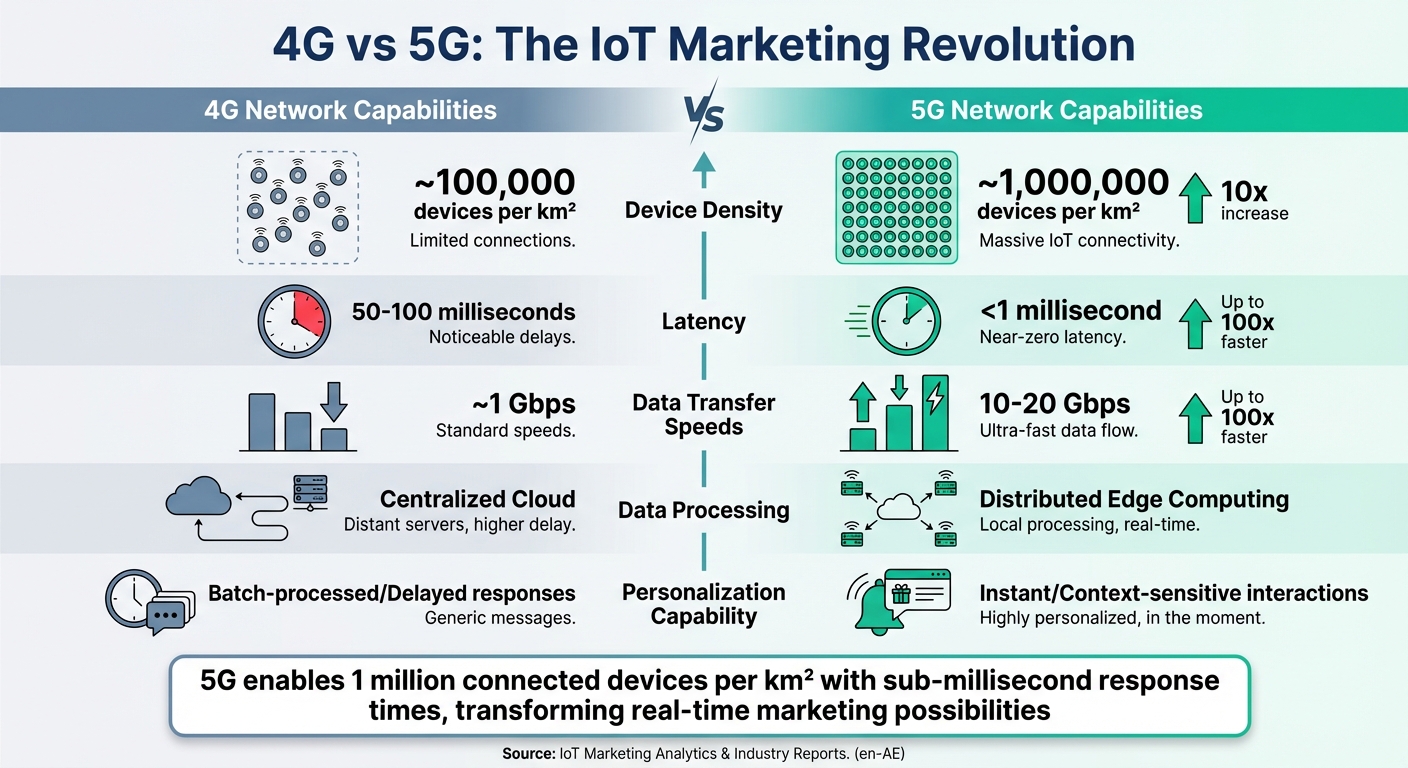
4G vs 5G Network Capabilities for IoT Marketing
5G is reshaping IoT marketing by addressing previous limitations in speed, capacity, and responsiveness. This isn't just about improving existing systems - it's about opening up entirely new ways for brands to connect with customers in real time. With these advancements, marketers can create personalised, instant interactions that were previously out of reach.
Minimal Latency for Instant Interactions
One of the standout features of 5G is its ability to cut latency down to as little as 1 millisecond, compared to the 50–100 milliseconds typical of 4G networks. Ron Westfall, Vice President at HyperFRAME Research, puts it succinctly:
This low latency is essential for creating a genuinely responsive and automated IoT ecosystem.
This is made possible through Ultra-Reliable Low Latency Communications (URLLC), which is engineered for applications demanding incredibly low error rates (less than 1 in 10^5 packets) and near-instant responsiveness. When combined with Mobile Edge Computing (MEC) - which processes data closer to the IoT device instead of relying on distant cloud servers - brands can make decisions in real time. This allows marketers to instantly analyse customer data and deliver hyper-relevant content, offers, or ads at the exact moment they are most impactful.
Faster Data Transfer Speeds
5G's data transfer speeds are up to 100 times faster than 4G, reaching peaks of 10 Gbps or more. This isn't just about faster downloads - it allows seamless handling of high-resolution videos, 3D graphics, and immersive AR/VR experiences. As Verizon explains:
5G's speed and low latency will help compatible wireless devices process high volumes of data extremely quickly and close to the source.
For marketers, this means the ability to gather and process rich data from multiple IoT devices simultaneously. The leap from 4G to 5G is often likened to upgrading from a garden hose to a fire hose - everything flows faster and more efficiently. This increased throughput also enables networks to support a dense array of connected devices, ensuring smooth data flow even in crowded environments.
Connecting More Devices Simultaneously
Perhaps the most game-changing aspect of 5G is its ability to support a massive number of devices. While 4G networks can handle around 100,000 devices per square kilometre, 5G can manage up to 1,000,000 devices in the same space. This leap is powered by Massive Machine-Type Communications (mMTC), a feature designed specifically for large-scale IoT deployments.
Here’s how 5G compares to 4G on key metrics:
| Feature | 4G Network | 5G Network |
|---|---|---|
| Device Density | ~100,000 devices/km² | ~1,000,000 devices/km² |
| Latency | 50–100 milliseconds | < 1 millisecond |
| Data Rates | ~1 Gbps | 10–20 Gbps |
For marketers, this means the ability to connect a wide range of devices - like smart shelves, wearables, beacons, and digital signage - all at the same time without network congestion. This interconnected network provides a detailed, real-time view of customer behaviour, enabling campaigns that respond to what a person is doing right now, rather than what they did moments ago. These capabilities allow marketers to craft highly responsive, data-driven campaigns across a wide range of IoT touchpoints.
Real-Time Marketing Use Cases with 5G and IoT
With the arrival of 5G technology and its ability to handle massive data streams with minimal delay, real-time marketing is entering a whole new phase. By combining 5G with IoT (Internet of Things), brands can connect with customers in ways that feel immediate and personalised.
Collecting Customer Data in Real Time
5G supports up to one million connected devices per square kilometre, creating endless opportunities for marketers to gather data from sensors, wearables, and smart devices all at once. Imagine tracking a shopper’s journey through a mall, noting how long they pause near a product display or which stores they visit.
Take smart retail environments as an example. Smart shelves monitor inventory and customer interaction, while smart mirrors in fitting rooms record which items are tried on and for how long. Thanks to 5G’s ability to process data closer to the source (known as edge computing), brands can analyse this information and react in milliseconds.
Connected vehicles are another game changer. The global market for connected car subscriptions is projected to hit nearly US$65 billion by 2028. These vehicles can share real-time data on location, driving habits, and diagnostics. This allows brands to deliver offers tailored to the car’s needs or the driver’s destination - whether it’s a discount on fuel or a restaurant recommendation nearby.
Delivering Personalised Offers Instantly
5G makes it possible to send hyper-targeted offers at just the right moment. For example, geofencing can trigger a special discount when a customer’s phone enters a specific area - whether that’s near your store or even a competitor’s.
Smart appliances also play a role. A connected refrigerator can track what’s running low and immediately send grocery offers to a user’s phone or wearable device. Similarly, smart packaging on products like cereal boxes can send recipe ideas or loyalty rewards directly to a customer’s device as soon as they pick up the item.
In physical stores, augmented reality (AR) apps powered by 5G can guide shoppers with real-time navigation. As they approach a specific aisle, they can instantly receive product reviews, recipes, or personalised coupons. Digital billboards take this a step further by interacting with nearby smartphones, turning them into tools for engaging with ads - offering rewards once the interaction is complete.
AR and VR Marketing Experiences
Beyond data collection and personalised offers, 5G opens the door to immersive marketing experiences. Its ultra-low latency makes augmented reality interactions feel seamless and natural, paving the way for applications like virtual try-ons. For instance, customers can see how a pair of glasses fits their face or how a sofa looks in their living room without any lag interrupting the experience.
This is especially impactful given that 84% of consumers say they’re more likely to buy a product after watching a brand’s video. With 5G, brands can deliver high-quality, interactive content instantly, boosting engagement and conversions. Additionally, 5G supports shared AR experiences, enabling thousands of people at events like concerts or festivals to interact with the same digital content without network issues.
Brands are also experimenting with volumetric and holographic marketing. Using 5G, they can stream 3D holograms of products that customers can view from every angle in real time. Multi-access Edge Computing works alongside 5G to handle the heavy data load, ensuring that AR applications can quickly generate 3D models or locate inventory with minimal delay. IoT sensors further enhance these experiences by responding to customer actions - triggering lights, sounds, or visuals based on real-time movements and surroundings.
Connecting 5G-IoT Data with Marketing Platforms
The introduction of 5G is reshaping how IoT data integrates with marketing systems. With 5G now being implemented across the UAE, brands can process and transform data collection into action faster and more efficiently than ever. This advancement opens up new opportunities for leveraging real-time data through advanced processing and specialised network features.
Improving Data Flow and Analysis
Edge computing brings data processing closer to its source. Instead of sending all IoT data to distant cloud servers, edge computing allows AI models to analyse consumer behaviour locally. This means marketers can trigger responses almost instantly. For example, in October 2020, Cisco and China Unicom collaborated to launch the first 5G SA IoT network for BMW's connected vehicles in China. This system enabled features like high-definition maps, predictive maintenance alerts, and in-car streaming by processing data at the edge.
Network slicing is another game-changer. It allows marketers to create dedicated virtual networks within the 5G infrastructure. This ensures that high-priority data - such as real-time AR experiences or personalised offers - flows without interruptions, even during high-traffic periods.
Using Automation and AI Tools
The rapid data flow enabled by 5G enhances the capabilities of AI-driven platforms, helping marketers deliver personalised, context-aware interactions in real time. With the capacity to support up to 1 million connected devices per square kilometre, 5G provides the data needed for predictive analytics and journey mapping. Open APIs in 5G IoT services make it possible to integrate with automated marketing solutions like Marketo or Salesforce.
"5G is driving change in the Internet of Things (IoT). It's a powerful enabling technology for a new generation of use cases that will leverage edge computing to make IoT more effective and efficient." – Rishi Vaish, CTO and VP, IBM AI Applications
An example of this in action is the 2021 collaboration between IBM and Verizon. They combined Verizon's 5G network with IBM's Maximo Asset Monitor to create a system that used near real-time video analysis and AI-powered sensors. This setup detected equipment defects on factory floors, identifying potential failures before they caused downtime. By processing data at the edge, operational efficiency improved significantly.
Before and After 5G: Marketing Data Comparison
The leap from 4G to 5G marks a fundamental shift in how marketing data is processed and utilised. Here's a side-by-side comparison of key features:
| Feature | Before 5G (4G/LTE) | After 5G Adoption |
|---|---|---|
| Latency | 50–100 milliseconds | 1–10 milliseconds |
| Device Density | Thousands per km² | 1 million devices per km² |
| Data Throughput | Mbps range | Gbps range (up to 10–20 Gbps) |
| Processing | Centralised Cloud | Distributed Edge Computing |
| Personalisation | Batch-processed/Delayed | Instant/Context-sensitive |
With 5G, brands gain more than just speed. They can connect far more devices, process data locally, and deliver highly personalised experiences in real time. By 2026, the number of cellular-connected IoT devices worldwide is expected to surpass 2.6 billion, giving businesses that embrace this technology a substantial edge in the market.
Wick's Four Pillar Framework for 5G-IoT Marketing
Wick's Four Pillar Framework reimagines 5G-enabled IoT marketing to enhance real-time customer engagement across the UAE. With an impressive 97.8% 5G coverage in populated areas and 60% of mobile traffic already operating on 5G networks, the UAE is well-positioned for this transformation. These pillars tackle previous challenges in IoT marketing by capitalising on 5G's speed, capacity, and ultra-low latency.
Build & Fill: Developing Marketing Assets
The first pillar focuses on creating marketing assets that utilise 5G's high bandwidth to deliver seamless, high-quality experiences. Unlike 4G, 5G supports uninterrupted 4K streaming, high-resolution video ads, and interactive banners. This opens up opportunities for brands to design immersive content, such as 360° virtual tours or interactive video ads that provide instant product information. For instance, a furniture retailer could offer augmented reality (AR) tools, allowing customers to virtually place furniture in their homes, with results rendered instantly on their mobile devices. This approach overcomes the bandwidth limitations that once hindered instant personalisation.
Plan & Promote: Extending Campaign Reach
This pillar takes advantage of 5G's ultra-low latency to implement hyper-local marketing strategies. With sub-millisecond response times, businesses can activate location-based offers, such as discounts triggered when a customer enters a 500-metre radius. Real-time data from IoT devices enables marketers to adjust campaigns on the go, improving targeting precision and maximising return on ad spend. By addressing the delays in data collection that previously led to missed opportunities, this pillar ensures timely and effective customer engagement.
Capture & Store: Managing Data and Insights
With 5G's ability to support up to 1 million devices per square kilometre, businesses can handle massive data streams from wearables, smart home devices, and connected vehicles. Wick integrates this data into real-time dashboards, mapping customer journeys across various touchpoints. The UAE's IoT market, estimated to reach AED 18.7 billion by 2024, provides businesses with continuous behavioural insights to better understand customer interactions. This pillar addresses the connectivity challenges of pre-5G networks, enabling seamless device integration.
Tailor & Automate: Personalisation Through AI
The final pillar uses AI to deliver personalised content by analysing IoT data in real time. Thanks to 5G's near-zero latency, AI platforms can process data instantly and trigger customised offers at the perfect moment. A notable example is the partnership between e& UAE and ADNOC in January 2025, which deployed a private 5G network covering 11,000 km² and generated AED 5.5 billion in value through instant AI integration. This pillar eliminates the delays that once hindered marketing responsiveness, ensuring brands can act in real time.
"Brands can analyse customer data immediately and deliver tailor-made content, ads, and offers at the exact moment they resonate the most." – MarTech Cube
Conclusion
5G is transforming the way businesses engage with customers in real time. With latency dropping to less than one millisecond and the ability to handle up to 1 million devices per square kilometre, marketers now have the tools to deliver personalised experiences precisely when they matter most. In the UAE, where 5G covers 97.8% of populated areas, businesses are uniquely positioned to take immediate advantage of this cutting-edge technology.
Gone are the days of buffering, delays, and connectivity hiccups. 5G empowers brands to analyse customer behaviour in the moment and respond with relevant offers instantly. As Eddie Bridgewater from Bluetext puts it:
The advent of 5G is more than just an upgrade in connectivity; it's a paradigm shift that will redefine digital marketing.
This leap in technology also enables businesses to incorporate real-time IoT data into their strategies, unlocking deeper insights and more accurate targeting. But to fully capitalise on these opportunities, a structured plan is essential.
Wick's Four Pillar Framework offers a practical roadmap for integrating 5G's benefits into customer-focused strategies. By guiding businesses through key steps - like developing high-quality marketing assets and implementing AI-powered personalisation - the framework simplifies the process, ensuring that companies can use 5G effectively without being bogged down by technical challenges. The emphasis stays on addressing real customer needs, making it easier to connect with audiences in meaningful ways.
With the global 5G IoT market expected to grow from US$13.2 billion in 2023 to a forecasted US$59.7 billion by 2028, the question isn't whether to adopt 5G, but how quickly businesses can adapt their strategies to harness its potential for long-term growth.
FAQs
How does 5G improve real-time marketing with IoT technology?
5G is a game-changer for real-time marketing, thanks to its lightning-fast speeds, low latency, and ability to handle a massive network of connected devices. These features allow businesses to gather and analyse data instantly, paving the way for highly personalised customer interactions on the spot.
Marketers can use IoT devices like smart sensors, wearables, and connected appliances to tap into real-time insights and engage with customers effortlessly. Imagine a business in the UAE sending location-based offers or live updates to customers - this kind of precision ensures interactions are timely and relevant, aligning perfectly with the region's commitment to digital innovation.
How does 5G address key challenges in IoT-based marketing?
5G addresses key hurdles in IoT-driven marketing, making real-time customer interactions more seamless and impactful. By drastically lowering latency, it enables instantaneous data sharing and quicker decision-making processes. Plus, its ability to handle a higher density of devices ensures smooth connectivity, even in heavily populated areas.
Another game-changer is its improved energy efficiency and extended coverage. This means IoT devices can function reliably for longer periods and across more locations. With these capabilities, businesses can gather and analyse data on the spot, creating marketing experiences that are not only timely but also tailored to individual customer needs.
How can businesses in the UAE use 5G to improve their marketing efforts?
Businesses in the UAE can tap into the potential of 5G technology to reshape their marketing efforts. With its ultra-fast speeds, minimal delay, and capacity to connect numerous devices simultaneously, 5G opens doors to real-time customer interactions and smooth delivery of engaging experiences like high-resolution video ads, augmented reality (AR), and virtual reality (VR). These features make marketing campaigns more dynamic and engaging.
On top of that, 5G strengthens the use of Internet of Things (IoT) devices, enabling businesses to gather and process real-time data. This paves the way for highly tailored marketing strategies based on customer behaviours and preferences, enhancing satisfaction and driving higher conversion rates. Businesses can also take advantage of 5G for location-based services, instant customer engagement, and AI-driven personalisation, ensuring campaigns are more targeted and relevant to specific contexts.
As the UAE advances in its digital journey, incorporating 5G-powered solutions will allow businesses to keep up with changing consumer expectations and deliver cutting-edge, real-time marketing experiences that connect with local audiences.